Search This Blog

Showing posts with label management. Show all posts

Sunday, 1 October 2023

Polymoth Books

Updated August 2026

One of my books mentioned below, Australianisms,  about Australian language when it emerged and which is now available as an ebook. using this link. 

Then there is The Biggest Book of Australian History, all the bits of our past that conservatives want to hide, Sign on the Dotted Lion, a commonplace book; The Lesser of Two Weevils, outrageous puns, feghoots and paronomasia For samples, see https://www.facebook.com/groups/736842831672293 )

Then there is my novel Sheep May Safely Craze, a wild ride the picaresque badlands, with insights into higher mathematics, lower mathematics and the dark side of pea soup.

Update, January 2025

Books being pitched this year:

I have been cleaning out the old files, and think these titles have legs: if they don't go to traditional publishers, they will be out through Polymoth.

The lesser of Two Weevils: juvenile to adult, intelligent wordplay. 

What on Earth: behind earth science. Late teen to adult: how scientists know.

Australia: a social history. The history they don’t teach in schools, but should: a much-expanded account, based on but well beyond The Big Book of Australian History.

Australianisms: when did we start saying that? Our national language.

The Cornish Boy: Quartet of YA Australian historical fiction.

Keeping People is Wrong: serious history of forced labour and near-slavery in Australia.

Echidnas and Their Friends: the biology of a curious mammal.

The Science of the Lambs: fantasy of a sort, for adults of all ages. .

Sorry, if the Australian language TinyURL brought you here. That link is not playing nicely, but this should get you there.

On the other hand, maybe you want to know what else I have been up to in the past couple of decades: if that is the case, read on. Or do both.

When my former ISP decided to get out of hosting web sites, they shut my sprawling web of sites down. This treacherous action was taken unilaterally, without either warning or consultation. Now, I must rebuild, and this is the start, commenced 1 October 2023.

The task has proved more onerous than I expected. One of my major contributions to scholarship, an analysis of early uses of Australian words has now been rescued. So has a template for playing with paper aeroplanes, and also a master sheet for messing with Möbius strips.

And if you want to know about the awards I have won for my work, they are at the end of this entry.

Note that all of these awards were for writing for children. The late Martin Amis once infamously commented that he would only write for children if he were brain-damaged, whereon many children’s authors said through gritted teeth that they would be happy to prepare him for his new career, but Amis was plain wrong. Writing for youngsters takes a lot more effort than writing for adults, because you have to catch kids’ interest and hold it. Those who write for the young have no problems reaching anybody up to advanced middle age.

Some 48 years back, I developed a “slow learner” writing style to be used for kids with reading or language problems. A few years on, I was an official, riding in the ranks and making decent policies happen, and when I tried this style on senior bureaucrats, I got immediate and positive responses, so I have used it on adults ever since (but please don’t tell them!)

Needless to say, it works for kids as well, and yes, “slow learner” is no longer PC, but it was fine in those days, and my writing got a lot of 1970s refugee kids into the main stream. So, I also write for adults, OK?

So what's a polymoth?

Me, that's what, over there on the right. Some of my friends are kind enough to call me a polymath, because I write about all sorts of things, but seriously, I just flit from thing to thing. I truly believe that if I were in school today, I would be diagnosed as ADHD, but I'm highly productive in lots of areas, and publishers with the minds of grocers get terrified by that mutability, which is why some of the books listed here were self-published, because I saw a need and plugged it, then got tired of talking to slow-witted publishers, fearful of this strange, flitting author. Other works are books that were commercially published but not reprinted, even when they had won assorted awards, and I did my own improved versions. So I'm a polymoth, and that's a word that usually only turns up on the web as a typo.

My sort of polymoth chases temporary obsessions into corners, bales them up, calms them down, and squeezes them until the juices flow. The juices make a rich ink in which words grow until they form a conga line, and march across the page. This is how books are created in the real world, and don't believe anybody who says otherwise.

Over time, there will be links to pages devoted to each title but here is a list of the works on offer here, both as ebooks and also as Print on Demand.  In due course, each of these will be a link to an entry for that book.

The double ISBNs below refer to the original edition and the current Amazon edition (the ISBNs are for the print edition, but there is also an ebook edition for each one). One book is also on Google Play.

Late May 2024

The ebook version of what was called The Big Book of Australian History is out now. It is now called Australia, a Social History, and it is three times as long as the original, lots of pics. I doubt it will ever go into dead-tree format.
This link will take you there: https://www.amazon.com.au/dp/B0D2VH34RY 

May 2024, the most polymothish books of them all: 

You won't be the same after reading these

Australian Backyard Explorer (for kids) ISBN Amazon, 9798481633664, NLA, 9780642276841

Australian Backyard Naturalist (for kids) ISBN  Amazon, 9798495706415, NLA, 978064227

Australia's Hidden Heroes (all ages up to 99) ISBN Amazon, 979-8695940701

Australia's Pioneers, Heroes and Fools (older readers) ISBN Amazon, 9798782772017, Pier 9, 9781741960488

Curious Minds (for older readers) ISBN NLA, 9780642277541. Amazon, 9798352827123

Kokoda Track: 101 Days (for teenagers and up) ISBN Amazon, 9798773321583, Black Dog, 9781876372965

Looking at Small Things (for kids) ISBN Amazon, 9798554636875

Mistaken for Granite (for older readers) ISBN Amazon, 9798620093632

Mr Darwin's Incredible Shrinking World (for older readers)ISBN Amazon, 9798471053212, Pier 9. 9781741962796

Not Your Usual Australian Villains (for older readers) ISBN Amazon, 9781520917023

Not Your Usual Bushrangers (for older readers) ISBN Amazon, 9781728936932, Five Mile, 9781760065690

Not Your Usual Clever Ideas (for older readers) ISBN Amazon, 9798554540233

Not Your Usual Gold Stories (for older readers) ISBN Amazon, 9781983092077, Five Mile, 9781760065706

Not Your Usual Treatments (for older readers) ISBN Amazon, 9781973560531

Old Grandpa's Book of Practical Poems (for kids of all ages up to 99) ISBN Amazon, 9798583706266

Playwiths (for kids of all ages up to 99) ISBN Amazon, 9798630095190

The Lawn: a social history (for older readers) ISBN Amazon, 9798548866714, Pier 9, 9781741960396

The Monster Maintenance Manual (for kids of all ages up to 99) ISBN Amazon, 9798769371530, Pier 9, 9781741968088

The Nature of North Head (for everybody) ISBN Amazon, 9798554660238, Google, 9780642279514

The Nature of North Head, (special phone and tablet version, revised 2024

The Speed of Nearly Everything (for older readers) ISBN Amazon, 9798461321918, Pier 9, 9781741961362

They saw the difference (history of science for older readers) ISBN Amazon, 9798520324102

You Missed a Bit (history of Australia for older readers) ISBN Amazon, 9798552065523

Awards.

I have had a few of those in my time...

  • Seven CBCA long listings (notables), two CBCA short listings, one Honour Book and one Book of the Year;
  • One Short Listing in the NSW Premier's History Awards, Young People's History Prize ;
  • Two Australian Awards for Excellence in Educational Publishing;
  • One WA Premier's Book Award for Children's Literature;
  • One international White Ravens List entry (Germany);
  • One Wilderness Society Short List entry, and
  • Two Whitley awards.
In other words, there's some serious intellectual merit here.


Monday, 28 November 2022

Sydney under attack, 1942


Sydney harbour today, from North Head. The boom referred to below was more or less where the dotted line appears.

This is a sidelight from my Kokoda Track: 101 Days, an Honour Book in the 2007 Eve Pownalls, and it was short-listed for the NSW Premier's History Prize. Originally published by Black Dog, which later became Walker, it is now available in my own updated and better-designed Polymoth Books imprint. This is from the Introduction.

The attack on Sydney

There was no valid reason the authorities to worry about the Japanese invading Australia, because as we know now, Allied code-breakers would have had early warning of any Japanese fleet being assembled to invade Australia.

Attacks on key sites like ports were more likely and harder to predict. That had to be kept secret, though, so the codes would not be changed. So the public were told the threat was real, to help keep the secret.

In June, 1942, the USS Chicago was in Sydney harbour. It was partly protected by a boom net close to the harbour entrance, from near Watson’s Bay to George’s Head. Some parts of the net were kept up by buoys, while other parts were strung between timber piles, driven into the sea floor. It was rather like a shark net, except that shark nets don’t have gates, sections that can be swung open to let ships in and out. These floating gates were pulled open, and hauled closed again, by an old ferry,

The gates and the gaps they left caused a problem that was made worse, because the boom wasn’t finished. Work was started in January 1942, and not completed until August. When the raiders called on the night of 31 May–1 June, there were easy ways in.

There was a third problem: when the attackers were seen, it took two hours before anybody “in charge” would believe there were submarines in the harbour. Midget submarines had been used unsuccessfully in the attack on Pearl Harbor, so the authorities knew they existed.

One of the subs surfaced near Dobroyd Head and was seen by a fisherman, who ran about 5 km to the nearest police station at Manly to report it. Nobody believed him. The most reliable report came from a boom watchman who heard the crew trying to free the first submarine, after it got tangled in the net.

The watchman radioed in a report. Finally, the submarine’s crew realised they could not get free, and blew their vessel up with demolition charges. After that, the Navy accepted that something was wrong.

This was a battle which would be won by the side which was the least incompetent, but most of the time, neither side really looked like winning. When a searchlight operator on USS Chicago saw a second submarine, the gunners opened up with machine guns and artillery, but the guns could not depress (tilt down) enough to hit the submarine. At least one of the shells bounced off the water and hit Fort Denison, and other shell fragments were found later in the suburbs of Cremorne and Mosman.

The submarine submerged and moved to a point in the harbour where it could see Chicago in silhouette, backlit by construction lights on Garden Island. The Japanese crews were on what was almost a suicide mission, yet amazingly, they failed to move in and launch a torpedo at Chicago. Equally amazingly, the lights on Garden Island stayed on for an hour and a half, but even more amazingly, the submarine only fired its torpedoes five minutes after the lights went out.

Both torpedoes missed Chicago, but one sank a ferry being used as a floating dormitory. In all, 21 sailors died, and ten were wounded. A third submarine was also in the harbour, and small vessels were rushing around, making and losing contact, dropping depth charges and in the process, damaging the third submarine to the extent that it could do no harm.

The midget submarines had failed in their main mission of sinking a major warship, but they certainly succeeded in their second aim of bringing alarm and despair to Sydney. People who could get away fled to the Blue Mountains, far from the sea. And in the Eastern suburbs, close to the ocean, there were spectacular falls in property prices in the winter of 1942.

Now about that fisherman who saw the sub: you probably won’t read about him anywhere, but he was real enough. He shouted to my (now deceased) aunt that the Japanese were invading, as he ran past her. This is one reason why we need more oral historians!

Sunday, 27 January 2019

The $ecret Touri$m Plan

PLANNING DOCUMENT, 
DEPARTMENT OF TOURISM, CULTURE AND COMMERCE.

The following information is embargoed.  Under no circumstances is it to be shown to any person who cannot prove Australian citizenship.  In appropriate cases, loyalty oaths may be administered as a precursor to granting permission to view the following.

It is a well-known fact that public museums do not pay their way: it is time they looked to private industry, which always pays.  The public sector should examine more closely the specific activities which pay.  They should seek to move our museums into the New Age of economically rational cultural experience.

Instead of displaying old bones and other relics of an increasingly irrelevant and bygone age, our museums must begin to address the needs and concerns of today.  They must present useful and memorable cultural experiences, compressed to allow the maximum variety and the widest geographical coverage, all within the shortest possible time.  Museums must be forced, if necessary, to give value.

We need look no further than one recent development to see how public museums are at present completely missing the commercial point.  I was recently fortunate enough to visit ‘The Australian Experience’.  It was a truly eye-opening to see just how much can be done commercially with just a small amount of flair and imagination.

The Australian Experience is a train of eight exhibition carriages, running from the Gold Coast down into northern New South Wales and back each day, with inbound tourists (that is, foreigners with plenty of disposable income) as the main targeted market.

It is hauled by a steam locomotive fondly known as ‘The Mauler’, (having been involved in 106 confirmed human fatalities: a definite draw-card for the non-traditional museum demographic).

The Australian Experience aims to give the busy tourist all of the experiences and photo opportunities which would otherwise take many days to achieve, and always with the risk of bad weather spoiling some of the shots.  The Australian Experience guarantees that there will be no such problems with photography for its guests.

On boarding at 9.30 am, passengers are welcomed to their seats in one of the lounge cars by Aboriginal hostesses in traditional gold bikinis.  There, they are given a choice of cocktails (named, for their principal flavours, ‘Billy Tea’, ‘Draught Beer’ and ‘Bluestone’).  The soothing background music in the lounge cars is a medley of traditional railway songs and ballads, including ‘Casey Jones’, ‘The Wreck of the Old Ninety-Seven’, and ‘The Tay Bridge Disaster’.  Once the train is under way, passengers can wander at will through the exhibition cars, trying all the varied delights that our wide brown land has to offer.

Car 1.

This carriage re-creates the parched outback.  Authentic smells (the carriage doubles as a working cattle truck each night), authentic lighting (cracks in the walls are covered with red cellophane), and a realistic cow depict life in the outback.  Staff are at present working on synthetic wool coats that will allow them also to use the cow in a scaled-up demonstration of genuine Australian shearing.  The carriage is heated to outback levels by a ducted system running from the locomotive's fire-box, demonstrating the designers' concerns for both parsimony and for the conservation of energy.

At a quarter to each hour, coinciding with the simulated low tide in the Great Barrier Reef car, the Wet Season arrives, followed by the projection of time-lapse images of the desert bursting into bloom.  Visitors will be able to purchase colourful souvenir ‘Snowy River’ raincoats of reinforced paper (seen being manufactured later in Car 7), or they can remain within the protective plastic tunnel which extends down one side of the carriage, five minutes before the start of the Wet Season.

Car 2.

After the heat of the parched outback carriage, the tourist next enters the air-conditioned comfort of the ‘Great Australian Pub’ carriage.  Here we see trained blow-flies performing in one corner of the carriage, and two stunt men re-enacting a variety of famous Australian bar-fights.  There are broken bottle fights on the hour and half hour, with audience participation by prior arrangement.   All guests are provided with one complimentary drink from traditional Australian beer-cans (reusable, but hygienically sealed prior to use).  Further drinks may be purchased by guests.

Car 3.

Here the Great Barrier Reef is re-created.  Entering by a raised area, guests move down a ramp between long narrow tanks filled with brightly coloured fish and preserved corals.  This carriage has elliptical wheels to give the impression of sea motion, and to ensure appropriate smells of motion nausea from those patrons who spent too long in Car 2.

As patrons move down the ramp, they gain the impression of dropping below sea level, entering the secret world of the fishes, complete with recorded whale songs and sea shanties.  A small beach panorama is available at the far end, where guests may be photographed, along with a range of cardboard cut-outs.  Masks and snorkels are available for photos in front of the Reef tanks (realistic bubbles in the tanks are strategically placed for guests to pose near).

Car 4.

Here, guests meet the Australian Bush.  With a surround-sound system of taped bird-calls, Australian aborigines demonstrate their traditional Dingo Circus, and show videos of their boomerang-throwing skills (due to insurance problems, management have required them to use only cardboard boomerangs inside the car), and a small shop sells traditional Australian bush scents (Lantana, Prickly Pear, and Salvation Jane), plastic didgeridoos and other authentic Aboriginal memorabilia.

Car 5.

This is a marvellous Chamber of Horrors where guests see at first hand the problems of the early settlers.  There are tableaux of families dying of the Barcoo Rot, a face-painting activity where children's faces can be made up to simulate Sandy Blight, giant models of blow-flies (photo opportunity!), live Hexham Grey mosquitoes, depictions of dingoes stealing settlers' children, and, behind a fire-proof screen, a real bushfire, complete with recorded screams and simulated burning bodies (to allay the worries of the squeamish, guides point out that the bodies are actually those of bush-rangers).

At the far end, a children's jumping castle features a user-friendly range of giant goannas, crocodiles, taipans and other snakes and spiders.  With the exception of the taipans, which are de-fanged to protect the fabric of the jumping castle, all of these animals are inflatable rubber models.  Smaller inflatable versions of these may be purchased from the concessionaire.

Car 6.

Aussie tucker and Aussie self-sufficiency are the themes here, and guests are invited to participate in a shooting gallery activity.  No live animals are used: white metal targets with projected images of assorted mammals and birds on them are used.  Sensors identify where the target is hit, and sophisticated circuitry generates a scream appropriate to the shot's accuracy.

In any case, prizes are awarded to all.  For example, hitting five kangaroo targets causes a cup of kangaroo tail soup to be automatically dispensed, and other prizes include roast meat in damper sandwiches (pure reconstituted beef, but with an authentic aroma of koala meat), and savoury ‘possum stew’.

All food is cooked under the patrons' gaze on a gas-fired barbecue, and stuffed toy replicas of all the Australian wildlife targets will be on sale.  Guests who wish to be photographed with the tastefully posed giant dead Diprotodon may borrow a replica of a semi-automatic rifle to improve the authenticity of the photo.  This segment is augmented by one of the staff who collects road kills on her way to work each morning.  As a trained make-up artiste, she adds realistic bullet holes to each body.

Car 7.

The Australian city is recognised as the natural habitat of most modern Australians.  Along one wall, are panoramas showing the major cities of Australia, with strip-lighting from above, to allow these backdrops to be used for taking souvenir photographs (for the sake of convenience, Uluru will also be depicted here).  All of the expected icons are depicted in these panoramas.

The other side of the carriage features typical Australian city scenes: a typical sweat shop where newly arrived migrants make the ‘Snowy River’ coats for sale in Car 2.  Nearby, famous multiple murders are re-enacted against rear-projected backdrops (allowing a later expansion to international coverage), drug addicts inject themselves (using only the safest organically-grown and Australian-made materials), and convicts are flogged.  Products on sale include replicas of Arvie Aspinall's alarm clock, and the sweat shop staff and addicts perform multicultural dances when their other duties permit, adding a delightfully realistic air to the proceedings.

Car 8.

Known as ‘The Big Car’, this last carriage features scaled-down versions of thirty of Australia's favourite ‘Big’ icons: the Big Merino, the Big Banana, the Big Pavlova, the Big Prawn, and others.  By a clever application of optical systems, the guests may be photographed alongside apparently full-size icons.

This is the end of the exhibition, and guests can now return to the lounge coaches until they reach their destination, where they can have a two-hour visit to the ‘Las Vegas’ room of the local RSL club, complete with authentic poker machines, designed to accept and pay out in all Pacific Rim and EEC currencies, or they can join in the community singing of German beer hall songs, directed from a Karaoke machine.  On the return journey, they are free to visit the exhibitions again.

As you can see from this brief outline, the example is there, completely ready for us to emulate.  Even if Sydney ignores the chance of offering the same or similar experiences in other parts of Australia, The Australian Experience has by no means completely capitalised on the commercial possibilities

For example, many of the photographic props are provided free of charge, when they could be hired or sold, there is no rain forest experience, there are no crocodiles, no psychic sheep dogs, no albino, mutant or deformed animals, and there are no trained birds able to swear in many languages on command.  There is no option for conservation-minded patrons to shoot feral cats.

Looking again at the high end of the market, they offer no surf experience, no surf boards, no video games or simulations, and there are no plans to offer virtual reality experiences.  There are no thoughts of providing computerised interactive videos where the purchaser's image is electronically inserted into a wide range of pre-filmed Australian adventures, ranging from soft focus sex in the tropics to skiing naked down Kosciuszko (naturally, with tastefully placed simulated icicles covering the rude bits), to more family-oriented fare, such as a kangaroo-back ride across Arnhem land.

The operators have totally missed the perfect opportunity to offer paravane sports from the rear platform of Car 8.  At this point, The Australian Experience has no special rides for the under five age group, no publishing plans, and no awareness of the franchising possibilities of their scheme.  That being said, they have still done well, and the way is open for a forward-looking organisation to seize this opportunity with both hands.

This madness is, in fact, based on a real submission that passed over my desk at one point, because the institution I was working for had a few hare-brained Marketing types who wanted a slice of the action.  I have toned down some of the more excessive suggestions, but there are definite echoes of the original to be found in Car 1.

I have recently found a long-lost file called Rudes, which contains many of my best minutes, notes and correspondence, written during a surprisingly long career as the world's only anarchist-surrealist bureaucrat. This was among them, and there are more of what my colleagues usually called Acid Drops to come.


Monday, 24 October 2016

A potted history of climate change

I was searching for a reference that I knew was in my files, and I tracked it down, so here is some surprising news: we knew that "global warming" was happening, way back in 1950!


What is different now is that most reputable atmospheric scientists believe human activity is driving the modern slow warming of our climate. All the same, now we know that global warming is a bad description, so we call it ‘climate change’. Under any name, it’s the same beast, and the same looming disaster, and it was happening 66 years ago.

Oddly, the suspicion that humans are to blame may be even older. The problem before was that there was not a lot of hard science in the arguments, which come down to logic, reason, careful modelling — and interpretation that is likely to be biased by a generous serving of self-interest. That has changed in the last ten years.

Nobody denies that the Earth is getting warmer, because the evidence is there, and it was apparent in 1950, when George Kimble reported in Scientific American that the northern limit of wheat-growing in Canada had moved northward some 2 – 300 miles (call it 400 kilometres), adding that farmers in southern Ontario were experimenting with cotton. While that industry seems not to have taken off, he reported another trend that continues to this day, the northward retreat of the permafrost:
“In parts of Siberia the southern boundary of permanently frozen ground is receding poleward several dozen yards per annum.”
The matter open to question back then was the cause. Kimble noted that the Domesday Book featured 38 vineyards in England in 1086, in addition to those of the Crown. He pointed also to the Greenland colony which was frozen out, back around the mid-1400s and other evidence that climates change. He also looked at Biblical evidence on the distribution of date palms to suggest that conditions in 1950 were much those of Biblical times, providing a picture of a climate that fluctuates around a mean. Maybe it was just one of those cycles.

That was a time before ‘global warming’ when climate change was referred to as the ‘greenhouse effect’. In cold climates, a greenhouse is a glass shed which allows sunlight to shine in, where much of it is absorbed and changed to heat. Glass is less transparent to heat, but a greenhouse does not just trap warmth that way: it also holds a body of warm air around the plants, and protects them from wind-driven evaporation. So while we still speak of ‘greenhouse gases’, it is rare to hear anybody mention the greenhouse effect these days, but even that goes way back.

In the 1820s, Joseph Fourier realised that heat-trapping might occur. Then Svante Arrhenius reminded us in 1896 that both water vapour and carbon dioxide were ‘greenhouse gases’ (escaping that bad analogy is hard) and so water and carbon dioxide would play a role in making the planet get warmer. He also considered changes that might be happening, and consulted Arvid Högbom, who just happened to know all about carbon dioxide sources and sinks.

Carbon dioxide was coming from life forms when they breathed, from volcanoes, and from humans burning fossil and other fuels. The human additions were a very small part of the total in the air already, perhaps one part in a thousand was added by the burning of coal, and there were probably checks and balances. Arrhenius estimated that it would take 3000 years to double the atmospheric levels of carbon dioxide, if it ever happened, but that such a doubling would raise world average temperatures by 5 to 6°C.

In 1896, the CO2 level was around 290 parts per million: in 2016, the value was estimated at 396 parts per million: we had travelled one third of the projected distance in just 120 years.

To Europeans back in the 1890s, the warming effect seemed nothing to worry about, because nobody had stopped to consider the cascades, the flow-ons that might be driven by that rise in temperature. Walter Nernst, even wondered if it would be feasible to set fire to uneconomical and low-grade coal seams, so as to release enough carbon dioxide to warm the Earth’s climate deliberately!

Scientists are slow to move to a new model, a new way of understanding, something called a paradigm, and just a few years before the world’s earth scientists were shown irrefutable evidence of plate tectonics, we undergraduates in geology were being told by one of our lecturers “go and watch Carey perform at the conference — he’s mad, and thinks that the continents move!”

Sam Carey wasn’t quite right, but he was closer to the truth than his denigrator. It is, however, a well-kept secret that scientists engage in robust rhetoric and vilification. Sam seized on every scrap of evidence to push his own viewpoint, most of the audience laughed dutifully — and felt rather embarrassed a few years later when palaeomagnetic evidence showed that Carey was largely on the money. In the end, the good science was recognised and accepted.

A decade back, global warming was in much the same position, with some of the scientists arguing furiously, even when they agreed on the main principles, and as in the puzzle of the wandering continents, the key evidence is probably there. Mind you, when I covered the 2002 Spring Conference of then American Geophysical Union, there were no nay-sayers there.

The problem is that so long as people can get away with saying "global warming", we are once again stuck with a bad analogy, just as the early 1960s saw us hung up on “continental drift”.

That aside, the cost of disagreement and bickering is remarkably different. It mattered not at all if people disagreed about plate tectonics (except, perhaps, that it makes tsunamis like the 2004 Indian Ocean tsunami easier to understand), but global warming is likely to be a major disaster for humanity, and any delay has the potential to cost lives. To understand this, we have to accept some puzzling propositions.

To take one example, the formation of sea ice in the Bering Strait is probably what stops Dublin and New York being iced-in each winter. This is because the sea ice is largely free of salt, and leaves a residue of cold brine that drives a current known as the Conveyor, which in turn drives the Gulf Stream. The Gulf Stream takes warm water from the Caribbean and swirls it up around the North Atlantic, contributing to fogs and breaking icebergs loose, but keeping many ports warm and open, even in winter.

Just as the prion proteins of mad cow disease have more than one stable form, so do weather patterns, and if the weather once drops into a new pattern, we may not be able to bounce it back to where it started. The good news is that as northern Europe freezes over, the glaciers which are now melting away fast will be replenished, lowering sea levels. The increased snow cover will also increase the reflectivity of the northern hemisphere, and that may cool the planet down a little. We just have to hope it does not trigger a new stable pattern that happens to be an ice age.

The actual changes that might follow the breaking point are hard to predict. They are unlikely to be spectacular and major, and probably they will do their harm stealthily, when infrastructure, port facilities and cities are flooded, or when agricultural land is lost, either by being covered by the sea or as a result of drastically changed rainfall patterns. If rock is exposed in Antarctica, this could lead to a low pressure zone over the icy continent that could change weather patterns around the world.

It hasn’t happened yet, but we need to learn from history. Ten years ago, no politician would take a long-term view and force the changes needed in the next thirty to forty years, when most of them are elected for a mere three to four years, and then face the voters again. It is easier to bleat plaintively that there is no real agreement among the scientists yet (there is), or that some eminent scientists (they aren’t: just look at where their funding comes from) believe that there are other explanations.

That load of bollocks saves the politicians from having to act — and the honesty of scientists in saying that they cannot be sure just how things will go wrong allows devious short-term opportunists to prate that “the scientists aren’t sure…”.

Politics is a marvellous human discovery. It is a pity that politicians still have to discover humanity and consider its prospects. It is likely that politics, dithering, duck-shoving and shilly-shallying will make this disaster happen.

Saturday, 22 October 2016

Should climate change be about politics?

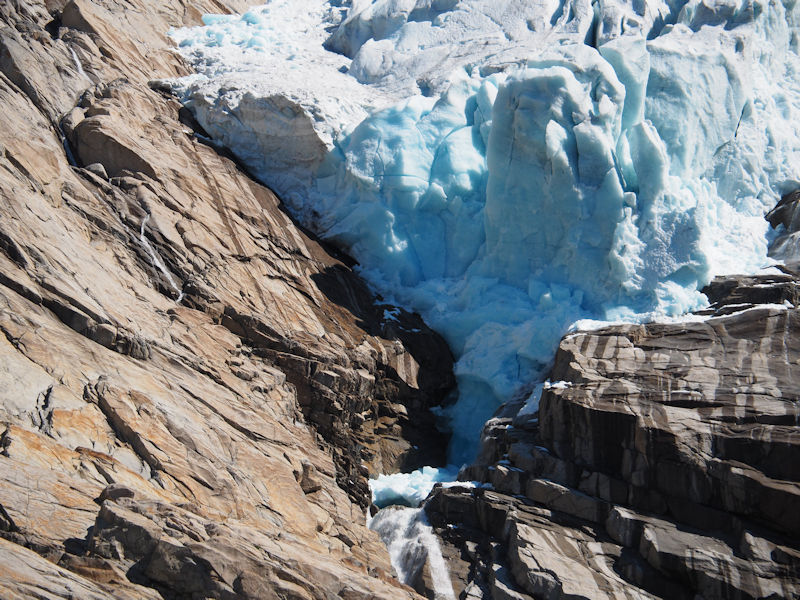
Click on this to see a larger view, and spot the blue colour.
My last post was about seasons, and that set me thinking about how the natural seasons are changing as our climate changes.

 In the past two years I have been around quite a few glaciers in north-west North America and Scandinavia. They are all, like this one on the left, seen at Briksdal in Norway, going backwards, retreating.

(Perversely, a handful of the world's glaciers are going forward, but the general trend is clear: climate change is melting the glaciers. There is trouble on the way!)

I discovered that in Scandinavia, they understand this very well, and Jens Galschiot's installation 'Unbearable' in Copenhagen makes the point brilliantly: look to the right first.

Gruesome, isn't it?  If you don't get it, scroll down towards the bottom of this entry, where there is a wider shot and some explanation.

In 1967, Dan Greenberg quoted Luis Alvarez, a VERY clever scientist as saying "There is no democracy in physics. We can't say that some second-rate guy has as much right to opinion as Fermi." (If you don't know who Fermi is, he won the Nobel for physics in 1938, and in 1942, set up the first-ever nuclear reactor in Chicago, an action that led to the Manhattan Project and the atom bomb.)

What Alvarez might have said was: should any science be about politics? Like it or not, scientists engage in political games and polemics, and that seems to give the unqualified the idea that science is about voting to choose the most popular theory.

That, I am sure, is what lies behind much of the fulmination against evolution that comes from the USA — the opponents hope they can shout at the idea and make it go away. As Sir John Pringle put it (in another context), they have as much hope of repealing the law of gravity.

There is certainly one place where politics looms large in science, and that is when science says we need to do something that will hurt. We don't get to vote about which scientific idea is right, but we do get to vote about the actions we take on it.

Political leaders in the US and Australia will not risk making decisions that will upset voters in marginal electorates (or congressional districts in the US). Anti-Bush types used to point to the links he had with the oil industry, but while I never had a lot of time for GWB, I don't believe any US President acts on the behalf of the oil companies in a corrupt way, any more than our Prime Minister (whoever that is) must be in the hands of the coal lobby because they are paying him. It just happens that votes can be found in backing fossil fuel use, and cheap fossil fuel use at that.

The skinny of it: acting responsibly will cause howls of outrage from those who are affected by taxes and price hikes, but without those changes, the planet is doomed. You don't need to seek a plebiscite of the scientists — they are as near to unanimous as a bunch of independent thinkers ever will be.

I used to hang out quite a lot with geophysicists, and I know that for years now, only a few mavericks have tried to argue either that the world is not warming, or that if it is, that is because of something other than increasing levels of atmospheric carbon dioxide. I know also that when you burrow, these people generally turn out to be elderly or funded by fossil fuel interests, or unqualified to speak.

So the politics is already there. The only way to bring about change is to educate the general public, but global warming is complicated. It will lead to weird effects, like some places getting cooler (there is a good chance that the Irish Sea will start forming sea ice, some time in the next hundred years or so). We know that a few of the big storms we get in the next decade or two will be caused by global warming.

I was in London in June 2006, when the Londoners were screaming "heat wave!". I was having a beer in the John Snow pub (that's another story, but immediately understandable to those knowing a bit about anaesthetics or epidemiology or both) when I read that an insurance company had mounted an ice sculpture of the world, and it was within walking distance. The friendly barman helped me work out how to get to where it was supposed to be, but when I got there, it must have melted away.

So what was an insurance company doing, staging a stunt like that? Simple: they notice when things start to go pear-shaped. As early as the 1920s, insurance companies were wary of people who worked with asbestos — it took more than fifty years for the rest of us to wake up to the harm it was doing. When the insurance companies get scared, it's time for us to get scared.*

A US poll of 1,018 likely voters was released a bit later in 2006 (http://www.newswise.com/articles/view/522946/?sc=dwtr)

The poll showed that not only were Americans more convinced that global warming is happening than they were two years before that, but they were also linking the then recent intense weather events like Hurricane Katrina, heat waves and droughts to global warming. People were making the connection between global warming and the more intense weather events they experience and hear about.

In short, there may be hope for us yet, though I suspect that a prolonged and calculated PR campaign over the past ten years may have pushed that back in the US, the UK and Australia. Of the sample, 74% were more convinced today that global warming is happening than they were two years earlier. Only one is five said they were less convinced global warming is occurring.

The numbers of people more convinced global warming is happening cut across all demographic segments including region of the country, age, religion, racial background, gender and income group.

Majorities of Democrats (87%), Independents (82%) and even Republicans (56%) said they were now somewhat or much more convinced that global warming is happening than they had been two years earlier.

When reviewed in total, this poll indicated that 10 years back, a growing majority of Americans, across all demographic categories, and political persuasions, recognized global warming as a threat that their nation must address.

We don't make the science right or wrong by voting on it, and politics and science don’t mix, but if people begin to get the message, if they start to tell the pollies that they are worried, maybe the pollies will start to take a few of those hard decisions.

The thing is: policy and politics do mix, if only because evil and corrupt people are using underhand political methods to confuse the general public.


The J-curve on which the polar bear is skewered reflects the graph of the inexorable rise of atmospheric carbon dioxide, and the curve is made from a length of oil pipe. Art and politics go together very well.

- - - - - - - - - - - - - - - - - - -

*Footnote

In the early 1970s, I taught boys about science at what was then Fort Street Boys' High School. In about 1972, I saw a boy, one afternoon, close the drawer in my lab that contained the asbestos mats that used to be placed under the Bunsen burners. A cloud of asbestos dust wafted up into the air, and I saw it because the late afternoon sun was slanting into the lab.  That afternoon, I took out all of the mats, wrapped and sealed them and put them in the garbage.

That is not the best way of disposing of asbestos, but I didn't know that then, and at least it got this dangerous material away from me and the boys.

At that time, my chain of command was though an idiot to an idiot. Wally Bray was unqualified to be head of any department, and had been kept, safely away from any science classes for 20 years, until he was appointed by a clerical error. Heads of science had to be on "List 2", and Wally's name wasn't there.

This blunder was covered up when a hatchetman named Colin (if you knew the scene, that much will suffice) came out and gave Wally a retrospective List 2, but it was a bad decision. He did things like having kids pipetting carbon tetrachloride and 4M potassium hydroxide and other things. (The sight of a boy's tongue, burnt by 4M KOH, is quite alarming!)

It was largely my role to stop his worst excesses, and he objected to it.  Most of the time, I used guerrilla tactics, so he only had suspicions. I admit nothing, but action was needed, and somebody did the needful. I have no idea who, but Wally was sure he knew. He complained about me to the principal, a wily primary school teacher who had become a high school principal by using loopholes.

I think Tom Cooke realised that I knew how he had got to his exalted position and did not respect him, but for whatever reason, Tom and Wally used to try to browbeat me on piddling charges, and I failed to cooperate, denying everything.  I kept showing them that running a barefoot rear-end-kicking contest against a hedgehog is a bad idea, but these two were slow learners.

One of the funniest items was that Wally insisted on taking the incubator/oven that I was using in classes so he could use it to raise fruit fly larvae. I had been oven-drying soil at 105ºC, so I had been using the 100 - 200ºC range setting on the back, so when he dialled up 37ºC, it was actually 137ºC, and he got a bunch of crunchy fruit fly. Well, of course that was all my fault...

No it wasn't.  It didn't occur to me to tell him about the range switch, but even if I had, he wouldn't have listened. Still, he complained, there was a hearing, I explained that Wally knew what I had been using the oven for, that it was his failure, and I warned them that any future hearings would need to be properly convened with a union representative and with a formal record.

That slowed them down a bit, but with the mats, Wally thought he had me.  He trumped up a charge of causing damage to the lab benches, and this time he had evidence because I freely admitted what I had done.  I was hauled in and ordered to replace the mats.  I can't, I said, they've gone.  You will face disciplinary charges, I was told. I grinned my nasty debater's grin.  I never started the politics, but I could play the game.

"Bring it on," I said. "But understand this: you know I will require a formal record of a formal hearing. And also understand this: I'll bring in the media, and you'll be shown up as complete idiots, ordering me to endanger the welfare of students. There's more than enough evidence out there that asbestos causes cancer, and I will bring expert witnesses. You bring your charges, and I'll bring you ridicule.  Oh, and I might accidentally let slip something about Wally's lack of a place on List 2..."

They caved in.  That was using politics in science.

I think those two disgraceful pieces of alleged humanity are dead now. If they are alive, now that everybody accepts that asbestos dust causes mesothelioma, I wonder if they ever suffer a quiver of shame for their pusillanimous stupidity. In all probability, by applying politics in a science context, I saved lives.

But back to my topic, did you know that we already knew the world was warming, way back in 1950? That will be the topic of my next post.


Sunday, 13 March 2016

The management of superordinates

What is a superordinate?

It is somebody to whom, in terms of pay and stuff, you are lower down the pecking order.  It is a person who is in no way, shape or form, your superior.  If you have people like that, there's a lesson here, that I am publishing now under the 30-year rule. This is how to make your superordinate an unlucky bunny, like the one on the right.*

I spent many years working in hierarchies where I came up against superordinates. In the old days, one would say that an OBE (Officer of the British Empire) actually meant "Other Bloke's Efforts".  I came across it when my father, and Education Department official, was visited in hospital, in my presence, by a man with a lot of questions. My father stone-walled him, and after the fellow had gone, I asked who he was.

"That was Jack Buggie," he said, then he pointed at himself. "He'll get an OBE one day, but not from this bloke's efforts."

A year or so later, my father was dying of cancer, and my mother got an odd letter from Dr Harold Wyndham, then the Director-General, saying how he, personally, would never forget my father's work on something called "the wall of pins", which was a planning solution.

She asked my father what it meant, so he reached over and handed her a newspaper clipping, from the 'Daily Telegraph', as I recall. It showed a photo of Jack Buggie in front of his invention, the "wall of pins".

"He's got his OBE," I said, and my father nodded.  He wrote a masterly squelch, and my mother created multiple copies which went all over the Department, but Jack later made it to Director-General.

So when I became a Departmental official myself, I determined that no superordinate would pick my brains, steal my credit.  Jack was still DG, but while the lowly folk knew whose son I was, I avoided him.

I was bright, not concerned about a career as much as I cared about doing useful stuff. Most of the OBE types waited for somebody else to do stuff, and then jumped in to claim it, but I made sure that my authorship was known, in advance.  I also out-played them, and spent their budgets — I don't play office politics, but I don't waste my time on drones, either.

Enter Brent C**ish (yes, I blanked a couple of letters to make lawsuits harder).  He was, I think, a woodwork teacher, but he was inserted as my superordinate and he came around to find out what people were doing. Read: what he could purloin.

In all innocence, I let him see an idea of mine in mock-up form, a collection of school reports. I had written to my contact list, explaining that I wanted to assemble a set of school report forms, and I wanted them to fill them in one of their school's forms for a non-existent person. Many of them, knowing me, slipped jokes into the comments, and I assembled a 100-page booklet of the samples called 'Sorts of Report'.  I had sent if off for printing.

I told Brent that I was going to present it at a conference.  He promptly disappeared and came back soon after to say that the director had decided he, Brent, should go in my place.  The bloke knew sweet FA about reporting, while I had a master's degree in stuff like that, but I knew who would be claiming the credit for "something I had one of my staff run up."

I could have argued,  but that's not how I operate. The only operation I do is amputation — though  I don't regard the deployment of tactical nukes or the strategic use of socks filled with sea urchins as operations within the meaning of the Act.

Thieves are mugs.  "Sure thing," I said, and I slipped out to talk to my friend, the printer.  I always make friends with the service people.  I asked the printer to lose the print masters for a week, and told him why I needed this done.

"Bastard!" he said. I agreed, and he told me it would be better if he sent the masters to another office, and this is what he did, so when Brent went off to the conference, he went empty-handed. Not before, let me add, he went up to the printers and abused them — which made them even more helpful to me.  I bought the boss printer a beer, anyhow.

Note: none of this was about my career. I was too busy being useful to be worried about my career, but I could not, in all conscience, help the career of an OBE-expert. My idea was a practical solution to a problem lots of people had. The solution was only possible because my networks knew I did useful practical stuff, so they collaborated. If a scrote pinched my credit, I lost some of my ability to get solutions in place.

By the time Brent got back from the conference, the copies had arrived (well if the truth be known, they actually arrived the day before he left) and the clerical assistant, another mate, had packed and addressed them in a store room and dispatched them all, accompanied by my 'With Compliments' slips.  Once they were gone and Brent was out of the building, I went and left a copy on his desk.

The next day, he came steaming in, clutching his copy, and I told him how I had really chased the printers, and the copies had arrived at 10 am.

"Where are they now?" he asked, and by this time, the steam was really rising.

"In the post," I said.  "All gone."

Well, he moved on, not long after, but he kept rising of course. That sort always do.  But at least I wasn't to blame for his rise, though I think my presence may have worried him a bit, because while he was around, he never asked again about what I was doing.

The moral: don't get mad, get even, and given that you are superior to your superordinates, getting even will be no challenge at all.

--------------------------------------

* Rabbit's feet are lucky, right?


Brent Corish