Search This Blog

Showing posts with label science projects. Show all posts

Sunday, 1 October 2023

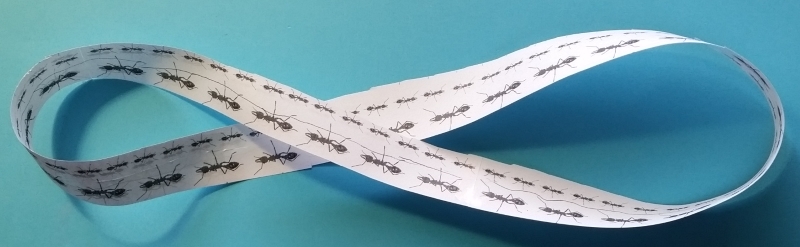
A Möbius strip activity, tossed out by iinet's idiots

 This is another one, vandalised by buffoons:

The link to the PDF to make the strip is http://members.ozemail.com.au/~macinnis/writing/Mobius%20ants.pdf

Well, that's gone, but here it is. back again

Now here's the context:

The pictures below show what you get when you cut the strip. The first picture shows that a cut down the middle gives a single loop, but there is a surprising result when you test for Möbiusness (my own word). The test is simple: draw a pen line along one side until you get back to the start: If the paper is still a Möbius strip, the line will be on both sides, but in the first picture, that doesn’t happen:


A Möbius strip

Now in the second picture, there are two interlinked loops. I cut off the big ants, and something odd happened: the little ants are isolated on a Möbius strip, but the big ants are on a non-Möbius strip.


Another Möbius strip, but this one has been cut


That's enough for now!


Sunday, 13 May 2018

The Microscopist's mate, part 8 of many.


Just for the record, all of what you find here, and in the other blogs in this series, is now available in fuller detail in my e-book Looking at Small Things.  Go to this link to find out more about how to get the free low-resolution copy, or the cheap high-resolution version: I'm a professional writer, so I like selling books, but I'm also a professional educator, so I like sharing ideas.

There's a similar free or cheap deal on offer for my Playwiths ebook as well, and to see what else I have been doing (LOTS!), go to this link.

You know what they say about ducks, calm, serene and quiet on the surface, paddling like #**@!^ underneath?

Well, that's been me, over the past fortnight, but it's all been worth it.

In one direction, I have just finished going through the the design draft of Australian Backyard Earth Scientist.

Thanks to Jo Karmel's patient editing and Stan Lamond's meticulous design, it now looks and quacks like a book. Or a duck. The bird above, by the way has a name, but  I use the name as my alter ego in another place, so I'm not telling! (What I will tell, is that the National Library of Australia will publish in in January 2019.)  The picture above indicates the likely appearance of the cover, but no guarantees, OK?


But wait, there's more! I have finally worked my way to the end of a guide for K-6 teachers on introducing the gentle art of microscopy in a simple way to young people. You can find it as a PDF by clicking on this link.

Basically, I have looked at all the exciting things you can do with a clip-on magnifier and a device (phone or tablet) to photograph small things. I matched each of these activities to the sloppily drafted pious hopes that make up the National Curriculum.

All of the images (except the one showing the gadget, above) were taken with the Go Micro, and the circle you see is a 9 mm field that you get on a device with no digital zoom.

I did this work as a pro bono for the people who are marketing these Go Micro gadgets: they are a start-up, based on Flinders University. In case you don't know, pro bono is Latin for posh people. As I said, a couple of years back, Latin is a very useful language, at times. Excreta tauri cerbrum vincit.

Back to garnering images, I care about this project because one way into the sciences is by the study of nature, which has absolutely nothing to do with the rubbish my cohort was subjected to in Year 6 under the name "nature study", work that I suspect was mandated by a po-faced and unadventurous pile of stodge, splendiferised by the cognomen 'curriculum'.

No, I want adventures, and here's one I haven't written yet. It is based on the 'skin' or exoskeleton of a huntsman spider, left in my garage after it moulted.

Now huntsman spiders are hard to photograph, because they run around, so I wondered what I could see, and after I looked and found things like the long face on the left, I called this adventure

...do spiders have eyelashes?
First off, I shared one of the images with my older grandchildren, who are 9 and 11, and used to grandpa's odd friends. I headed it: 'A really GRUESOME spider?'

This is really a harmless Australian spider called a huntsman. The circle you see there is about 9 mm across, so it's fairly big.

Well, to be precise, it's only the skin of one. When insects and crabs and spiders and things need to grow, they burst out of their skin. When they do that, there's a soft skin underneath, and they push that soft skin out before it hardens. We call this moulting, but don't worry about that name so much.  The important thing is that the skin sits still for photos.

In the picture, you can see the transparent skin that covered the eyes, lots of whiskers, and also the fangs, which curve around too much for them to be able to bite us. 


I hope you two like it, because at least one species of Australian huntsman spiders is now living in New Zealand.  If you ever watch the movie 'Arachnophobia', you will see the NZ spiders.

Why? Well, it seems the ones that survived in NZ had a "communal habit", meaning they lived together as a group, while the Australian ones prefer to be alone.  If you want mobs of spiders to move together, the New Zealand ones were the best ones to use.


Now, back to my question about the the eyelashes. Today, I started getting adventurous, zooming in by using the built-in digital zoom that comes with most devices, which means losing a bit of clarity.

Still, the bristles that were hard to spot in the first image are now fairly clear.


Here, we can see four of the eyes, but I wasn't finished yet. I zoomed in again, and blow me down, don't those whiskery things look more than a bit like eyelashes?

They aren't eyelashes, of course, but things like that must have evolved for some good reason, and doesn't that look like a nice little question to debate?

Or maybe it sounds more like a future Ph. D. topic? From little things, big things grow, and if those questions have already been solved, there are other huntsman bits to be investigated, like these shots of a palp and some gleaming fangs:


And because the source was a sloughed-off skin, no animals were harmed!

Now back to fitting things to the curriculum, anybody who has seen me in a workshop will know my on-man dialogue:

Me 1: But where dos this fit in the curriculum?

Me 2: In the slot marked Wonder...

Me 1: But there isn't and slot marked Wonder...

Me 2: (grinning wickedly): Then make one!

Oh the things we can think...if we're allowed to.


Wednesday, 2 May 2018

The Microscopist's mate, part 7 of many.


Just for the record, all of what you find here, and in the other blogs in this series, is now available in fuller detail in my e-book Looking at Small Things.  Go to this link to find out more about how to get the free low-resolution copy, or the cheap high-resolution version: I'm a professional writer, so I like selling books, but I'm also a professional educator, so I like sharing ideas.

There's a similar free or cheap deal on offer for my Playwiths ebook as well, and to see what else I have been doing (LOTS!), go to this link.

Announcing: some serious progress!

Links to previous parts: Part 1, Part 2,  Part 3, Part 4, Part 5 and Part 6.

The drought has been due to the fact that I have been producing this guide for teachers, as a pro bono job.

I will, as indicated previously, be expanding this into a book on the arts of microscopy.

You can now see the fruits of my labours, though if you have read the previous six parts, you will have seen some of that already. Anyhow, we have released a draft document: Go Micro: Foundation to Stage 3.

This links interesting activities to the National Curriculum in Science, though there is one to the Maths curriculum as well.

I am an opinionated old secondary (and occasionally tertiary) teacher of matters biological, though when people asked me what I taught, my answer was always a bright "children!".

Over the years, I acquired a healthy distrust of theory, even as I was completing a Master's degree in Education. This work concentrated on measurement, evaluation and curriculum, and I still have a small private practice as a "fixer" of multiple-choice questions, here in NSW.

I became a bureaucrat, specialising in translating good theory into good practice, keeping the Head Office parasites away from the teachers, and that is still my position.

That is why I now, having acquired all of the papers I need to prove that I am retired, spend my time writing beautiful practical books for kids. Most of these relate to science, technology, Australia and history in various combinations.

I write for grownups as well, and I am a volunteer bush regenerator, doubling as the wrangler-of-first-resort for trapped possums, confused echidnas, snakes and redbacks. Venomous, sharp-toothed and spikeful animals are no threat to an old bureaucrat...

Clearly, my life lacks any real excitement, so I am also the 'visiting scientist' at a local primary school in a CSIRO volunteer program. My aim is to get my 500+ charges (Foundation to Year 6 in a bush setting) excited and inspired to go and look for themselves.

When an acquaintance told me about the Go Micro, I saw its possibilities right away, and started playing with the gadget, aided by two grandchildren. It worked, so I suggested using them in class to the primary teacher I work with, but a number of primary teachers advised me that they are required to link things to the National Curriculum.

For readers unfamiliar with the NC, here is a police artist's impression, prepared from the statements offered by the surviving victims.

Reminding the reader of my post-graduate qualifications in this area, the National Curriculum is, in my professional opinion, proof that a camel is a horse designed by a committee, the sort of committee that compares a camel with a horse by taking two camels and sawing the humps off one of them. (A quick nod to Lee J. Cronbach, who crafted that vision.)

The National Curriculum is a horrid, dull, uninspiring farrago that quacks when it should lead, and acts as ballast when it should be providing extra lift. No doubt it means well, but it does harm to the spirit. (I hope, dear reader. that you weren't a part of writing the NC, but I'm a risk-taker, and I warned you that I'm opinionated.  And, you should be ashamed of yourself. So there!)

Many years ago, I was an observer/advisor to the NSW lower secondary science syllabus committee, and I became aware of the problem at Snake Gully Central School (not its real name, for obvious reasons). There, each year, there was one science teacher, and the idiots in Staffing sent out a new first-year-out teacher each year, to be the only science teacher in a small school, with no support, no guidance—and no hope.

In particular, the syllabus was deliberately "non-prescriptive", which meant it offered zero guidance or advice, and young teachers need just that. By mid-year, in three successive years, the new teacher had packed up and gone by the middle of the year, and the principal wrote an impassioned letter asking for a bit of common sense, which outraged the air-headed theorists.

Their theories were fine, but totally unrealistic; their doctrines were unworkable. I watched them, and went away to do what I could to get helpful ideas out there. I still care about turning theory into practice, and buried in the mess of the National Curriculum, there are some useful suggestions.

As a bureaucrat, I lurked in the interstices, and wriggled through the gaps, doing practical things among the inert and the fearful, making life easier for teachers, and so now, as Advanced Middle Age looms, I have set out, once again, to make life easier for teachers. It occurred to me that an old sweat knows the tricks of the trade, and has a duty to share those tricks before falling of the perch.

I am a private citizen, so nobody has to listen to me, and I certainly don't have to listen to the plastic trendoids who wrote the curriculum. So far, the clean draft of my guide is complete, up to Year 6, and I am now tackling Years 7 to 10.

Teachers, I believe that the format covers most of the things you need: if you have any thoughts for improvements or additions, I would welcome them.  I have the time and the equipment to solve most challenges, but don't fear any copyright rubbish if you take one of my basic ideas and do something with it.

The Creative Commons copyright shown on my activities is Attribution, Non-commercial, Share Alike, but as I see it, the format is just a format, and not subject to copyright. Take the framework, and do your own thing!

Use it as you see fit, but if you see an essential aspect that needs to be added, please throw those thoughts to me, so I can do the heavy stuff.

It's time for Stone Soup, people.

Normal service will be resumed shortly.

Saturday, 3 February 2018

Ant lions

Ants are a necessity we fail to appreciate.  They clean up our gardens, disposing of dead things keeping the garden sweet-smelling.  Ants are generally hard to see, so people often ignore their usefulness.  When they show up around picnics, we resent them, if they get into the house, we hate them, and when they sting us, we loathe them.  Small wonder, then, that most Australian children love the ant lion.

The ant lions are not a tall tale.  They are small predatory insects, the larval stages of lacewings, which prey on ants.  In their adult stages, some lacewings are said to eat aphids, so they are highly regarded by even the most ant-loving adults, or at least those few who know them.

There are ant lions all around the world, but we seem to have more of them in Australia.  The larval ant-lion digs a pit of great cunning, and lurks at the bottom, waiting for an ant to tumble down to its lair.  Once there, the ant will be seized in the ant lion's terrible pincer jaws, and sucked dry.  To do this effectively, the ant lion uses a rather handy little principle of engineering.

Pile some dry sand upon a table, and it will form a cone of a very predictable shape.  Dry sand has a typical ‘angle of rest’, about 30.5 degrees from the horizontal, if the grains are perfectly spherical.  If you shovel dry sand back over your head, you will dig a hole that will slowly get deeper.  If the slope of the sides becomes steeper than the angle of rest, some sand will roll down, making your hole broader and shallower, until the angle of rest is achieved, all around the edges.

If the slope is less than the angle of rest, you can go on deepening your hole until the angle of rest is exceeded.  In the end, either way, you get a beautifully symmetrical conical depression with dry sandy sides, all poised to fall away at the lightest tread.  The ant lion uses its large head like a flicking shovel.

It burrows backwards into the sand, and then flicks the dry grains up and away.  Some fall back into the hole, but soon there is a conical depression which grows until the trap is some 2 cm across.  Then the ant lion digs in at the bottom, with only its pincers in view, waiting for dinner to slide into reach.

An ant, blundering over the edge, starts to slip down the side, dislodging a small avalanche of sand grains as it goes.  This is no problem for the ant, this sort of thing happens all the time in sandy soil.  It starts to scramble laboriously up the slope.  As it goes, it casts more sand down, but slowly it creeps up towards the rim and safety.

But at the bottom of the pit, the ant lion feels the patter of the falling grains, and begins furiously casting sand out of the hole in all directions.  This deepens the hole and undermines the struggling ant from below, and some of the falling grains help to tumble it back down from above.  Occasionally, an ant escapes, but mostly, they fall to the bottom where they are seized and reduced to a husk.  This dried shell is later cast out of the pit with a single toss of the ant lion's powerful head.

Children who have been bitten by ants delight in dropping their tormentors' relatives into the pits of wild or captive ant lions.  In the past, I have collected a wide range of other small insects, and found that ant lions are eclectic diners.  They only eat ants because ants are so much more freely available.  A small weevil, a small sand hopper, even a spider will be dragged down and consumed if it strays within reach.

Ant lions are found wherever there is sandy soil, especially where it is protected from direct rain: under rock ledges, in hollow trees, beside fallen logs, close to buildings, and under any buildings which are on raised piers, a common Australian architectural form.  In really sandy soil, they may even cover open ground with neatly spaced traps.  
All you need to keep ant lions.

The ant populations around our house are increasing now to the highs of high summer, and the ant lion numbers are building up as well.  In a few weeks, I shall catch half a dozen, and take them to school in an ice cream container of sandy soil.  I can think of few better animals to use when introducing students to the hidden world of small insects.  After all, a system is a system, wherever you find it . . .

Friday, 1 January 2016

Keeping cockroaches as pets

Let's start the New Year with a BANG. *

Household cockroaches cause strong and inexplicable reactions. In some thoughts about insects, I quoted this anecdote:

 I once unfortunately stated to a Queensland gentleman that my coat had been bitten by cockroaches at his brother's house, which I had just left.  'You must have brought them with you then,' was the fraternal defence immediately set up.  I was compelled at once to antedate the cockroaches to my previous resting-place, owned by a friend, not by a brother.  'It is possible,' said the squatter, 'but I think you must have had them with you longer than that.'  I acquiesced in silence, and said no more about my coat till I could get it mended elsewhere.
— Anthony Trollope, Australia and New Zealand, London: 1873, page 67.

Some cockroaches, on the other hand, are cute.  Yes, I know that sounds weird, but I share the general revulsion to cockies in the house, but these are different: they are bush cockroaches.

Because so many people have strong reactions, I want to share a quick and easy "cage" that you can use, to keep your pets secure. The two photos above were taken, using a bush cockroach that I kept in the "cage" for a couple of days. It had leaf litter for it to burrow in, and I kept this moist. Not soaking wet, just moist enough to save poor cocky drying out.

The photographs were taken like the one above on the right.. I always use a sheet of coloured card behind the things I am photographing. Usually, I use blue, but I felt like a change this day. You rarely see this sort of rough shot, because I normally crop, rotate and resize as necessary, but in every set, I include one pulled-back shot to show how I did it.

The key thing, though,is containing the cocky or cockies. The picture on the right is from page 177 of my Australian Backyard Naturalist, if you happen to have a copy, but it isn't necessary to buy it. Just get one out of a library though, because there are quite a few easy wrinkles like this one.

There are four bits: a plastic container with a rim; leaf litter and residents; a large-enough piece of fly-screen; and TWO (note that: two) sets of linked rubber bands, joined up by a double hook, made from a paper-clip.

In these photos, you can see one set of rubber bands holding the fly screen in place, while the other set is just lying there.

Rubber bands break: that seems to be one of the unstated laws of science. That is why you need two sets, so the cockies don't get out.

As for food, I often throw in a slice of raw potato, which provides food and moisture, but usually, my pets aren't there long enough to risk starving.


Sometimes, I keep mosquito wrigglers, and I don't let them go when they emerge as adults, so I use flywire there as well. Note the sticks that the adults can rest on: otherwise, they will drown. You need nice green water which provides food for the wrigglers.

Here, once again, I use two or even three rubber bands, just to keep my family happy.

The cockroach cage can also be used to keep slaters (alias pill bugs) and also mystery eggs that turn up in the garden I found one set of these and suspected they were lizards, so I transferred them indoors.

My suggestion: take this idea, purloin it, try variations on it, and if you find a neater way, please leave a comment here.


* Oh, yes, about starting with a bang: I was up until 3 am, having seen in the New Year with Sydney's fabulous fireworks.  Here's a sample of what you can see at that link:

So if there are any typos, I have an excuse!

Wednesday, 30 September 2015

A more modern pooter

Some time ago, I created this blog entry on pooters, and later, I also did a Youtube clip for the National Library of Australia. That showed in careful detail, how to make a pooter.

Unfortunately, both of those are about the design that you can see on the right,  which uses a 35 mm film canister, and those canisters are now hard to get.

Some little while back, I sat down and considered the pooter (also called an inhalator). It has a tube that insects and other small animals are drawn up in, a chamber they are held in, and another tube, with a filter, which the user sucks in on.

Don't forget the filter!

And so, the design above was born.

Making it is easy: here on the right is what you need. The only thing missing is the drill, because the bottle lid was already drilled when I took this shot.  It is essential that you do the drilling on a piece of scrap board, not on the best dining table, and adult supervision is important.

By the way, you can click on most of these pics to embiggen them.


Now here is a set of shots that show the process of assembly:


The thing that is missing here is how I tape a small square of cloth over the end of the sucking tube (the longer one), holding it in place with wrapped-around sticky tape.


Just one thing: the plastic tubing: you can buy it from an aquarium shop, but I got my last lot from Bunnings (if you are outside Oz, that's a large hardware chain.) Oh, and you need a drill that makes a hole that is a tight fit.


All you have to do after that is put the cap on, and start catching animals.


Now here, just to finish up, are a couple of shots that I took after a praying mantis laid eggs near my screen door. The eggs hatched, and I scooped them up for these photos before dispersing them. You need to do that, because otherwise, they will eat each other!  You will notice that in the first shot, while it was recent, I used the older-style pooter.  I have lots of them, you see, because I have been making them since about 1992.


Tuesday, 9 June 2015

Making a fly and insect trap

Last week, I was working at and on the periphery of the Bellingen Readers' and Writers' Festival, where I gave workshops to children in Years 3 to 6, a selection from my novel about mad sheep, did a panel appearance and also gave the Mary White Address at the Dorrigo Rain Forest Centre.

Three things stood out in the schools program.  One was making a pooter: see the Youtube clip here; the use of an upside-down umbrella, which I will come to later, and the construction of a simple trap for flies that can be adapted to catch fish or small crustaceans.

This is a simple idea, based on a simple hack that took me ages to develop, but which I am sharing for free. This is a very simple device to make, once you know a very simple hack that is easy to apply, but it was very hard to come up with. Like all simple hacks, there are probably lots of other ways that readers can apply this. If you think of one, please share it with me by way of a comment on this blog.
The finished product in its dry-land form.


You need two 1.25 litre clear plastic bottles, some sharp straight scissors, a sharp knife, and preferably a pair of nail scissors. You also need a thick wad of old newspaper to stop you stabbing the table or desk, and you need your thinking cap on! If you can’t think, wear a thick gardening glove to protect your other hand, the one that isn’t operating scissors,

Look at the pictures as you follow the instructions.

Take one of the bottles, and cut a slit, just below the bottle’s “shoulder”. Then use the straight scissors to cut around the bottle to make a funnel. If this part has a cap on it, remove the cap, but keep it.

Now take the other bottle. Remove any label on it, and use the knife or scissors to make a small hole in the side.

This is the point where you need to think, so you don’t cut or stab yourself. Then use scissors to make a neat round hole, about the same size as the neck of the funnel.

Go slowly, remembering the rule of holes: you can easily make a hole larger, but you can’t ever make a hole smaller. Don’t worry if the hole is smaller than the neck: here comes the trick!

Using the picture for reference, make a series of small snips, about 5 mm long, radiating away from the centre of the circle.

Now you have a hole, surrounded by a series of flexible flaps. Push the funnel through, and it will clip into place.

You may need to try this a couple of times before you get it right. Then if there isn’t a cap on the bottle, fit one.

Using the trap

If you remove the funnel, you can add some bait, and what you use is up to you: a bit of banana peel or an apple core will attract fruit fly, fresh or rotten meat ought to attract bush flies, house flies and blow flies. What you use is for you to decide. Just remember that the easy way to get bait inside is to remove the funnel and use that hole.

You can also use the trap in water: add a few pebbles to weigh it down, tie a string to the neck of the bottle, add some bait, tie the string to something, and sink the trap in water for 24 hours or so before pulling it in, using the string.

You might also like testing to see if a waterproofed torch works at attracting stuff overnight: this is a tool that doesn’t come with instructions, so play with it as you wish — and remember that the trick with the flaps around the hole probably has other uses. If you think of one, please tell me!

Monday, 20 April 2015

The tale of Buckland's sturgeon

This is too funny not to share. Frank Buckland was a highly eccentric zoologist, and enjoyed his notoriety, I suspect.


Science in the 19th century was the play space of the gifted and curious amateur– and "curious" sometimes took on more than one meaning. 

Buckland is a prime example. The son of a clergyman, he was ordained as a priest, but became an academic and practical geologist, the first Reader in Geology at Oxford, where he presented a close argument for the way geology demonstrated Biblical truths in 1820.

Later, Buckland was swayed by Agassiz' theories on Ice Ages and modified his stance, but he remained opposed to the idea of evolution, up to his death in 1856. Buckland was memorable. among other things, for eating all sorts of animals: zebra, snake, earwig, puppy, sea slug and even a bluebottle, though he declared mole the most disgusting thing he had ever consumed.

He may or may not have eaten the dried heart of King Louis XIV (tradition says he did), but on his honeymoon, he identified some bones said to be those of St Rosalia as goat bones, and he investigated the alleged blood of a saint, which appeared fresh on a cathedral floor each morning. He lay on the floor, tasted it, and declared it to be bat urine (with which we assume he was familiar).
They don't make scientists like that any more, but if he were alive today, Buckland would surely be a leading television raconteur of science, with his own Youtube channel. Gilbert White would today be an environmental blogger, but White is another story for another day.


That's Buckland on the left. His words are below.


On Tuesday evening, at 5pm, Messrs Grove, of Bond Street, sent word that they had a very fine sturgeon on their slab. Of course, I went down at once to see it. The fish weighed, I was informed, 212 lbs [~95 kilograms]; it measured 9 feet in length [nearly three metres]. I was anxious to make a cast of this fine fellow, but I confess the size and weight rather frightened me; however, they offered me the fish for the night; he must be back in the shop the next morning by 10 am. Determined not to lose the chance, I called a cab, and we tried to get the sturgeon on the top of it, but he was "too much" for us, and we were obliged to give up all idea of this mode of conveyance of our huge friend from Bond Street to Albany Street.
Messrs. Grove then kindly sent him up in a cart, and we got him out of the cart easily enough on his arrival at my door, but it was with the greatest difficulty we hauled him up the doorsteps. We then thought of pitching him headlong over the railings into the area below, and thus getting him into the little front kitchen, which, though terribly small, I use as a casting-room; but his back was so slippery and his scales so sharp to the hands, that Master Sturgeon beat us again. However, I was determined to get him down into the kitchen somehow; so, tying a rope to his tail, I let him slide down the stone stairs by his own weight.
He started all right, but, "getting way" on him, I could hold the rope no more, and away he went sliding headlong down the stairs, like an avalanche from Mont Blanc. At the bottom of the stairs is the kitchen door; the sturgeon came against it "nose on" like an iron battering ram; he smashed the door open in a moment with his snout and slid right into the kitchen, gliding easily along the oil-cloth till at last he brought himself to an anchor under the kitchen table.
This sudden and unexpected appearance of the armour-clad sea-monster, bursting open the door—shut purposely to keep out the sight of "the master's horrid great fish "—instantly created a sensation scene, and great and dire was the commotion. The cook screamed, the housemaid nearly fainted; the cat jumped on the dresser, upsetting the best crockery; the little dog Danny, with tail between his legs, made a precipitate retreat under the copper and barked furiously; the monkeys went mad with fright, and screamed "Murder" in monkey language; the sedate parrot's nerves were terribly shaken, and it has never spoken a word since; and all this bother, because a poor harmless dead sturgeon burst open the kitchen door, and took up his position under the kitchen table.
—Bompas, George Cox, The Life of Frank Buckland, London: Smith Elder and Co., 1886, p. 200.

The first image is from an unidentified source, the second is from Vancouver Island University's sturgeon collection, and it bears no copyright notice — as one would expect from an 1886 original.

General note that I am adding to some of my blog entries: I have lots of different interests. If some area interests you, look at the very end and you will see a set of tags called labels. These are hot links that will give you a list of other articles with the same tag/label.