I use TextAloud to convert what I write to mp3 files, so I can listen to them for checking. Reading involves seeing what is there and guessing some of the gaps, which is what makes proofing do hard.
So here I am in Chicago, where things are not always what you expect. This is why I always take the Goodman Theater to be the Goddamn Theatre, and the DuSable Bridge to be the Disabled Bridge, or that's my theory, anyway.
Tuesday, 26 April 2011


Monday, 18 April 2011
Dedication OR I wish I had written that
William J. Lines is (or was?) a West Australian, a writer of lovely history, and I have just been mining his tale of Georgiana Molloy, called An All Consuming Passion, for a short piece in a more general book. Because I had already done a fairly extensive coverage, he filled out the picture for me and clarified a few oddities and misconceptions, but without offering any extra meat that I could use—but he provided a delightful read.
All the way through, I admired and enjoyed his prose, and then I came upon this gem:
Bravo, Mr. Lines!!
It's a book well worth finding and reading, even before you get to that on pages 335-6.
All the way through, I admired and enjoyed his prose, and then I came upon this gem:
"I also wish to thank the archivists at the Cumbria Record Office, Carlisle, England, whose institution epitomises the very best Anglo-Saxon traditions of openness, access, and cooperation. Despite a decade and more of ignoble Thatcherite economic rationalism, which attempted to rob public life of its purpose and community of its bonds, the spirit and means of free enquiry endure."
Bravo, Mr. Lines!!
It's a book well worth finding and reading, even before you get to that on pages 335-6.
Sunday, 17 April 2011
The age of the short put-down is not dead
I do not like thee, Dr. Fell,
The reason why, I cannot tell—
But this I know, and know full well:
I do not like thee, Dr. Fell.
Someone I know very well (no names, no pack-drill) once engraved a quatrain on a bench in the Chemistry lecture theatre, a celebration of Joe Broe, our lecturer and a very dry but thorough old stick. It read:
J. J. Broe
Never said no
That is of course unless
He'd plainly first said yes.
Sir Humphry Davy
Abominated gravy
Because he lived under the odium
Of having discovered sodium.
Mr. Robert Liston
Used the saw like a piston
He was that elated
When he amputated.
But nobody writes clerihews any more.
The short put-down has emerged again. I recently discovered the Green Tea Party blog, which is a hoot. Today, came a "tweet of the day" from a comedian whom I have hitherto not rated highly, Will Ferrell. It reads:
Dear scissors, I feel your pain . . . . Nobody wants to run with me either. Sincerely, Sarah Palin.
Like all innovations, Twitter has been loudly slammed by those who don't understand it and don't want to understand it. I don't really understand Twitter either, but I'm waiting for Twitter and its users to determine what it is.
Recall that the Internet was seen as a way of sharing scientific data and not what it is now, and one version has Bell inventing the telephone to deliver sermons to multiple churches. New technology rarely ends up being what the inventors thought it would be: the users decide that.
Users like Mr. Ferrell are now making the key decisions about Twitter by the ways they use it. Come back to this thought in 2020, and see if I was evidencing any sort of 2020 vision—or if I got it wrong like Sir William Preece, who thought (allegedly) that messenger boys were better than telephones.
And I think I will need to re-assess Mr. Ferrell.
Saturday, 16 April 2011
Some brilliant news for Adele K. Thomas
When we set out to do The Monster Maintenance Manual, we had a competition for a new (that is to say, unpublished) illustrator. Pier 9 spotted about a dozen others who will end up getting a gig, one way or another, but a few really stood out, and one of them was Adele K. Thomas. We made an excellent choice!
In the excitement of the short lists announcement the other day, it didn't occur to me to look at the short list for the Crichton Awards, mainly because I didn't know much about them, because pictures aren't really my thing.
Well, if you haven't already looked, and you happen to be solid teak from the neck up, you may not have guessed yet about the joyous discovery I made today: Adele K. Thomas is on the short list!
I know something of three of the other books that are there, so the competition will be intense, but in my estimation, Adele is in there with a good chance.
Brava, Adele!
And good luck!
 |
| Adele's version of the Sinking Goose. |
In the excitement of the short lists announcement the other day, it didn't occur to me to look at the short list for the Crichton Awards, mainly because I didn't know much about them, because pictures aren't really my thing.
Well, if you haven't already looked, and you happen to be solid teak from the neck up, you may not have guessed yet about the joyous discovery I made today: Adele K. Thomas is on the short list!
I know something of three of the other books that are there, so the competition will be intense, but in my estimation, Adele is in there with a good chance.
Brava, Adele!
And good luck!
Friday, 15 April 2011
Another piece of tsunami wisdom
I am always on the look-out for parables, and Al Lee passed on to me a link to an AP report about the Japanese tsunami. There's more to it than what I am extracting here, but there was one aspect: tablets which say "Remember the calamity of the great tsunamis. Do not build any homes below this point."
Now there's a curious twist to this, as the report points out. If any of the tablets have been placed too low, then sooner or later a tsunami will carry them away, and the surviving ones will stand as testaments to the safety of their locales.
It's a savage form, but the parallel to the rather more subtle odds-shading of Darwinian evolution are pretty obvious. I can work with that at some point, if only in a radio essay. As that link reveals, I do those as well.
Sometimes the wisdom of past generations is complete rubbish (think phlogiston, the impossibility of heavier-than-air flight or bad smells causing disease), but as a rule, even those approximations have a message for us, if we squint and look at them the right way. Whatever the past generations believed, it didn't kill them outright, and it may well have contributed to their survival, even if it was for all the wrong reasons.
Take these Eucalyptus trees, snapped from the train while travelling from Frascati to Rome. Baron Sir Ferdinand von Mueller, KCMG was an Australian botanist who features in Curious Minds.
I have long known that Eucalyptus trees were exported for their disease-fighting powers to quell malaria by their nice smell, while the reality is that these thirsty trees lowered the water table and dried up the swamps and marshes where mosquitoes bred. I have snapped these trees in Cambodia, and on Kefalonia and and Cyprus, playing the same role.
It was only last week that I found that the chief distributor of seeds around the world was Baron Sir Ferdinand von Mueller, KCMG. You hunt down the bits for long enough, and in the end, they fall into place.
That is how my parable of the Japanese stone tablets will eventually find a home. A bit like those unbiquitous eucalypts.
Now there's a curious twist to this, as the report points out. If any of the tablets have been placed too low, then sooner or later a tsunami will carry them away, and the surviving ones will stand as testaments to the safety of their locales.
It's a savage form, but the parallel to the rather more subtle odds-shading of Darwinian evolution are pretty obvious. I can work with that at some point, if only in a radio essay. As that link reveals, I do those as well.
 |
| From the Frascati-Rome train, 2010. |
 |
| French colonial hospital, Siem Reap, Cambodia. |
I have long known that Eucalyptus trees were exported for their disease-fighting powers to quell malaria by their nice smell, while the reality is that these thirsty trees lowered the water table and dried up the swamps and marshes where mosquitoes bred. I have snapped these trees in Cambodia, and on Kefalonia and and Cyprus, playing the same role.
 |
| Mature river red gum, Argostoli, Kefalonia |
That is how my parable of the Japanese stone tablets will eventually find a home. A bit like those unbiquitous eucalypts.
Thursday, 14 April 2011
A quick one: two links that fascinated me.
 |
| Lava flow on Kilauea, in the dusk. |
 |
| Me, my hat and the lava flow. It was close enough to frizzle the hairs on my legs. |
Then I discovered that the Pacific Tsunami Museum was located there, and spent a couple of useful hours there. I had always found tsunamis interesting, but I came away finding them awe-inspiring and fascinating. That said, I don't really want to be close to one. But if ever I need to write about one, I know the sort of stuff I will draw on, thanks to my friend Robin posting a link today to a personal account of the Japanese tsunami.
The author is an American who has been living in Japan as a teacher of English, but look, just read it, OK?
The second link came from the same email list. I need to explain here that I am a social climber: I hang out with librarians. That means I have a few rudiments of what cataloguing is about: not enough to qualify me as a shelver's second deputy assistant, but I have a sense for it. I suspect that even without it, you would enjoy this contribution from Lois. It is a blog entry called 'A digression on literary categories' at the blog Making Light. A word of advice: read the 200+ comments, because they are severely hilarious.
Go on! What are you waiting for? There's nothing to see here!
Tuesday, 12 April 2011
Wherein I get a small award
Today, the Children's Book Council of Australia presented its Notable Books list. My The Monster Maintenance Manual was listed as one of the notable books of 2010 for Younger Readers. It was always going to be difficult to get even that far, given that I didn't really fit the categories, and there was an excellent field, so that was as far as I got, but at least the publishers get to affix a sticker to the book.
During the day, I came up with an excellent new theory: dragons hate chocolate. Consider: every person I know loves chocolate, and none of them has ever been attacked by a dragon. It follows that all the chocolate haters have been eaten by dragons, which shy off at the mere hint of the cocoa bean. Nobody alive has ever seen a dragon, because since the chocolate haters have been eliminated, there has been no food for dragons, and they have all moved to another planet.
Don't stop eating the chocolate, because if they come back, you will be dragon droppings, quicker than you can say "brown bread!"
This is what I mean about where ideas come from. I estimate that if I can come up with 31 other theories like this, I can have an entertaining book. If I don't think of any others, I will write a popular diet book about the central role of theobromine as an antidraconic agent.
This will reap me a fortune, because it tells people to eat something they like, but dresses the advice up in New Age gibberish.
Note: the above text is entirely fictitious, and any similarity to any existing dietary manuals is purely coincidental.
During the day, I came up with an excellent new theory: dragons hate chocolate. Consider: every person I know loves chocolate, and none of them has ever been attacked by a dragon. It follows that all the chocolate haters have been eaten by dragons, which shy off at the mere hint of the cocoa bean. Nobody alive has ever seen a dragon, because since the chocolate haters have been eliminated, there has been no food for dragons, and they have all moved to another planet.
Don't stop eating the chocolate, because if they come back, you will be dragon droppings, quicker than you can say "brown bread!"
This is what I mean about where ideas come from. I estimate that if I can come up with 31 other theories like this, I can have an entertaining book. If I don't think of any others, I will write a popular diet book about the central role of theobromine as an antidraconic agent.
This will reap me a fortune, because it tells people to eat something they like, but dresses the advice up in New Age gibberish.
Note: the above text is entirely fictitious, and any similarity to any existing dietary manuals is purely coincidental.
Monday, 11 April 2011
Where do the ideas come from? part 2
There are probably three main aspects for me when a book is emerging, brewing or developing.
The first is having a temporary obsession that leads me to burrow after information. Robyn Williams once described me as a "fact-fossicker", a term that I have proudly claimed as my own. Recently, I even fossicked the origins of that quintessentially Australian term, working through the marvellous source of historical newspapers that is to be found at TROVE. As one of the Trove volunteers (there must be thousands of us), I play a part by correcting the OCR renditions of digital images of articles, and adding tags to help other searches.
As of today, I have tagged 133 articles as <early use of language>, with a further tag to indicate which Australian word or term I was targeting: you will find bushranger, sheoak, damper, bandicoot, cobber, bodgie, widgie, dinky di, on the wallaby, bonzer, gibber, death adder (a corruption of the Biblical 'deaf adder', and not the other way around), swag, squatter, bludger, billy and kookaburra all marked—but it all began with 'fossick'. (You can see all of these, by the way, just by searching in Trove for the phrase "early use of language", like that, inside double quotation marks.)
Right now, I have no direct plans to use any of my finds about early Australian language, though it will be handy if/when I get into the Cornish Boy (mentioned elsewhere), and I have placed the information in the public domain so that others can also gain from it, but at any stage, something I find might start off from some of that. That's how temporary obsessions get to have life breathed into them, but the original plan was just to keep an eye out for early uses while digging for other stuff.
 I'm also a member of Project Wombat, a group of people who like to solve "stumpers", difficult questions. Burrowing for information is deep in my genes. My (currently stalled) plan to do a book an misplaced genius and mad inventions just emerged from having the sort of ratbag mind that enjoyed digging up oddities. Even though there are no immediate plans for that one, I keep spotting and noting ideas that might improve it.
The second aspect is storing useful information in such a way that I can track it back to source, later. I mainly use spreadsheets, which all take the same formatting, but I'll come back to the wild and woolly ways I use spreadsheets some other time. Suffice it to say that the people who wrote Visicalc and Lotus 1-2-3 would never have expected the antics I get up to.
Still, it's people finding new ways to use technology that pushes it forward. Mr. Bell never expected people to hook up the descendants of Babbage's Difference Engine with his telephone wires, any more than Time Berners-Lee could have anticipated that I will be doing an electronic check-in for my flight next week, using the internet—or that I would have booked my hotel online.
The third involves building up logically—and keeping all the bits.
Being logical first: I was "taught writing" by English teachers who manifestly were not practitioners, but they all loved to drum into us the stuff that had been drummed into them at university, about the motivation of characters and the flow of the action. Coming from talking marionettes, these wooden words meant little, but I can see now that in their inarticulate way, they were on the money. A story only works if there is a clear logic to it. This applies to both fiction and non-fiction.
This morning, I have taken time off from the story of a part-eater called Bitz who keeps losing weight, and in the end, her friends Kilimanjaro (a troll) and Papagena (a calculator imp) solve her problem. She has been using all the bits and parts in her pantry to make things, and so Bitz has forgotten to eat. I use logic there at all points: these little stories have 17 parts, and I write the first eight or so, based on notes, then I write the conclusion (one or two parts) and then join the ends by filling in the blanks. Right now, I have five blank frames to go, and notes enough to fill about nine or ten, so some pruning will be needed.
These short stories are, in a Dodgsonian sense, high-grade nonsense, but there is a total sense to the structure and to the names: all imps take their names from operatic heroines (and Papagena may be Brunhilde before this sees the light of day—and an editor may tell me it's all too fluffy and to drop all the high-art stuff). That's how I work.
In the end, a number of the notes scribbled around the story frame will end up not being used. Word-plays will miss the cut, plot-lines will be dropped, but when I take the draft and paste it into the final collection, the left-overs will be saved.
I have a bad habit of scribbling notes on scrap paper, the backs of bills or envelopes, and then later, dropping those into the recycling. As a rule, it may be six months before I recall that there was something in my logic structure that needs revision. So anything that isn't in a spreadsheet is in a notebook, with dates to show what was when.
This makes me sound amazingly organised, but that is only because I am extremely disorganised, but savvy enough to see that this is so.
The first is having a temporary obsession that leads me to burrow after information. Robyn Williams once described me as a "fact-fossicker", a term that I have proudly claimed as my own. Recently, I even fossicked the origins of that quintessentially Australian term, working through the marvellous source of historical newspapers that is to be found at TROVE. As one of the Trove volunteers (there must be thousands of us), I play a part by correcting the OCR renditions of digital images of articles, and adding tags to help other searches.
As of today, I have tagged 133 articles as <early use of language>, with a further tag to indicate which Australian word or term I was targeting: you will find bushranger, sheoak, damper, bandicoot, cobber, bodgie, widgie, dinky di, on the wallaby, bonzer, gibber, death adder (a corruption of the Biblical 'deaf adder', and not the other way around), swag, squatter, bludger, billy and kookaburra all marked—but it all began with 'fossick'. (You can see all of these, by the way, just by searching in Trove for the phrase "early use of language", like that, inside double quotation marks.)
 |
| One of my lucky finds. |
You can never tell which bits will prove to be not just amusing, like the "rat guillotine" above, so the only sensible solution is to store it in some machine-searchable way.

The second aspect is storing useful information in such a way that I can track it back to source, later. I mainly use spreadsheets, which all take the same formatting, but I'll come back to the wild and woolly ways I use spreadsheets some other time. Suffice it to say that the people who wrote Visicalc and Lotus 1-2-3 would never have expected the antics I get up to.
Still, it's people finding new ways to use technology that pushes it forward. Mr. Bell never expected people to hook up the descendants of Babbage's Difference Engine with his telephone wires, any more than Time Berners-Lee could have anticipated that I will be doing an electronic check-in for my flight next week, using the internet—or that I would have booked my hotel online.
The third involves building up logically—and keeping all the bits.
Being logical first: I was "taught writing" by English teachers who manifestly were not practitioners, but they all loved to drum into us the stuff that had been drummed into them at university, about the motivation of characters and the flow of the action. Coming from talking marionettes, these wooden words meant little, but I can see now that in their inarticulate way, they were on the money. A story only works if there is a clear logic to it. This applies to both fiction and non-fiction.
This morning, I have taken time off from the story of a part-eater called Bitz who keeps losing weight, and in the end, her friends Kilimanjaro (a troll) and Papagena (a calculator imp) solve her problem. She has been using all the bits and parts in her pantry to make things, and so Bitz has forgotten to eat. I use logic there at all points: these little stories have 17 parts, and I write the first eight or so, based on notes, then I write the conclusion (one or two parts) and then join the ends by filling in the blanks. Right now, I have five blank frames to go, and notes enough to fill about nine or ten, so some pruning will be needed.
These short stories are, in a Dodgsonian sense, high-grade nonsense, but there is a total sense to the structure and to the names: all imps take their names from operatic heroines (and Papagena may be Brunhilde before this sees the light of day—and an editor may tell me it's all too fluffy and to drop all the high-art stuff). That's how I work.
In the end, a number of the notes scribbled around the story frame will end up not being used. Word-plays will miss the cut, plot-lines will be dropped, but when I take the draft and paste it into the final collection, the left-overs will be saved.
I have a bad habit of scribbling notes on scrap paper, the backs of bills or envelopes, and then later, dropping those into the recycling. As a rule, it may be six months before I recall that there was something in my logic structure that needs revision. So anything that isn't in a spreadsheet is in a notebook, with dates to show what was when.
This makes me sound amazingly organised, but that is only because I am extremely disorganised, but savvy enough to see that this is so.
Thursday, 7 April 2011
Where do the ideas come from?
I was asked the other day where my ideas come from, and it struck me that there isn't a single answer to that, because some of them leap on me out of the blue, some are long-term temporary obsessions, others are thrust upon me.
Let's take the way I started writing adult/general non-fiction, the genre known as narrative non-fiction, which one of my favourite second-hand bookshops calls "History of Things".
I had a call, sometime in 2000 from Ian Bowring, who had been my publisher at Longman-Cheshire. He had moved to Allen and Unwin and was casting around for somebody who could write in that genre.
"We'd like you to do a book about malaria, scurvy or sugar," he said. I gave him good reasons why malaria and scurvy might not be good ideas to tackle (I was effectively a full-time science journalist in those days, and knew what was happening in the research world).
But I did have a curious riddle, posed by a line in Shakespeare's Winter's Tale, and I told him I had found the answer, and could hang a book on it.
Other books are commissions. A freelance editor I had worked with passed my name on to another publisher, and they asked if I could whip up a treatment on "Lawn". An outline and a sample chapter, they said, cash money to be paid, and a contract if they managed to sell the idea.
 It was only years later that I twigged that all the odd editors who came offering "fixer" work, which I always took, knew each other. I had, without realising it, got a bit of a name for being reliable. It paid off!
So I did the work on The Lawn, got the pay, and nothing happened. The chap who asked me to do the work left the companyOther works came and went, then out of the blue, they sold the idea to an overseas publisher and it was a goer.
Now for the odd part. I always do interviews on radio when asked, and I did a promo for the book in a hook-up to New Zealand.
When that went to air, I had an email from a New Zealand lady who explained that she had the paperwork to prove that she was nuts (I think she meant she was bipolar, but no matter, she had and interesting idea, and she presented it in a sensible way).
Having only heard an interview and read a review, she said that if I could do a social history of the lawn, I ought to do one on fences.
My first reaction: "daft idea". My second: "Hmmm". My third (this was over a couple of weeks): "Naah, it doesn't have legs."
Now I'm fairly certain it would work. If I expand "fences" to barriers of all sorts, so I can add the Great Wall of China, the walls of Istanbul, the Maginot Line, the Berliner Mauer, Hadrian's Wall, the dog-proof fence, the rabbit-proof fence, barriers in Israel/Palestine and the southern USA, slip-rails and the fencing requirements placed on squatters and selectors, dry-stone walls, the effects of barbed wire, stuff like that, there may be something in it. Along the way, I plan to visit the world's only barbed wire museum. Not this trip, though.
Right now, 'Fences' is an idea that I'm toying with, but it's on my list of eight major books (and 26 booklets) that I want to do before I hang up my pen. I'm visiting places, taking notes, gathering pictures and ideas, just in case—and even when I'm after something else, I keep an eye out for interesting barriers.
Next time, I'll say something about finding out, but here is where I list my favourite research sources.
Let's take the way I started writing adult/general non-fiction, the genre known as narrative non-fiction, which one of my favourite second-hand bookshops calls "History of Things".
I had a call, sometime in 2000 from Ian Bowring, who had been my publisher at Longman-Cheshire. He had moved to Allen and Unwin and was casting around for somebody who could write in that genre.
 |
| My first book for Big People. |
"We'd like you to do a book about malaria, scurvy or sugar," he said. I gave him good reasons why malaria and scurvy might not be good ideas to tackle (I was effectively a full-time science journalist in those days, and knew what was happening in the research world).
But I did have a curious riddle, posed by a line in Shakespeare's Winter's Tale, and I told him I had found the answer, and could hang a book on it.
Other books are commissions. A freelance editor I had worked with passed my name on to another publisher, and they asked if I could whip up a treatment on "Lawn". An outline and a sample chapter, they said, cash money to be paid, and a contract if they managed to sell the idea.
 It was only years later that I twigged that all the odd editors who came offering "fixer" work, which I always took, knew each other. I had, without realising it, got a bit of a name for being reliable. It paid off!
So I did the work on The Lawn, got the pay, and nothing happened. The chap who asked me to do the work left the companyOther works came and went, then out of the blue, they sold the idea to an overseas publisher and it was a goer.
Now for the odd part. I always do interviews on radio when asked, and I did a promo for the book in a hook-up to New Zealand.
When that went to air, I had an email from a New Zealand lady who explained that she had the paperwork to prove that she was nuts (I think she meant she was bipolar, but no matter, she had and interesting idea, and she presented it in a sensible way).
Having only heard an interview and read a review, she said that if I could do a social history of the lawn, I ought to do one on fences.
My first reaction: "daft idea". My second: "Hmmm". My third (this was over a couple of weeks): "Naah, it doesn't have legs."
 |
| Australia's 5000-km "Dog Fence", near Lake Eyre |
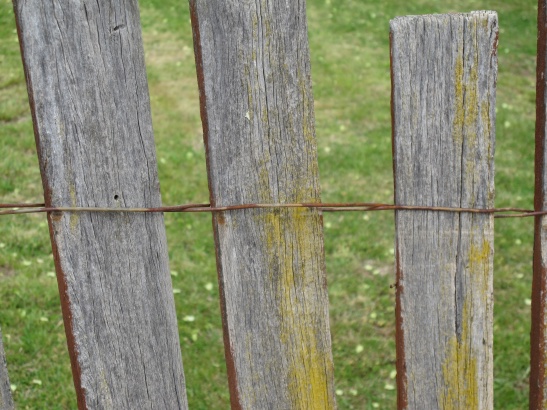 |
| Hill End, New South Wales, visited in relation to my planned study of gold rushes. No rails, no nails, just posts, palings and wire. |
Right now, 'Fences' is an idea that I'm toying with, but it's on my list of eight major books (and 26 booklets) that I want to do before I hang up my pen. I'm visiting places, taking notes, gathering pictures and ideas, just in case—and even when I'm after something else, I keep an eye out for interesting barriers.
Next time, I'll say something about finding out, but here is where I list my favourite research sources.
Tuesday, 29 March 2011
And at last, a post for 2011!
March 29, 2011
As I have said before: when I fall silent here, it's because I'm working. I have completed a book (Curious Minds) to third draft stage in the past four months, and I have also been in New Zealand's North Island (we have grandchildren there).
In the past four months, I have written additional material for Australian Backyard Naturalist, and most importantly, I have finally dragged my old journal into a modern blog format. It's not very adventurous as yet, though you will find links further down to several audio clips and also to three clips on Youtube.
The stuff below this is a bit of a mess, because I just hacked the old journal up, pasted it into Word, cleaned up the links a bit and dropped it in here. I think this resulted in some rogue legacy formatting. Sorry about that, but it wasn't a core activity.
Some of the links may be dodgy, so I will leave the original version online for now. You can get to it here. If you want to see what else I have written without ploughing through all of this, the portal to my writing site is here. That also has a number of pointers to other areas of interest.
I hope to find the time to go back and retrofit a few more pics, but I'm in the calm before travelling: we will leave our younger son to sit the house and the plants while we head off to the USA, Morocco and Spain for about seven weeks.
 As well as completing a major book for adults, with the working title Curious Minds, I have been working on some spin-offs from The Monster Maintenance Manual. Some of those are the subject of negotiations, the other is a rather wild account of the later life of Count Henry Blenkinsop, seen here, bearing a remarkable resemblance to me.
Many people believe that Blenkinsop died after being pursued over the Reichenbach Falls, by some of the monsters he created, on the night of May 4, 1891, it has since been shown that he was rescued by an Englishman wearing a deerstalker cap who happened to be in the vicinity. This man, who called himself Doyle, accompanied Blenkinsop to Australia, where he devoted himself to developing a high explosive derived from eucalyptus oil.
Blenkinsop was unaware that the great powers of Europe were well aware of him and a large number of well-known people visited him at different times. I have acquired the papers he left behind, and the story is absolutely astounding.
I have three books I want to write for the adult market (as previously noted, Gold, Ingenuity (mad inventions) and one other, still under wraps, and the Cornish Boy project is still in my mental list of things to do, now to be a set of four solid books for the teen/YA market, historical fiction much closer to the truth than the Blenkinsop yarn, and set in the mid-19th century. I plan to give some thought to these ideas while bouncing around the Sahara and along the Camino de Santiago in Spain. (Note to burglars: the children are minding the house. Sorry about that!)
(FREE PLUG: We use Explore Worldwide quite a lot, because they are low enough in budget to make spoilt and pretentious whingers shy away, they have an itinerary and they manage logistics, the guides know what they are doing and we have somebody to rely on if things go pear-shaped, plus lots of walking. Mostly Brits, Australians, Kiwis, a few north Americans, but delightful company.)
As I have said before: when I fall silent here, it's because I'm working. I have completed a book (Curious Minds) to third draft stage in the past four months, and I have also been in New Zealand's North Island (we have grandchildren there).
 |
| Sunset, Paihia on the Bay of Islands. Charles Darwin came here, so did James Cook, and so did my Cornish Boy. most probably. Nice place, but I had to see it to see what would work. |
 |
| And we needed to look at thermal areas. This one (Orakei Kotako) was visited by Ferdinand von Hochstetter, an Austrian geologist who was in Australia and New Zealand in 1858-9. |
 |
| These Austrians get around. Frederick Hundertwasser had a holiday home near Kawakawa, and offered to design their new toilet block, probably the most-photographed in the world. |
The stuff below this is a bit of a mess, because I just hacked the old journal up, pasted it into Word, cleaned up the links a bit and dropped it in here. I think this resulted in some rogue legacy formatting. Sorry about that, but it wasn't a core activity.
Some of the links may be dodgy, so I will leave the original version online for now. You can get to it here. If you want to see what else I have written without ploughing through all of this, the portal to my writing site is here. That also has a number of pointers to other areas of interest.
I hope to find the time to go back and retrofit a few more pics, but I'm in the calm before travelling: we will leave our younger son to sit the house and the plants while we head off to the USA, Morocco and Spain for about seven weeks.
Many people believe that Blenkinsop died after being pursued over the Reichenbach Falls, by some of the monsters he created, on the night of May 4, 1891, it has since been shown that he was rescued by an Englishman wearing a deerstalker cap who happened to be in the vicinity. This man, who called himself Doyle, accompanied Blenkinsop to Australia, where he devoted himself to developing a high explosive derived from eucalyptus oil.
Blenkinsop was unaware that the great powers of Europe were well aware of him and a large number of well-known people visited him at different times. I have acquired the papers he left behind, and the story is absolutely astounding.
I have three books I want to write for the adult market (as previously noted, Gold, Ingenuity (mad inventions) and one other, still under wraps, and the Cornish Boy project is still in my mental list of things to do, now to be a set of four solid books for the teen/YA market, historical fiction much closer to the truth than the Blenkinsop yarn, and set in the mid-19th century. I plan to give some thought to these ideas while bouncing around the Sahara and along the Camino de Santiago in Spain. (Note to burglars: the children are minding the house. Sorry about that!)
(FREE PLUG: We use Explore Worldwide quite a lot, because they are low enough in budget to make spoilt and pretentious whingers shy away, they have an itinerary and they manage logistics, the guides know what they are doing and we have somebody to rely on if things go pear-shaped, plus lots of walking. Mostly Brits, Australians, Kiwis, a few north Americans, but delightful company.)
All of the entries for 2010
November 3, 2010
I have finished all the trimming of text, the polishing of words, the honing of discourse, and I have attended to all of the dreary administrivia of photography and art work. Writing is fun, but there's always hack work to do. Still, Australian Backyard Naturalist is near as can be to done. Two hours before I signed off on the text, with 24 hours of picture-shovelling to go, I had the go-ahead on a new book.
That, however, stays under wraps for now. Suffice it to say that it bears some relationship to other books I have done, and it's for adults—though some of the sorts of children I write for would enjoy it as well. More later.


October 27, 2010
The long gap means I have been busy. Australian Backyard Naturalist turned out to be twice as long as I had planned, so I have just done major surgery on it. Now I am listening to machine-generated MP3 files of the chapters as the final stage in the process, so I can have it out of the way before The Monster Maintenance Manual comes out next Monday. I listen to all my books as one of the final stages, because listening makes most of the editing slips that I have made show up. Then I get Chris to read it.
The next book? Two possibilities at this stage, one for older readers, one for younger readers. I will do them both, Real Soon Now, but which comes first? Even I don't know. And there are several possible dark horses that may leap out of the shadows and seize the lead.
August 21, 2010
I am back from New Zealand, coming back via Brisbane, where I was lucky enough to pick up the Children's Book Council of Australia 2010 Eve Pownall award for Information Book of the Year! Next up, catching up on stuff before I head for the Flinders Ranges and Lake Eyre. I managed to almost tie up the loose ends in Backyard Naturalist while I was in New Zealand, and I gathered some excellent material on gold in New Zealand, but the next book is still a matter for some thought. The South Australian trip may decide it for me.
 |
| Who's that with the GG? Can't be Macinnis—he's wearing a tie. AND a suit! |
Note that I said "lucky enough". That wasn't false modesty, that was an honest assessment. I was very lucky with the editor, designer and other support staff at the National Library of Australia. It was a good book, I always knew it would be, but you need a publisher with vision to come up with the idea, and then you need a support team.
July 31, 2010


March 30, 2010
I was present today at a function in Sydney when the short list was announced, and my Australian Backyard Explorer is in the 2010 Eve Pownall short list. Results will be announced on August 20.
The large gap since my last post reflects a busy time. I have been working through drafts 3, 4, 5 and 6 of Australian Backyard Naturalist, as well as checking the page proofs of the Monster Maintenance Manual. I am now doing background reading for a history of gold: it appears that I will need to read or dip into some 300 books and probably read twice that number of research articles, some of them going back into the 17th century.
The large gap since my last post reflects a busy time. I have been working through drafts 3, 4, 5 and 6 of Australian Backyard Naturalist, as well as checking the page proofs of the Monster Maintenance Manual. I am now doing background reading for a history of gold: it appears that I will need to read or dip into some 300 books and probably read twice that number of research articles, some of them going back into the 17th century.
 |
| Hydraulic miners in California used nozzles like this to direct water and bring hills down so they could extract gold from the wash. |
This will be a social history of gold and its effects, as filtered through the mind of a science writer. Our friends Theta and Gerry Brentnall took Chris and I to see the damage done by alluvial miners in northern California in the 19th century, and made me aware that this damage led, in the end to the world's first environmental legislation. I'm going to take my time with this one, but given that gold has been taking on a more key role in the plot lines of the Cornish Boy project, I expect to either start work on that again, in parallel, or launch straight into it when Gold (that's a working title only) is done.
Coming soon: news of a publication date for the Monster Maintenance Manual.
The second half of 2009
December 27, 2009
 |
| The cover of the recent Korean edition of Mr Darwin's Incredible Shrinking World. |
I sold the rights to that one, so no royalties, but writing isn't all about money and I was paid well for the rights in any case. Mainly, I think writers care about the money because it's evidence that people are reading what we write. To be blunt, if we cared about money, we'd do something else, because unless you write good quality bad fiction (no, there isn't a contradiction there: the stuff in teh page-turners I'm talking about is always well-crafted), the money isn't going to emerge.
December 17, 2009
This morning, I completed the final touches on the returned edited manuscript of Monster Maintenance Manual and sent it back to my patient editor, Shelley Kenigsberg. I'm working along on the completed first draft of Australian Backyard Naturalist, and I have bought the new camera, though I have yet to take it out of the box. Been busy, see? I have also had some nice reviews that you can see at Australian Backyard Explorer: you can see them at that link.
 |
| This is my favourite design. |
December 7, 2009
I have sent back the corrected edits of Monster Maintenance Manual. By this, I mean that I have mainly been through and agreed to the edits of the editor, commented on a few, questioned a couple and provided new text in the points where it was needed. Today, I went to Sydney for Christmas shopping, to arrange some travel for next year, and to buy a new camera. Coming home, it was a bit hot to correct the draft of Backyard Naturalist so I read some mathematics instead, looking for reminders of things I might do. That was how I came across the following comment from Bertrand Russell. He said that said that a mentor had given him:
…various simple rules of which I remember only two: "Put a comma every four words," and "never use 'and' except at the beginning of a sentence." His most emphatic advice is that one must always re-write. I conscientiously tried this, but found that my first draft was almost always better than my second. This discovery has saved me an immense amount of time.We hates him, we does. Re-writing is essential for me! That does it: Russell's Paradox is banned from The Book of Numbers. Just as well, given the way I have struggled in the past to understand Russell and Whitehead.
December 2, 2009, a bit about editing
Life comes in rushes. I have just returned from Briskepticon, the Australian Skeptics' convention in Brisbane. On the plane coming back, I read the Naturalist draft but I also sketched out some of the plans for a new book, probably to be called The Book of Numbers, which has been lurking at the back of what passes for my mind since I saw a travelogue about Paris on SBS. No, I'm not saying any more about that one just now.
I arrived back to find that the edited ms of the Monster Maintenance Manual was in my inbox. So I have Ingenuity briefly on hold, the Backyard Naturalist draft to check, Numbers to think about and the Monsters ms to work through. Shelley Kenigsberg has edited my work before, and she is marvellously thorough, which is what is needed, but it makes for a bit of a slog.
Books don't emerge like a bean shoot sprouting out of the ground: they need lots of meticulous work to get them right. I have worked in editorial roles in the past, and my golden rule is that the editor is pretty much always right, even when he or she doesn't "get it". If the editor doesn't understand, the writing is bad, but the suggested change may not work: that means the writer needs to stop, think and rephrase. More often, the editor does get it, and changes, usually the suggested ones, are made.
It is a very stupid writer who gets on a high horse and rejects changes, because the writer is too close to the work, and cannot see the flaws. As an educational bureaucrat, I used to, as I said then, conduct 51 choirs, all composed entirely of prima donnas.
These were the HSC examination committees in the state of New South Wales, and I and my team of editors were put in place because the committees had been missing mistakes because they saw what they expected to see. It wasn't stupidity, it was just human nature. Anyhow, the result is that I don't argue with editors. I may reason or plead, but if they won't budge, I go with what the editor says.
The editors I work with are all happy to take my MS Word files and mark up the changes with "Track Changes" turned on. Typically, I read the amended text for sense, skim the deletions and insertions and then select a block of text and click to approve all the changes in that block with a single click. I also have "Track Changes" turned on, so the editor can look at the file I send back and react further as necessary.
The editors also add comments from time to time, maybe explaining why a change was made, or asking a question. I attend to these as well and add comments (in italics) within their comments, or occasionally, add one of my own. It's all SO much easier than a battered bunch of paper with scrawls all over it. Sometimes, technology is incredibly sweet for writers.
November 22, 2009
As usual, the delay in coming back is an indication that I have been busy. Two major presentations, one in Canberra, one in Sydney, and two books in the air. I finished the first draft of Australian Backyard Naturalist yesterday, and I have printed and bound a copy to take away to Brisbane for a conference next weekend, where I will be addressing the question: If Darwin did not exist, would it be necessary to invent him?
Now I will be working on that, and also on the Monsters book and Ingenuity. And enjoying summer.
September 12, 2009
Notice how these posts are getting more frequent? I'm having a bit of trouble getting down to the disciplined setting-out of ideas because I'm having too much fun. Chris (my other half) and I went out to Camden, more than 100 km away to visit a generous tardigradologist, Dr Sandra Claxton, who has spent more than thirty years working on these tiny animals. She shared with us her ingenious methods for extracting tardigrades from bark scraped from trees, I had a try, and succeeded. I'm stoked!
[Note in 2011: sadly, these ended up only getting a marginal mention in the book. Most of the microscopy went, but I am adding that material into this blog, and I hope to follow up with lots more of the advanced stuff. You will find most of the key tardigrade information in an entry called Hunting the Elusive Tardigrade.]


If this description doesn't make sense, look at the pictures. You can see the components and an untouched bottle on the left, along with an assembled funnel in the right-hand picture. The idea is to put some leaf litter in the funnel, then lay a cover on the funnel, and apply a gentle heat source like a 25 watt incandescent light bulb to drive the tiny animals down. Incidentally, the plaster is damp (I soak it in water for several minutes, then pour off the excess and blot the plaster dry), so that will help to keep them alive when they fall through the mesh.
Tomorrow, once the plaster is set, I will give it a test run, and take pictures of it in operation and add a picture or two of my 'catch'. What actually shows up depends a lot on where I take my samples.
September 8, 2009
Over the weekend, I ported across the two spreadsheets I have for Ingenuity and Australian Backyard Naturalist into Word, and got the rough formatting done, though I will leave Ingenuity to mature for a bit. Try this sampler of crazy inventions to see some of the things that may end up in it.

Today, when I went out to check for mail, I spotted a small and very hairy caterpillar on the path. Right now, I take every opportunity as it arises, so I'm always coming home with odd bits to photograph. So I fetched a dish and a brush, and gently collected the caterpillar. As a rule, the hairy ones cause discomfort or pain, so I treated it with care and set it down on a book in the sun to take a shot with the macro lens. The light was sharp and bright, but some of the detail was lost in the shadows.
I decided that what was needed was some light from the other side, to fill in the shadows, so I went and got a mirror and called my wife to help. We lit it from two sides and quickly learned something new: when lit by sunlight from one side by the sun and from the other by reflected sunlight, a caterpillar gets hot and takes off. Anyhow, I got a few nice action shots of a caterpillar trying to pass itself off as a racehorse.
I'm putting some of my nicest shots up on Webshots, and so far I have Plants (please admire the dandelion), Rocks, earth and stone, and Cape York. I have started the animals one and put some token shots in there, with more to come soon. There are a few other albums as well, and there will be more in the fullness of time.
September 5, 2009
I am now hard at work on Australian Backyard Naturalist, the sequel that was mentioned below. As part of this, I have bought two new microscopes, I'm about to choose a new digital camera, and I have ordered a 3 megapixel specialist camera to match the microscopes. The book dungeon is now also a lab, and I am spending more time poking my nose into invertebrate habitats. This is the sort of stuff that I enjoy . . . it's a terrible life, but somebody has to do it!
 |
| An ordinary house fly, seen under the microscope. This is actually a composite of a number of pics taken on different focal planes. |
My aim will be to introduce young readers to the vast array of life that is all around them, including mites on their foreheads, and methods for doing things like keeping spiders and even making a microtome. As you will soon realise, I have a lot of stuff to hand in my web site, but there will be much more in this book. Tardigrades, onychophorans, springtails, ant lions will all be there, along with ideas on how to catch and keep these wee beasties.
Those, however, are just a few of the starting points. Meanwhile, I am still researching the ingenuity book and getting it into shape.
 | |
| A microtome made from a large bolt and matching nut. The details on this appear in this blog in 2011 in an entry which has a self-evident title. |
The publicity is going well for and I have even been in the Sydney Morning Herald. Yesterday, I had an email from the National Library of Australia, and there will probably be a follow-up to Australian Backyard Explorer. Details later, but I'm hard at work on the plans.
I have just posted the zipped explorer quotes database online. This is the flatfile DB that I used to create both Australian Backyard Explorer and Australia's Pioneers, Heroes and Fools. This is in Excel format and draws widely on Project Gutenberg sources, as well as material that I laboriously transcribed by hand. It is available for use and sharing in all educational or self-educational contexts. It may be shared for free, but I claim compilation copyright and will pursue vigorously any person who tries to sell it, unless they have discussed the matter with me first and shown that they have added value to the product. I am always approachable to those who share my ethical standpoint.
The main advantage is that the quotes are sources and given keywords, so that references to caymans, caimans, crocodiles, saurians, alligators, allegators and alegators all shoe up if you search on the right key-word. It was created for personal use, so it's a bit idiosyncratic, but play with it!
July 13, 2009
Well, I'm most of the way through the interviews for The Lawn, and I'm just back from FNQ. On social networking sites, I generally use the handle McManly, and you can see a bunch of my photos rather muddy-looking on Facebook or rather spiffingly on Webshots—look for the newest folder, with yesterday's date on it. While I was away, The Lawn had a good write-up in The Age, and before I left, I recorded an interview with ABC Radio National's Phillip Adams.

* * * * * * *
This blog covers quite a few different things, so I tag each post. I also blog about history, and I am currently writing a series of books called Not your usual... and the first two have been accepted by Five Mile Press, The offcuts appear here with the tag Not Your Usual... . For a taste of Australian tall tales, try the tags Speewah or Crooked Mick. For a miscellany of oddities, try the tag temporary obsessions. And language us covered under the tags Descants and Curiosities, while stuff about small life is under Wee beasties.
Subscribe to:
Posts (Atom)