Search This Blog

Showing posts with label travels. Show all posts

Monday, 15 September 2025

Not to be mistaken for granite

This is lifted from the book I am currently about to sign off on. I hope it will be published under the title What On Earth?

In 2017, I went to Sri Lanka to look (among other things) at the site of the 2004 Boxing Day tsunami. Stopping at Polonnaruwa, I saw several massive statues of the Buddha, all carved from a local rock, often called a “banded granite”. While I was trained as a botanist, I once studied a bit of geology, and worked with geologists, so I smelt a rat. To my aging botanist’s eye, the rock was gneiss, one of the metamorphic rocks. That meant that it was no sort of granite.

Reclining Buddha carved from local rock, Polonnaruwa, Sri Lanka, with a close-up. 
Yes, it was gneiss.

Some 60 km away by winding road, there is a large rock called Sigiriya, a name derived from the Sanskrit Sīnhāgiri, meaning Lion Rock, rather like Sinhapura, the Sanskrit for Lion City, which is now Singapore. About 1500 years ago, a time when blue body paint was the height of fashion among my ancestors, an advanced Hindu culture established a fortress on top of Sigiriya. As tourists do, we climbed to the top, and so I saw the rock, close up.

Sigiriya Rock, Sri Lanka, but what sort of rock is it?

Sigiriya is built on three layers of gneiss, but many web sites say the stone is granite, and a few assert that it is a volcanic plug—which would make it basalt! I had looked this up before going there, and found that the many contributors to Wikipedia dodge the issue, simply calling Sigiriya “a massive column of rock nearly 200 metres high”. I knew in advance that I needed a closer look. 

Now clearly, ‘granite’, without any doubt an igneous rock, forged and assembled in the planet’s fiery depths, means different things to different people, especially those with little in the way of geological training. It really isn’t rock(et) science, though. 

To a poet, any hard rock is granite, while a stone mason calls any rock with visible crystals granite, but geologists divide those big-crystal rocks up into granite, granodiorite, diorite, gabbro and more. The poet’s granite and the mason’s granite may not be granite at all, and a friend (not a geologist) says he once read that most Australian “granites” are really a relation, granitic porphyry.

On top of Sigiriya rock, I recalled having written a story about the Rosetta Stone while wearing my science journalist hat, some fifteen years before my climb. The tale began with an Australian quiz show causing a bit of fuss and bother after somebody found an apparent error that had been made a year earlier.

The Rosetta Stone: what sort of stone is it? 
Could it be mistaken for granite?

A contestant had said the Rosetta Stone was made of obsidian, but the quizmaster, looking at his cards, ruled that it was in fact basalt. The producers later conceded that it was “really granite”, and said that the contestant should have another chance to win the big money. The three named rocks are quite different, so what was going on? The Rosetta Stone was carved in 196 BCE, and it carries three inscriptions, saying the same thing in Greek, in Egyptian demotic script, and in hieroglyphics.

The content of the three texts is fairly boring, a list of taxes repealed by Ptolemy V, but the use of three languages made the stone very exciting when it was found in 1799 by French forces fighting in Egypt in the Napoleonic Wars. When the French lost a major battle, the stone became a prize of war, handed over to the victors, and placed on display in the British Museum in 1802, where it remains. Nobody seems to have asked the Egyptians what they thought (or think, now) about that… 

The Rosetta Stone, the key to decoding hieroglyphics, was described by its original French finders as ‘une pierre de granite noir’ (‘a stone of black granite’), but these were not geologists speaking. When Egyptologists called it “black granite”, they just meant a dark, fine-grained granodiorite from Aswan. 

A geologist’s granite has large and very obvious crystals of quartz, orthoclase and other minerals like mica. Forming at a great depth, it cools very slowly, leaving enough time for large crystals to develop. Granite is typically 40% quartz (silicon dioxide), and that means it is normally pale in appearance.

Basalt, on the other hand, is black to medium grey, and while it may contain a few larger bits of the minerals olivine and plagioclase, it is typically aphanitic, a term geologists use to indicate igneous rocks in which the grain size is small (less than 0.5 mm), so any grains or crystals cannot be seen with the naked eye.

That leaves us no further forward: why was a piece of granodiorite labelled basalt? Granodiorite is similar to granite, because it has quartz and plagioclase (with no orthoclase), but it also contains biotite and hornblende. It is typically darker than granite, but still a long way from basalt.

British scientists always called the Rosetta Stone basalt, and probably nobody gave the geology much thought, because it was the text cut into the stone that mattered, not the rock itself. When the stone was cleaned in 1998, it was found to be covered with black wax, printer’s ink, used to obtain contact-prints of the inscriptions, finger grease and dirt, with white paint in the incised lettering to make it stand out. 

Calling the blackened stone basalt made some sort of sense, maybe.
Andrew Middleton and Dietrich Klemm saw that the cleaned stone was not basalt at all, and they published their findings in 2003. In chemical terms, they said, the stone is more like tonalite (that lost me as well, so don’t worry!).

If you want to be precise, the Rosetta Stone is made of granodiorite that has probably been exposed to some extra heating. It definitely isn’t basalt, but neither should it be taken for granite—nor mistaken for granite, either.

Friday, 6 December 2024

About tsunamis


Waitakere City Council warning sign, New Zealand. In places with a high tsunami risk, like the coasts of New Zealand, there may be warning sirens, but if you feel tremors, play safe and go uphill.

In August 1805, The Sydney Gazette and New South Wales Advertiser reprinted a letter from Norfolk Island, a Pacific sub-colony, describing a ‘freak tide’ on 8 May 1805. At 3.30 pm, almost at low tide, all the water drained from a channel that usually had 2 to 3 fathoms (4 to 6 metres) of water in it, and in two minutes it was left dry. Suddenly, the water rushed back and came inland, reaching the military barracks, usually 20 metres above the high tide mark. Then, the water all ran out again.

You can read the story here: The Sydney Gazette and New South Wales Advertiser, 4 August, 1805, 1 – 2, https://trove.nla.gov.au/newspaper/article/626869

The “town of Sydney” that is mentioned there is now called Kingston.

This event was later called a ‘tidal wave’. In Japan, where this happened more often, people called it a ‘harbour wave’, or in Japanese, a tsunami. A tsunami is far bigger inside a harbour than it is out in the deep ocean, and it actually has nothing to do with tides. It is caused by movements in or under the sea.

English speakers adopted the Japanese name when we began to understand what causes these waves. Out at sea, a tsunami passes under boats without anybody on board noticing. The wave is not just on the surface: the disturbance reaches deep into the water and, as it approaches shallow water, the bottom of the wave touches the sea floor, it gets slowed down, and the water starts to pile up.

On Norfolk Island in 1805, the first warning of looming trouble came when the sea level fell. This often happens with a tsunami, and there will always be people who walk out onto the exposed seafloor when the sea goes out. If you ever see this kind of fall in sea level (with or without a starter wave), move quickly to high ground, because the several following waves will be larger!

In Sri Lanka, when the 2004 Boxing Day tsunami hit, the biggest wave was the third or fourth, which gave a British geologist time to warn people to leave the beach. In the ocean, those waves were a metre high, but their tremendous speed—almost 1000 kilometres per hour—is converted into extra height in shallow waters.

We live on top of a 65 metre hill (for primitive societies, that means 200 feet above sea level. Nonetheless a dodgy insurance agent tried to sell us tsunami insurance. and several fellow-residents scurried to sign, until I pointed out that any tsunami hitting us had to come through, 70 metres high, meaning that most of Sydney would be devastated, and the insurance company would be bankrupt, so we would never get any money back.

That aside, I told them, our coastline was unlikely to allow any surge to come our way. The most dangerous place to be during a tsunami is in a steep-sided inlet like a fiord or in a wedge-shaped bay. These shapes funnel the wave’s energy in, increasing the force and the danger.

In 1946, a magnitude 8.1 earthquake in the Aleutian Islands in the northern Pacific Ocean produced a tsunami that killed 96 people in Hilo, a town on a wedge-shaped bay on the eastern side of the island of Hawaii. The people of Hilo had two later tsunami warnings, in 1952 and 1957, but these waves were small and people had stopped worrying about mere waves. A few years later, in 1960, a magnitude 9.5 earthquake in Chile sent another huge wave into Hilo’s bay, killing 61 people. Seven hours later, the wave reached Japan where 142 people were killed.

Some of my Californian friends have just (December 5, 2024) been through a tsunami scare, and while they got off safely this time, there may be another quake that does produce a quake in the near future. Note the may. All I offer is a reasonable hypothesis.

A tsunami can happen when there is an earthquake resulting from a large part of the seafloor moving suddenly up or down; or when there is an earthquake or volcano that makes a large mass of rock tumble into the sea; or when a large solid piece of a meteor falls into the sea.

These days, people receive alerts if a tsunami is coming, but there was an insufficient warning system in place when the 2004 Boxing Day tsunami happened in the Indian Ocean, after a quake with a magnitude of about 9.1. In hindsight, that event might have been predictable, because a week or so earlier, there had been a powerful earthquake with a north to south sideways movement of the Australian Plate, south of New Zealand.

Sideways movements make no waves, but they transfer force and, sooner or later, the northern end of the Indian Plate had to slide under the Burma micro-plate, bumping it upwards. When the slide happened, 30 cubic kilometres of water were moved, leading to waves that were about one metre high, out at sea, but up to 15 metres high as they came ashore. With no warning, about 230,000 people died across 14 countries. 

This may perhaps happen off California: every seismic movement transfers stress to to a new place.

At other times nobody may notice. On 16 January 2022, Little Manly beach in Sydney harbour had repeated surges from a tsunami triggered by a volcano near Tonga. Only the present writer was aware of the continued one-minute ebb-and-flow, and my camera caught it: I managed to crop out members of the public and children, but they all remained blissfully unaware.


To the left of those pictures lies North Head, covered in a deep layer of aeolian (wind-blown) sand from the last ice age, but there is at least one Australian geologist who claims the sand was deposited there by a tsunami. If I were to assess this, I would need to use rude words. Let me just say excreta tauri...

Just a note about the height of the water in the lower shot: a "king tide" in March 2025 was about 40 cm lower than this.

This draws on my recent and about-to-be-pitched What on Earth: behind earth science.
So to my Californian friends, I advise a degree of vigilance.

Monday, 28 November 2022

Young explorers

This is an excerpt from my Australian Backyard Explorer, published by the National Library of Australia, now only available in second-hand shops, or in my revised edition, available through Polymoth Books, or from Amazon. The book won the 2010 Eve Pownall Book of the Year. It is a very different look at the way Australia was "explored" by the white invaders after 1788.

The young explorers

There was a surprising number of youngsters who went out exploring, some of them far more deliberately than Lieutenant King’s young stowaway. John Lhotsky had a youth, whom he refers to like this:

Paddy a little Irish lad performed the more minute occupation of insect catching…
—John Lhotsky, Journal.

Alan Andrews, who edited an edition of Lhotsky’s journey, worked out that ‘Paddy’ was Patrick Moore. By October 1834, Moore had run away, and Lhotsky offered a reward of two dollars for the boy’s return:

PATRICK MOORE, born in Dublin, Catholic, 13 years of age, a well looking, stout, intelligent, and rather talkative lad; brown hair, hazel eyes, and good teeth, ruddy complexion;—had on when he went away, a blue striped shirt, brown corduroy trowsers, dark striped waistcoat, a straw hat, and laced boots, rather big…

Boys would do as they were told, mainly getting wood, water and other lowly tasks, but some youngsters went for darker reasons. As we have already seen, Governor Gawler and Captain Charles Sturt took along Mrs Sturt, Julia Gawler, the governor’s teenage daughter, her teenage maid, Eliza Arbuckle, and an English boy of 18, Henry Bryan. The reasoning behind taking them comes from Eliza Davies, this being the married name of Eliza Arbuckle.

I heard a conversation between high officials, from which I learned that the policy of taking ladies with them, and bringing all back in safety, would ensure a readier sale of land in England. Capitalists would not fear the savages when ladies had traversed the country in safety.
—Eliza Davies, née Arbuckle, Diary, quoted by Monteath.

Peter Monteath cited this passage to support his view that Emily Creaghe and Bessie Favenc were expected to play a similar ‘window-dressing’ role. The aim was to ‘open up’ the Top End, and that meant showing that ‘white women’ could survive the experience of living there.

Emily Creaghe died, just after I was born... (SLNSW image)

When Leichhardt set out in 1844, he took along John Murphy who was 15, but he had met Leichhardt as a 12-year-old on the passage to Australia. On 22 September 1845, young Murphy discovered the allergenic effects of certain species of Grevillea, when he stowed botanical specimens inside his shirt. We will look at this in chapter 5.

Murphy was perhaps lucky, given that we have already met Henry Bryan who died aged 18, though we will look at both his case and also at the fate of Frederick Smith, also 18, at the end of chapter 7.

One other young explorer was Charles Whitmore Babbage, who was only about 18 when he drew the sketch of the Murray-Darling junction that you can see later in this book [In this blog entry, that image appears below.]. He had previously been out exploring with his father, the highly competent Herschel Babbage, when he was 15.

The fictionalised image on the right shows ‘an explorer’ camping out for the night. The tent is large enough to hold six men, yet only one man is shown, and one horse. The cooking pot, large enough to feed a small army, would be too large to carry on a horse, but where is the dray or cart and where are the horses to pull it? Where are the other explorers?

Perhaps they were off, looking for a way forward, but if they were, they should have waited until daylight.


Saturday, 26 February 2022

The birth of the tourist

This is drawn from Mr Darwin's Incredible Shrinking World, a social history of science in the year 1859. Find out more here.

Travelling from London to Rome took 21 weary days in 1843. It took just two-and-a-half days by 1860, and tourism had become a mass commodity. Just as new technology brought fast travel to the masses, so Thomas Cook brought the masses to fast travel. He augmented the technology with group excursions, travellers’ cheques, hotel coupons and round-trip tickets, teaching first a nation, then the world, to obey timetables.

Cook began simply, arranging for a temperance group of 485 people to go from Leicester to Loughborough in 1841 at a shilling a head, with a brass band, speeches and food thrown in. He built up slowly, then left his job in 1845 to run tours full time. By 1848, he was taking parties to Scotland and the Lake District, then running ‘specials’ to see the Great Exhibition in 1851, and private trains to London to see the Duke of Wellington lying in state before his funeral in 1852.

Mr Cook’s train with 28 carriages of paying customers ran across Brunel’s magnificent Saltash Bridge between Devon and Cornwall, when it opened in 1859. Ten years later, he was offering a 105-day tour of Egypt and Palestine, and one of his 1872 brochures is reported to have inspired Jules Verne to write Around the World in Eighty Days. Verne seems to be one of the few writers of his time who was sensitive to how the world was shrinking.

Cook offered a world tour lasting a more relaxed 222 days but Verne’s Phileas Fogg used timetables to find a faster way. In 1859, it might have been possible for a New Zealander to reach London comfortably, via Suez and Marseilles in eighty days, but getting around the world in that time was still a bit of a challenge.

Some travellers had more pressing reasons to travel than ‘merely’ seeing the world, motives like dodging spouses or obligations. The classifieds in London’s The Times of 3 January reveal that people could advertise for missing friends in Australia; a New York enquiry agency offered to provide information about traders or to collect debts. In London, Charles Frederick Field, a former Chief Inspector of the Detective Police of the Metropolis, offered London and Continental Private Inquiries, and access to his New York agent.

Just before Christmas 1859, the New York Times reported that a burglar named Hod Annis had been taken back to Boston. He had been arrested in Philadelphia, and managed to escape the clutches of the law, but he was undone when he telegraphed his mistress to send him money, and the authorities intercepted his requests. His travels had been in vain.

Up until 1859, travel books were written either by intrepid explorers to recoup their costs, or as guides for intending emigrants. With steamships making foreign travel more available, the need for guidebooks grew—Murray’s Guide to Madras and Bombay Presidencies for 1859 was the beginning of a long line of them. The author was Edward Eastwick and the ‘Murray’ who gets more credit than the author was John Murray, the publisher of Charles Darwin’s The Origin of Species. Eastwick advised his readers that on arriving at Madras (Chennai), the trick was ‘to get into a palankeen and be carried to the club, if a bachelor; or if travelling with ladies, to some friend’s house. There are, indeed, hotels which may be repaired to as a dernier ressort’.

Isabella Bird Bishop, who became the first woman member of the Royal Geographic Society in 1892, published her The Englishwoman in America in 1856. She was publishing still in 1900 having started when her clergyman father sent her to America to research American Christianity for him. A relative of William Wilberforce and cousin to John Bird Sumner, Archbishop of Canterbury from 1848 to 1862, she was well connected enough to get an introduction to John Murray, who accepted her first work, and she never looked back.

After the death of her parents, Bishop sailed for Melbourne in 1872, then visited New Zealand and Hawaii before crossing America and reaching New York at the end of 1873. There were more travels, and she circumnavigated the world three times, a record that few humans could have matched in the nineteenth century.

And it was all down to steam transport. Steamships were also used to take an England cricket team to North America in 1859, the first international tour involving any team sport. England won every match.

Sometimes, travel failed to broaden the mind. An American visitor to Berne had returned claiming that everything in Berne smelled of cheese. ‘Cheese is the Bernese otto of roses’, he grizzled, playing on the words of the then common use of ‘attar of roses’, an oil distilled from rose petals, and still used in many perfumes. Every city had its smells, but the odour of horse dung was common to all of them.

Sunday, 30 January 2022

Of timetables and tourism

I have been busy, cleaning up old books, so here's a bit of new stuff I have written for one of them. 

Despite what my publishers often assume, I am not really an historian. I do, however, write about historical matters, because like any good scientist, I am kin to Rikki-Tikki-Tavi, Kipling’s mongoose, who always had to “run and find out”. I want to know why things happened, and what made them happen as they did, and not differently. That is why I can argue that without the steam engine and the telegraph, Einstein may not have started the line of thought that led to special relativity.

It all began with a need to synchronise clocks, but nobody needed to do that until railways came in, and timetables were needed to make sure that up and down trains did not collide on the single tracks that were normal. (The single tracks between towns worked because train drivers would pull into sidings to let other trains pass. That is why they needed synchronised clocks and watches.)

Before long-distance railways, the only people who needed accurate times were those on ships who needed reliable time for navigation. The distance of a ship north or south of the equator, its latitude, was measured by taking sightings on certain stars, or on the sun, preferably at noon.

The harder task was finding your longitude, how far east or west you were. British sailors would set their chronometers by the standard time, as measured by the observatory at Greenwich. Using that as a basis, if the sun reached the highest point in the sky four minutes earlier than at Greenwich, you were one degree east of Greenwich, and if noon came four minutes later, you were one degree west of Greenwich.

Up until the 1850s, anybody with a telescope could set a ‘local noon’, but even in a small country like Britain, this system was no longer safe for the railways, and so Greenwich Mean Time was adopted in Britain.

An international convention in 1881 met to establish what we now know as the international date line as the prime meridian, but the convention had a majority of European members, and so the meridian through Greenwich became the standard for time-keeping, simply because it was closer to home for a majority of members. But if that meridian was the base line for timing, it still took more than 30 years for French and German geographers to accept the use of the Greenwich meridian as the base for all world mapping.

Einstein’s thinking about time arose from the needs of steam train drivers, but until the telegraph was available, synchronisation was hard. Without telegraphy, Einstein may not have pursued the deep problems of time and space.

Probably he would have got there, because trains and telegraphs were helpful precursors, rather than what scholars back then designated as sine qua non, a Latin tag meaning without which, nothing. There were many essential precursors like the invention of calculus, and probably a few enabling technologies.

In cities and towns, steam whistles, bells, flags and lights on towers indicated impending or recent arrivals and departures, summoning those to start walking who planned to meet (or be) passengers, and those seeking to send or collect goods or mail.

Timetables also fed tourism, the great leveller, that all too often pulls every culture down to the lowest common denominator, but which also opens the door to the acquisition of knowledge. Mass tourism corrupts, most of the time, causing hordes to rush from ticking Mona Lisa on their bucket list, to watching a “crocodile show” in Australia, or ogling the bare-breasted apsaras at Angkor Wat.

Angkor Wat apsaras.
Along the way, though, one learns to drink rauchbier, or to put lemon in weissbier, to gain a degree of cultural perspective. Tourism also eliminates weak vessels, the ones who want to play with grizzly bears or lions, so it has its good points.

The idea of the Grand Tour began in the late 1600s, but as late as 1843, travelling from London to Rome took 21 weary days, though in 1860, steam ships and trains got you there in just two and a half days. In those earlier and slower days, when people went on the Grand Tour, they tried to tick as many boxes as possible, and after Pompeii was rediscovered in 1748, it went on the list of marvels to see. Seeing things like that helped educate people more widely.

The Mona Lisa crowd. This was as close as I wanted to go.

Just as the new technology brought fast travel to the masses, so Thomas Cook brought the masses to fast travel. He augmented the technology with group excursions, travellers’ cheques, hotel coupons and round-trip tickets, teaching first a nation, then the world, to obey timetables.

Cook began simply, arranging for a temperance group of 485 people to go from Leicester to Loughborough in 1841 at a shilling a head, with a brass band, speeches and food thrown in. He built up slowly, then left his job in 1845 to run tours full-time. By 1848, he was taking parties to Scotland and the Lake District, then ran ‘specials’ to see the Great Exhibition in 1851, and private trains to London to see the Duke of Wellington lying in state before his funeral in 1852.

Mr Cook’s train with 28 carriages of paying customers ran across Brunel’s magnificent Saltash Bridge when it opened in 1859. Ten years later, he was offering a 105-day tour of Egypt and Palestine, and one of his 1872 brochures is supposed to have inspired Jules Verne to write Around the World in Eighty Days.

Verne seems to be one of the few writers of his time who was sensitive to how the world was shrinking. Cook offered a tour lasting a more relaxed 222 days but Phileas Fogg used timetables to find a faster way. In 1859, a New Zealander could reach London in comfort in 80 days, via Suez and Marseilles, but getting around the world in that time was still a bit of a challenge.

Some had more pressing reasons to travel, like dodging spouses or obligations. The classifieds in The Times on January 3 reveal that people could advertise for missing friends in Australia, while a New York enquiry agency offered to provide information about traders or to collect debts. In London, Charles Frederick Field, a former Chief Inspector of the Detective Police of the Metropolis, offered London and Continental Private Inquiries, and access to his New York agent.

Before about 1859, travel books were written either by intrepid explorers to recoup their costs, or as guides for intending emigrants. Now steamships made foreign travel more available, and Murray’s Guide to Madras and Bombay Presidencies for 1859 was the beginning of a long line of guides. The author was Edward Eastwick and the “Murray” who usually gets more credit was John Murray, the publisher of Charles Darwin’s Origin of Species.

Eastwick advised his readers that on arriving at Madras (now Chennai), the trick was “to get into a palankeen and be carried to the club, if a bachelor; or if travelling with ladies, to some friend’s house. There are, indeed, hotels which may be repaired to as a dernier ressort.”

Isabella Bird Bishop published her The Englishwoman in America in 1856. She became the first woman member of the Royal Geographic Society in 1892 and publishing still in 1900. She started when her clergyman father sent her to America to do research on American Christianity for him. A relative of William Wilberforce and cousin to John Bird Sumner, Archbishop of Canterbury from 1848 to 1862, she was well-connected enough to get an introduction to John Murray, who accepted her first work– and she never looked back.

After the death of her parents, she sailed for Melbourne in 1872, then visited New Zealand and Hawaii before crossing America and reaching New York at the end of 1873. There were more travels, and she circumnavigated the world three times, a record that few humans could have matched in the 19th century — and it was all down to steam transport. Steamships also carried an England cricket team to North America in 1859, the first international tour involving any team sport. England won every match.

Sometimes, travel failed to broaden the mind. An American visitor to Berne had returned claiming that everything in Berne smelled of cheese. “Cheese is the Bernese otto of roses”, he grizzled, using the then common version of ‘attar of roses’, an oil distilled from rose petals and still used in many perfumes. Every city had its smells, but the odour of horse dung was common to all of them.

But that's another story.

Saturday, 24 August 2019

Shipwrecks


Recapping what I said in a recent essay, every ship has to be a compromise. Sailing vessels must trade off a reduction in strength from thinner hulls in order to float higher and sail faster—or to carry more cargo. A broad-beamed vessel would carry more cargo, but it would wallow along, losing time. The tea clippers were lean, narrow and beautiful, and carried a light cargo, the new season’s tea, from China to a waiting world, eager to pay a high price for fresh tea.

The wreck of the Admella in Australian waters was a colonial scandal and cause for concern, but the loss of the Royal Charter in late 1859 was a far greater concern in Britain. Charles Dickens visited the site of the wreck and wrote about it in The Uncommercial Traveller, while every British man and his dog held an opinion on the cause.

Royal Charter was a famous iron ship which had gone from Liverpool to Melbourne in 59 days. The Reverend Captain William Scoresby FRS had travelled to and from Australia in the ship in 1856, studying how the compasses behaved, because compass adjustment was still an inexact art at best. 

Scoresby wanted to study the interplay of terrestrial magnetism and compass deviation on board an iron-hulled ship, but achieved little before he died in 1857. The meagre results of his researches were published posthumously in 1859.

Scoresby was a famous whaling captain who later became a parson and scientist. Aside from the link to Scoresby, the ship’s owners also made her famous, advertising her speed. Royal Charter was 2719 tons, and had 200 hp auxiliary engines, so the ship was 8 times the weight of Admella, but she only had twice the engine power. Royal Charter also had sails, which became part of the problem.

Late in August, the ship left Hobson’s Bay in Victoria with half a million pounds (around $100 million today) worth of gold and 400 passengers, bound for Liverpool. Reaching Ireland in late October, she anchored off the Cove of Cork, and some of the passengers sent letters and telegrams by the Petrel pilot-boat to their family and friends, then the captain pushed on for Liverpool as the weather closed in.

A wild storm on October 25 wrecked more than 200 vessels, but one ship grabbed people’s attention later. Off the Skerries, the Royal Charter signalled for a pilot, but no pilot could put out. The ship anchored, but both cables parted in quick succession. Wind pressure on the masts and rigging probably added to the strain, but the skipper may have avoided getting rid of the masts, fearing that the stern screw might be fouled by some of the lines that would still be attached– or perhaps he thought the masts would not go over the side cleanly.

The ship struck and the masts were then cut away, but it was too late. Guns of distress were fired, blue lights were sent up, and a line was put ashore. The captain sent 16 crew members ashore to work the line, but before anybody could be landed, the ship broke up and only 39 of the 498 passengers and crew survived.

A writer styling himself ‘Amicus’ wrote to The Times on December 6, arguing that iron ships were made of poor quality iron called ‘boat iron’. The writer wondered why a ship, a mere 50 yards offshore with a hawser in place saw so many deaths. The Great Britain had stayed aground for a whole winter without breaking up, and ‘Amicus’ said other examples showed that a well-built iron ship was safe, but Royal Charter was made of materials as wrong as a Yankee trader’s wooden nutmegs, a grocer’s sanded sugar or a petty swindler’s sewing cotton that is shorter than advertised.

Three days before the ‘Amicus’ letter, The Times reported that the plates had been tested earlier, and had then been found to be “above standard”. The view now is that the captain of an ordinary sailing ship might have dropped anchor, but the proud skipper of a famous fast ship felt impelled to rely on a drastically underpowered engine which could only drive the ship at eight knots per hour (“knots per hour” was the common usage in 1859) in dead water, according to The Times. It was a learning experience, but a harsh one.

H. Hallock and Isaac Smith announced in Scientific American that they had designed a state-room, self-contained and sheltered below a deck that might open, a room able to be sealed and equipped with food and water for those within. In an accident, the state-room would be detached and allowed to float free of the ship. It had a pump to keep waters at bay and lamps that could be lit at night. The idea sank without trace.

Other inventors were determined that warships, which by definition carried explosives, would be safer. In France, La Gloire was launched in 1859, described as the world’s first iron-clad, though Korea had iron-clad ships in the late 1500s. A ship of the line in the early 19th century used 3500 oaks, the product of 900 acres, timber which needed to be seasoned fir up to 25 years, but saving trees was not La Gloire’s inspiration, because she was timber beneath the plating. The ship was a response to the burning of the wooden Turkish fleet at Sinope in 1853 by the Russian navy’s explosive shells.

The launching of La Gloire signalled the end of the wooden warship, because where one nation led, others had to follow. In 1860, the Royal Navy’s HMS Warrior had guns mounted on a single deck, running 380 feet, displacing 9000 tons. The last wooden British ship-of-the-line was a three-decker launched in 1859, but by the end of the century, timber ships had been replaced by iron and steel dreadnoughts weighing 20,000 tons.

Charles Atherton wrote to The Times in January from Woolwich Dockyard to share his idea for making vessels with an interior of light material up to the waterline. Gunboats, floating-batteries and mortars could benefit, he said. The solids might consist of “cork shavings, light wood sawdust, rush stems, cotton waste, flocks, hemp, and other lightweight material, which, by the aid of a solution of gutta percha or other chemical process, would form a solidifying mass, so tough that it could not be knocked to pieces by shot, and so light that it would only be one half the specific gravity of water, and therefore, unsinkable, however perforated by shot…”

Atherton had previously offered a similar idea for treasure ships, so they would float, allowing recovery of the riches. It took until the end of the year for Scientific American to mention the idea, when a writer said that cork would not suit because heated shot could set fire to it, but a suitable material ought to be able to be found. Half a century on, most lifeboats were fitted with sealed cork-filled compartments and self-draining seacocks to keep them afloat under the worst of conditions.


Saturday, 29 June 2019

Fossils from Spain, Portugal and Morocco


My travels were partly
financed by this book.
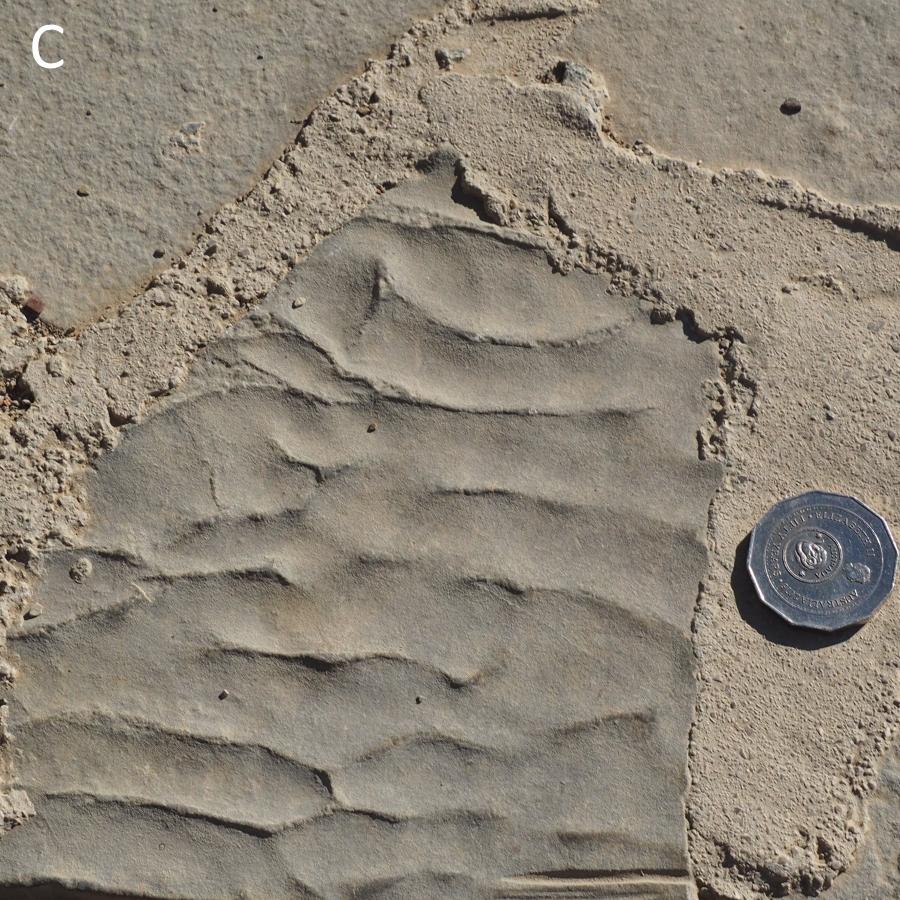
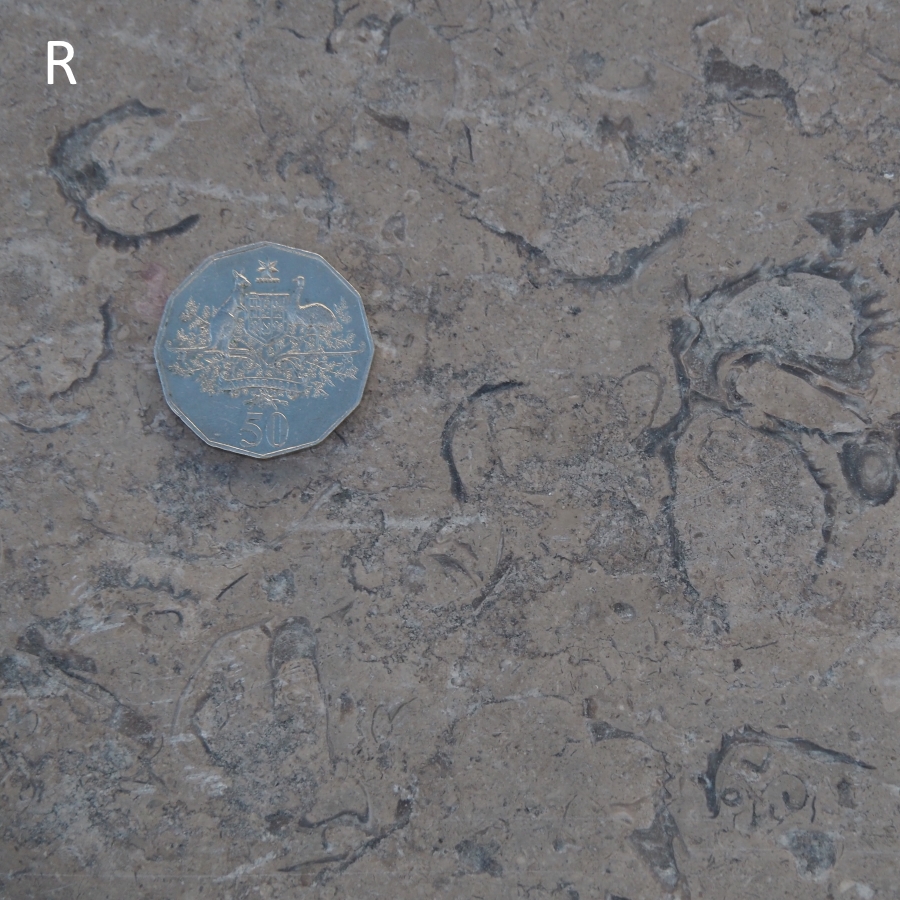
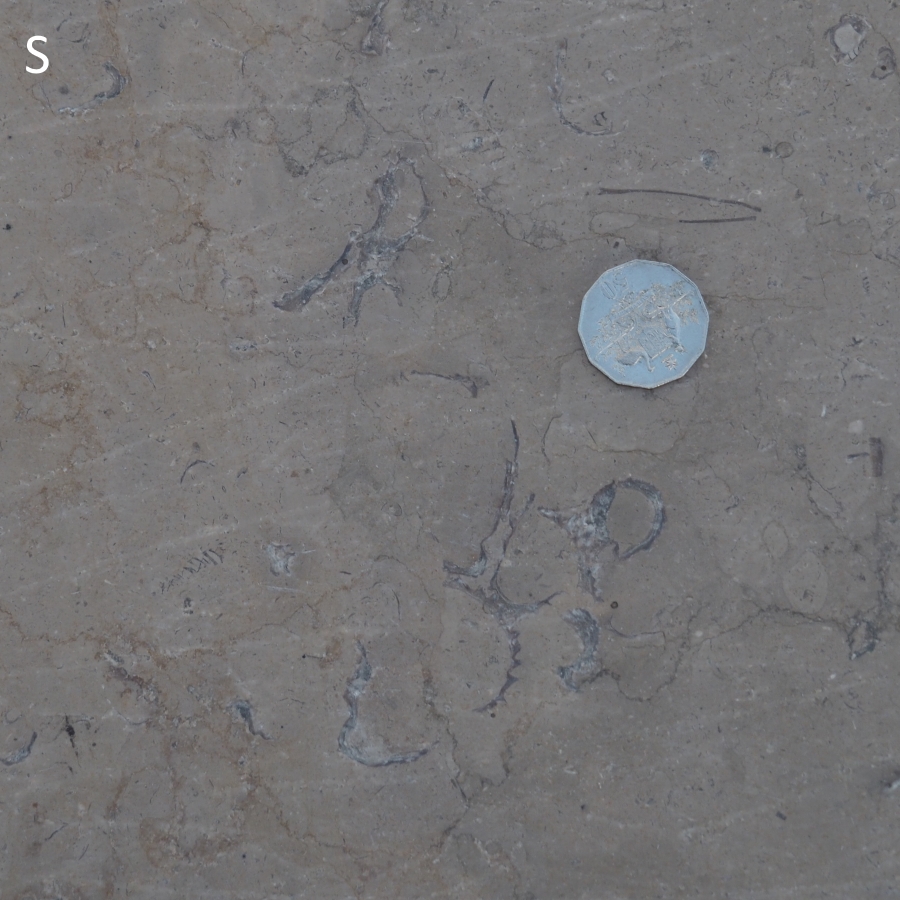
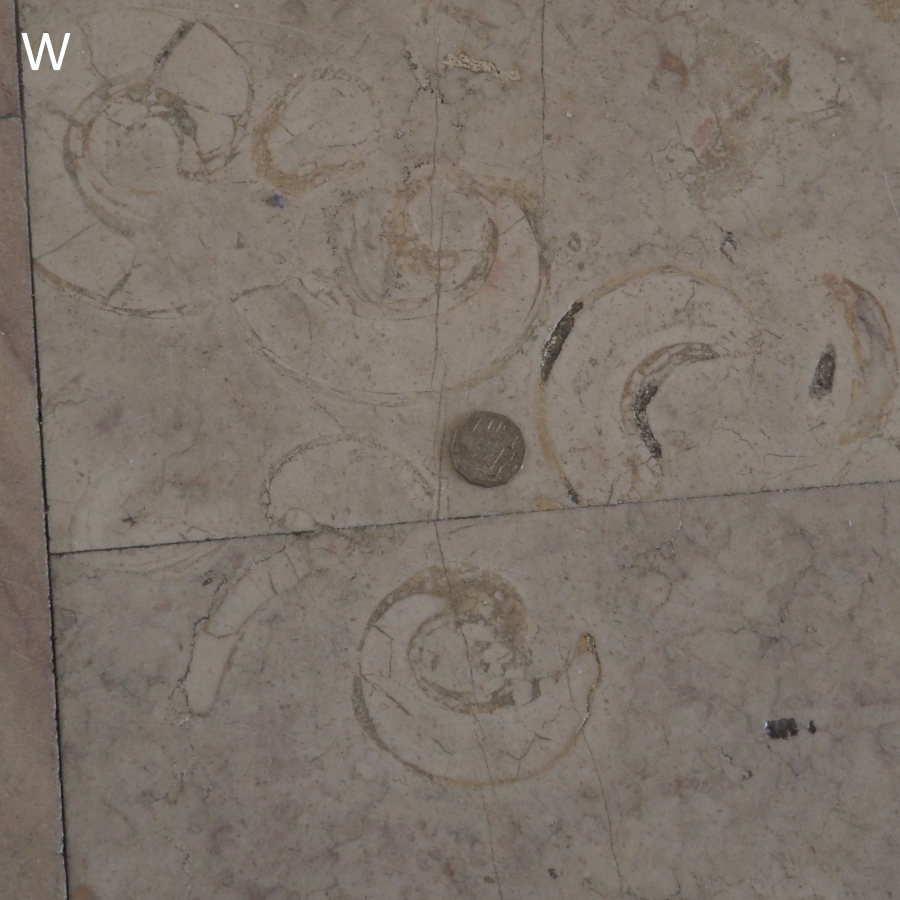
Our recent trip (the main reason for little communication over May-June) was mostly in areas where the streets are paved with fossils. We were mainly over an old coral reef that reaches out from Iberia to Hungary, and the limestone flagging turned up many fossils.

A-D were metamorphosed ripple shale in Chefchaouen, Morocco, E-F were from the Hassan II mosque in Casablanca, G-H were flagging in Ronda (Spain), I-K and M Lisbon, L and N-S were Obidos, T-Y Coimbra. With the exception of the first four, which were cleaved, the rest were cut and somewhat polished slabs.

Anybody, any hints on IDs would be good.

The coin? That's an Australian 50 cents, 38 mm across. Several of our companions saw me picking up coins as I walked around, and expressed surprise at me finding so much money: they had missed seeing me layong the coin down in the first place. I use them as a scale that will still be in circulation when I drop off the twig.


A-D were metamorphosed ripple shale in Chefchaouen, Morocco,


E-F were from the Hassan II mosque in Casablanca


G-H were flagging in Ronda (Spain)


I-K and M Lisbon,


L and N-S Obidos


T-Y Coimbra in Portugal


Monday, 11 February 2019

When push comes to shove


The very first challenge for colonists was moving things (and themselves) around the local area. In the very early days, with only a settlement at Sydney Cove and few animals that could be ridden or used to pull vehicles, transport was by foot or by boat. One of the first needs for Sydney was barracks, and bricks and tiles had to be made for these, and timber had to be cut. Then all of these heavy items needed to be transported.

When the First Fleet arrived in Australia, it was very poorly equipped. One problem they faced was the quality of the tools sent out by the government. Back then, cheap tools were made for bartering in the “African trade”, and that was the quality of tool sent to Australia. Governor Phillip was savage when he made this point in a despatch to Evan Nepean’ the Home Secretary, written on 28 September 1788 after eight months’ experience of the shoddy tools.

The tools and articles in the inclosed lists will be much wanted by the time they can be sent out, and I cannot help repeating that most of the tools were as bad as ever were sent out for barter on the coast of Guinea.
Historical Records of Australia, 1(1) 86.

The First Fleet had sailed in 1787 with enough food for two years, if everything went well, and things might have gone well. They had seeds of many crops, and they also had a good supply of animals, but these were mainly brought for breeding, and many others were, in any case, animals to eat. Any making and building meant things had to be moved, but where were the horses and bullocks to do the hauling? With just seven horses and seven cattle in the colony, the hauling would at first have to be done by humans, and the mills would need to be turned by wind power or water power.

To convey these materials from the brickfield to the barrack-ground, a distance of about three-quarters of a mile, three brick-carts were employed, each drawn by twelve men, under the direction of one overseer. Seven hundred tiles, or three hundred and fifty bricks, were brought by each cart, and every cart in the day brought either five loads of bricks, or four of tiles. To bring in the timber necessary for these and other buildings, four timber-carriages were employed, each being drawn by twenty-four men.
— David Collins, An Account of the English Colony in New South Wales, volume 1, 331.

All too often, we can only spot what was happening by inference from incidental comments. For example, when a convict fisherman named William Bryant was caught selling part of his catch, he had to be punished, but not by being sent to haul a cart:

For this offence he was severely punished, and removed from the hut in which he had been placed; yet as, notwithstanding his villainy, he was too useful a person to part with and send to a brick cart, he was still retained to fish for the settlement; but a very vigilant eye was kept over him, and such steps taken as appeared likely to prevent him from repeating his offence, if the sense of shame and fear of punishment were not of themselves sufficient to deter him.
— David Collins, An Account of the English Colony in New South Wales, volume 1, 1798, 44 – 5.

In May 1793, as the weather got colder and the days shorter, the working hours for labourers were changed:

… the lieutenant-governor directed that the convicts employed in cultivation, those employed under the master bricklayer, and those who worked at the brick carts and timber carriages, should labour from seven in the morning until ten, rest from that time until three in the afternoon, and continue at their work till sunset.
— David Collins, An Account of the English Colony in New South Wales, volume 1, 1798, 239.

Then there came the mills that were driven by humans. David Collins wrote this in 1794:

Wilkinson’s grinding machine was set in motion this month. It was a walking mill, upon a larger construction than that at Parramatta. The diameter of the wheel in which the men walked was twenty-two feet, and it required six people to work it. Those who had been in both mills (this and Buffin’s, which was worked by capstan-bars and nine men) gave the preference to the latter; and in a few days it was found to merit it; for, from the variety and number of the wheels in Wilkinson’s machinery, something was constantly wrong about it. Finding, after a fair trial, that it was imperfect, it was taken to pieces; and Buffin was employed to replace it by another mill upon the same principle as that which he had himself constructed; and Wilkinson returned to Parramatta.
— David Collins, An Account of the English Colony in New South Wales, volume 1, 1798, 305.

In time, though, bullocks became a major source of power, and I may get around to them, one day. 

A bullock cart on Brickfield Hill (near the present Town Hall), August 1896,
from David Collins, An Account of the English Colony in New South Wales.
In the 1820s, a treadmill was installed in Sydney, so that recalcitrant convicts might not only be punished, but return a dividend:

A tread-mill, the first of the kind in the Colony, we are informed, has been set going this week m the Carters’ Barracks. There can be no doubt but that this instrument will prove as salutary in this Country, in the repression of crime, as it has been found efficacious in the Mother Country.
The Sydney Gazette and New South Wales Advertiser, 21 August 1823, 2, http://trove.nla.gov.au/ndp/del/article/2182128

There was, it seems from an 1824 report, a graduated series of punishments, starting with the Sydney gaol gang (with or without irons: in the picture above, only one gang member is ‘ironed’), then the gang at Emu Plains, which in 1824 would have been the site where roadbuilding was going on, but there were worse fates:

Should this renovating station, however, prove inadequate to the end contemplated, which in some instances, after every care, will be the case, perhaps a visit to the tread-mill may not be considered quite inexpedient. In the event of all those experiments failing, Port Macquarie then becomes the most desirable spot for correction and reflection on this side of Bass’s Straits…

It is fit that men should smart for the abuse of that Royal mercy, which is so repeatedly despised. When Macquarie Harbour fails in deterring obdurate offenders from the commission of vice, then it is high time that the place of execution should sweep them away from the face of that earth, which groans under the weight of the many years’ atrocity that supplicates Heaven’s justice!
The Sydney Gazette and New South Wales Advertiser, 10 June 1824, 2, http://trove.nla.gov.au/ndp/del/article/2182973

Sometimes, though, humans were willing to take on a load: if there was a promise of gold at the end. Here, in 1851, Rudstone Read describes the scene as people “rushed” over the Blue Mountains:

The whole line of road to the diggings presented an animated appearance: drays, carts, cars, equestrians, pedestrians, and last, though not least to catch the eye, was an old man wheeling his all up in a barrow, his son harnessed in front, and his wife bringing up the rear, with a child on her back, who generally got a cheer from passers-by, or a question, as to how much she’d take for her “swag.” At every public house or coffee-shop on the road, all sorts of people were to be seen, and, excepting Esquimaux or Patagonians, every nation on earth might here be found represented.
— C. Rudstone Read, What I Heard, Saw, and Did at the Australian Gold Fields, 1853, 5 – 7.

Read added as a footnote that this party returned to Sydney at Christmas with £1000.

Then there were those who used human power to drive bicycles, which I dealt with recently.

Saturday, 26 January 2019

How to tell when an elephant is joking


Elephants walk at a sedate 7 km/hr or 4.5 mph, and they can keep that up for a considerable time. They have large territories, and need to keep moving, so as not to eat one area out, but when it comes to fighting their main enemy, humans, they accelerate to a higher pace.
Asian elephants know they are safer.

African elephants will sometimes engage in what is called a mock charge, but at other times, they are deadly serious. In either case, the elephant will approach, people say, at some 50 km/hr (30 mph), and reversing at this speed can be risky, so safari drivers need to know the difference when 6 tons of elephants is heading your way.

In a mock charge, the elephant’s ears are standing out wide from the head and the trunk is curled. In a serious charge, the elephant has his ears back and trunk down, but there is more to the charge than that.

They even stop by to look at the cameras.
Researchers have discovered that elephants hear through their feet, sending out rumbles at 20 Hz, so low that humans can hardly hear them.

Sound travels through soils at around 3300 metres a second, or 10,000 feet a second (that’s around 6800 mph, close to 12,000 kph), almost ten times as fast as in air, and the low sound travels amazing distances: as much as 10 kilometres or six miles.

In nature, female elephants use the mock charge to chase off lions or hyenas, and the effect of moving the ears away from the head is to make her look even larger than she is. It is possible that the sounds emitted and transmitted across the African plains also vary, but that only other elephants can tell the difference.

And given that the speed of the elephant sounds through the ground exceed the escape velocity of our planet, it is just as well that elephants cannot charge as fast as their sounds can travel through the soil!

There is just one problem with the safari-driver claims, and that is the speed attributed to the elephant: John Hutchinson and his colleagues studied and videotaped large numbers of elephants, and found the highest speed observed was more like 25 km/hr or 15 mph.

And interestingly, the elephants don’t run, even at top speed, not according to Olympic standards. The official definition of a walk is that at least one foot must be on the ground at any one time, and while elephants have been snapped with three feet off the ground, they have never been caught lifting all four at once.