Search This Blog

Saturday, 17 March 2012

Of gums, gold and a good-time girl


Gold and gums
One of my favourite analogies for the internet is the Penny Post.  It's an idea that I acquired from reading either James Burke or Jacob Bronowski.  Essentially, whoever it was said that the Penny Post made it possible for people to unite, to organise, to fight the Corn Laws in Britain.  In a similar way, the internet lets us spread ideas further and faster.  This can be good or bad, depending on how you trust your sources—and how wise you are to trust them.
Rome-Frascati rail line:
unidentified Eucalyptus species.

Argostoli, island of Kefalonia,
Greece: Eucalyptus camaldulensis
or river red gum.
The other analogy that I like is Marin Mersenne, a science gossip who spread ideas and information everywhere—though in his 90th year, Alexander von Humboldt was answering 2500 of the letters he received each year, and you only need to look at the Darwin Correspondence Project to see how they did things in the 19th century.

Ferdinand von Mueller, bust
outside the National Herbariun,
Melbourne, Victoria, Australia
We superior moderns curl our lips at the ignorance of the past, when people thought bad smells caused disease—but that was an OK theory for its day.  We might even snigger when we see Eucalyptus trees like the ones on the left, planted in Rome's Pontine marshes in the 19th century or the lagoons of Kefallonia, if we know that the idea was that their sweet smell would prevent malaria.
River red gum, Baths of Aphrodite,
western Cyprus.

I have just recently discovered that one of the main supporters of the spread of gum trees was Herr Doktor Doktor Baron Sir Ferdinand von Mueller, K.C.M.G., with more foreign decorations than you could shake a stick at, a German-born Australian botanist, but more of him some other time.  My photo was snapped from a train between Frascati and Rome, in July 2010 (but note well: these were NOT the Pontine Marshes).

Von Mueller, by the way, is one of the curious minds that I have written about in my other up-and-coming book, Curious Minds, which is due out on October 1.

River red gums in their native home. This is the Campaspe River, just before it flows into the Murray, and you can see here that
E. camaldulensis really doesn't mind getting its feet wet. Sooner or later, the trees fall into the river, causing snags that provide a
shelter for the fingerlings that become the mighty Murray cod, bit also causing problems, back in the days of paddlewheel river 
boats,  an item that will become a plot feature when I get around to writing the Cornish Boy series. No research is ever wasted!
And now I'm back to the methods used to locate gold under glacial till in Canada, because a few years back, the CSIRO estimated that there's probably twice as much gold under the Murray valley and plain as was ever dug up in the 1800s.  It's under a lot of overburden (just as it is in Canada), but with the present price of gold, it would be nice to locate some of it.

The Canadians hover around in helicopters, snipping bits off deep-rooted conifers.  They locate each specimen accurately, assay them for gold traces, and where the trees show a local concentration of gold, they can send down a bore to sample the rocks below.

Now I wonder how deep the roots of Eucalyptus camaldulensis grow?

Afterthought (just the stuff in red): this was lurking in my notes for the gold book, but only emerged a week or two after I posted this: the writer is Richard Burton, the African explorer and Arabist, not the Welsh actor, and he was writing of Freetown in Africa.
In this section of the nineteenth century it is the custom to admit that the climate is bad and dangerous; but that it has often been made the scape-goat of European recklessness and that much of the sickness and death might be avoided. The improvement is attributed to the use of quinine, unknown to the early settlers, and much is expected from sanatoria and from planting the blue gum (Eucalyptus globulus), which failed, owing to the carelessness and ignorance of the planters.
Richard F. Burton, To The Gold Coast for Gold (1883), Vol. I, chapter XI.

Now here is that same species, E. globulus, Tasmanian bluegum, above the town of Muros near Cape Finisterre, north-west Spain.  It is grown for its timber, not for any anti-malarial properties.

Now back to the main story!

The good time girl
I have been flat out on a difficult technical editing task this week, and there hasn’t been much time for blogging, but there is light at the end of the tunnel.

In my spare (ha!) time, I have been teasing out the story of Lola Montez, because I wondered how well she was known before she came to Australia during the gold rush.  I thought there might be a story there.  I was right.  The answer was there in the National Library's historic newspapers collection.   You can enter search strings there like "Lola Montez" (in quotes, like that) to see her appear.

Lola springs into view in print in 1847, and my search shows 1287 entries (that number will increase, over time).  She was the mistress of the King of Bavaria, and by 1848, as Europe was revolting, he abdicated in her company, but two weeks later, she was in Berne, under the protection of the British Charge d'Affaires, one Robert Peel, the son of Sir Robert Peel.

She was then in her thirties, they say, and probably realised that her clock was running.  There had been a husband, whom she had left in India, and he divorced her for adultery with a Mr. Lennox, but it was one of those tricky divorces which forbade either party to remarry.

I don't think this was the image
being sold to the bourgeoisie in
a maple and gold frame in 1848.
Lola didn't recall that part at all.  By November 1849, she was in court in London, charged with bigamously marrying a young lieutenant,  some eleven years her junior, and with some £6000 or £7000 a year.  She posted £1000 bail and skipped off to the continent.  Later, it appears, the lieutenant was forced to resign his commission and may have made a settlement on her (I still have to look into that), but she was already off on the next adventure.

All of this saga was retailed in the Australian newspapers, and in May 1848, Syney art lovers had the chance to acquire at auction in Sydney, engravings of Pope Pius IX, Jenny Lind, Jephtha's daughter, or Lola Montez, in a maple and gold frame.  (By the way, some of these links are to whole pages.  If you use control-F for Find and enter the name Lola, you will find her.)

And so it goes.  She did a tour of the Californian goldfields then hit Sydney and Melbourne.  Oh yes, I forgot the horse-whips: newspapers tended to say things about her, and as a consequence, editors tended to get horse-whipped by her—well, at least one Ballarat editor suffered that date!

As I hope to write about here, I guess I'm glad she's not around any more, though I think I may be less derogatory than that editor. After all, she was just giving her public what they wanted, a dream of a good time.  A bit like writers, I suppose.

I can definitely see why struck-it-rich and deprived-of-female-company males on the goldfields might find her interesting.  But the more I burrow into the 19th century, the less I get the feeling that these were times when self-styled "naice people" didn't mention sex and stuff.  They hinted at it, they nudged and sniggered, but things were left unsaid.

It's always been my ambition to have a book banned somewhere.  I think that this time I may be on a winner. Sadly, I think that Lola may not make the cut, as I have already as many words as I want, and half the story remains untold.

It's a big yarn.

Wednesday, 14 March 2012

Criteria for selection


Not a lot of science in this: it's more of a note to file, relating to my current interest in gold rushes and how they were managed.

Charles La Trobe, prize idiot and bungler.
This is Wikipedia's public domain image of him. 
http://en.wikipedia.org/wiki/File:Charleslatrobe.jpg 
Sitting on my back-burner is a series of Young Adult historical fiction with a scientific bias, set in Australia in the period 1852 to 1867.

I am working hard at getting a sense for the era across, within a series of adventures. That means showing how ordinary Australians fared and thought.  A lot of what the Australian-born Australians were thinking by 1870 is surprisingly modern.

Along with most decent Australians than and Australians today who know their Australian history, I have a deep contempt for the 'boy commissioners'.

These were the 19th century whey-faced poltroons and loons, the discards of the British aristocracy, adjudged incompetent by their peers, pun intended, who, from having been "born to rule", were judged well-suited for the colonies, like Hilaire Belloc's Lord Lundy, who was dressed down by his grandsire, the Duke, thusly:
Sir! you have disappointed us!
We had intended you to be
The next Prime Minister but three:
The stocks were sold; the Press was squared:
The Middle Class was quite prepared.
But as it is! . . . My language fails!
Go out and govern New South Wales!
Well, La Trobe got Victoria instead.  Far be it from me to draw any parallels with members of the Royal Family named Charles or William who think it might be fun to trot out and become Governor-General of Australia, using Australia as crash-test dummies while they learn how to be a figurehead, but that was how Australia was seen!

Gold escort by S. T. Gill, National Library of Australia,
nla.pic-an7537569-v.jpg
I think I may have acquired this attitude to British upper-class twits from Monty Python, though in relation to Australia, it owes more to reading Manning Clark. So imagine my surprise, recently, to find Clark praising one of these normally chinless, witless, gormless types when, at the age of 21, this youngster told Governor Latrobe how to sort the problems being encountered on the gold fields at Bendigo.

I wondered how he got so high so early, and turned to the Australian Dictionary of Biography to learn more of this clever young man. His name was Joseph Anderson Panton. I found him at http://adbonline.anu.edu.au/biogs/A050451b.htm and made the most amazing discovery: the way in which he was selected for his post.  Note well: here we are going on Panton's own personal recollection and account.

Panton stood "A good deal over six feet", and apparently was solid as well. When he applied for a post as an officer on the Gold Escort, La Trobe examined him. Remember that La Trobe was, by all accounts, a total buffoon, the sort of twit that is normally only seen in comic operas or in certain royal families. In 19th century Britain, it seemed like a Good Thing to make Charles La Trobe the Lieutenant-Governor of Victoria: now we let Panton take up the tale.
The Lieutenant-Governor looked me up and down, and then remarked jocularly "This fellow seems too big for a trooper. Too heavy. It would be too severe on the horses. I think he would make a Commissioner".
How lucky we were to have a good fellow get the job for once, but is this the reverse of the Tall Poppy syndrome?


Tuesday, 13 March 2012

Mr Belloc has been done a disservice


In my last post (which was actually drafted some time ago), I gave the common attribution for a versicle about Streptococcus to Dr Wallace Wilson.  Just after that, I saw something in the British Columbia Medical Journal which prompted me to write to the author, Kashmira Suraliwalla, seeking clarification, because the attribution has never been tracked down.

To save you digging back, it goes:
He prayeth best who loveth best
All things great and small.
The Streptococcus is the test
I love him least of all.
The first two lines, of course, come from Coleridge's Rime of the Ancient Mariner, but the last two lines express the sense of despair that a strep infection caused, back in the days before antibiotics.  It's a despair that will return to haunt us if people keep on misusing antibiotics, and a despair I almost shared a few years back when a routine biopsy gave me bacteremia (or if you're old-fashioned, septicaemia).

In the end, antibiotics saw it off, but it was a near-run thing.  Anyhow, the parody is commonly attributed to Wallace Wilson, who supposedly wrote it in a letter to Dr E. P. Scarlett.

Interestingly, in terms of what has transpired, my searches several years ago, brought to a nasty end by the crash of a hard disc, had pointed to Hilaire Belloc as a possible source.  Now people like me, who hunt down references, learn to distrust certain attributions, in particular, those to Mark Twain and Winston Churchill, and one or two American television comedians of recent vintage, while Belloc also gets his share.

For some reason, popular memory gives these people all sorts of lines.  The result: I had ignored the Belloc line of enquiry.  Silly me!

Dr Suralliwalla passed my email on to Scott Anderson, described as the Library Bookkeeper/Executive Assistant in the College Library of the College of Physicians & Surgeons of British Columbia.  Like me, Scott Anderson is interested in searching out such truths, and he did me proud, as I discovered when I opened my email the next morning.

First, he deduced (correctly) that I own a copy of Alan Lindsay Mackay's Harvest of a Quiet Eye, (look at the intro to my Australian language database and you will see a nod to Mackay there). Mackay's book is a selection of delightful quotes about science, and this, it seems, is the source of the error. He went on: "While I have not located the letter from Dr. Wilson to Dr. Scarlett, I have attached two files that I hope you will agree supports my conclusion."  I do indeed agree!

Item 1 was from the Historical Bulletin (Calgary), 1956, 21(2):64, where Dr Scarlett credited the lines to "the robustious Hilaire Belloc", but at the same time, mentions that it was passed on to him by "Dr, Wallace Wilson of Vancouver who has a fine appreciation of such things".

The second exhibit was an excerpt from an essay in Hilaire Belloc's "Short talks with the dead and others."  This was first published in 1926, though the copy comes from a 1967 reprint. Says Scott Anderson:

The essay discusses a game with the object of "taking famous lines out of the poets, and seeing whether he can improve them by some slight change." The verse in question is used as the final example, and can be inferred to have been a Belloc original.

Finally, he offered me the URL of a 1969 article in Life magazine, which also attributes the verse to Belloc.

Game, set and match to Belloc, I think.  Aside from doing justice to Belloc, a fine man whose Cautionary Tales warped me as a child, and who was a good friend of G. K. Chesterton, there is another notable feature, and again, I shall quote Scott Anderson:

"Thank you for your question, I hope this explanation is satisfactory. While I had previously heard the verse I didn't know its origin, and enjoyed searching it out. A large debt of gratitude goes to Karyn Fritz of the BC Medical Association for finding both the specific book the verse appeared in (Hilaire Belloc has an extensive bibliography), and the Life Magazine article. Her assistance definitely reduced the time required to find the supporting evidence, for which I am most grateful!"

What a wonderful world we live in, where people will take the time to solve such a simple if curious matter for somebody on another continent.  Thanks Kashmira, thanks Scott, thanks Karyn!

Sunday, 11 March 2012

Mozart is dead, either way


He prayeth best who loveth best
All things both great and small.
The Streptococcus is the test –
I love it least of all.
The provenance of this versicle is hard to trace, but it appears to have been the work of a Canadian physician, Wallace Wilson, and it was supposedly written in a letter to Dr. E.P. Scarlett, somewhere around 1920s.

Some years ago, I was zeroing in on it when I suffered a catastrophic hard disc crash, and I never got back to the search. Tomorrow, I must do so. No, I really will, because this matters.

I was reminded of it when I read one of those articles which make me regret that I never studied medicine. Medical gentlemen (they all seem to be male) of a certain age, spend inordinate amounts of delicious time, teasing out the real reason why X or Y died, and how they died. Alexander the Great, Claudius (emperor) and do on.  Nobody ever cares why Oddsocks the Bootboy died, but that's life (Or do I mean death?)

Anyhow, some time ago, an email brought me an article, Small “epidemic” may have killed Mozart. This outlines a plausible likely cause of Mozart's death.

Forget Salieri and poison, forget all of the conspiracy theories: it seems that what took him off was a streptococcal infection. I won't steal their thunder: go there and read the article, to see how the authors, Richard Zeger of the Academic Medical Center in Amsterdam and his colleagues, nailed it with a fair degree of certainty.

Mozart died at 35: just think what else he might have written, given even five more years!

I definitely loveth the Streptococcus least of all.

Friday, 9 March 2012

How to beat the recession #93: salting a mine.


OK, I lied.  The other 92 mthods aren't there, but in my current digging, I came across this yarn while wading through historic newspapers at The National Library's Trove historic newspapers archive.

It comes from The South Australian Advertiser, Tuesday 26 March 1889, 6, and you can read it for yourself at http://trove.nla.gov.au/ndp/del/article/30786762

Think about it: our incomes are plummeting as the GFC cooks our geese that were supposed to lay golden eggs, turning them into something less palatable than KFC *.  Meanwhile, the price of gold is sky-rocketing, and that means there has to be an opportunity for we older and wiser types.

Oddly enough, there was great mineral wealth at Leigh Creek, but it came in the form
of coal. I was out there last year, looking mainly at historical things, and there is a huge
open-cut coal mine there. If the geologists had known that then I guess they would have
been amused, as gold and coal don't usually both occur in the same place. I wonder
(a) if that is always so and (b) if they knew that in 1889?
Digging for gold is hard yakka.  It would be more fun catching and skinning a couple of money market wide boys, some of the undeserving rich, with a get-rich-quick (for us) scheme.  The temptation is there for me, but I now see that one needs to get up early to get past the experts who will be hired by the marks to keep their ill-gotten loot safe.

So I will take the moral high ground.  Children, this is no suggestion that you go out and commit an act of swindling.  Instead, it is an admonitory tale of how some not-very-bright evil-doers were caught by a bit of basic science.  If you choose to use the story to improve your own technique, it has not and will not occur to me that you might use it that way—though I rather think the 'Tiser may have been thinking just that, when you look at their 123-year-old headline.

Enough from me: here's the story

A GOLD SWINDLE: HOW MINES ARE SALTED.
The annexed documents will explain themselves. Certain gold specimens were forwarded to the Commissioner of Crown Lands by the Great Northern Gold Mining Syndicate with the request that be would allow the Government Mining Inspector to visit the property and report upon it. The result was a communication as follows:—
"Crown Lands Office, 25th March. Sir, On the 14th inst. an application was received from the Great Northern Gold Prospecting Syndicate for the Inspector of Mines to be allowed to inspect and report on the syndicate's claims at Leigh Creek. Accompanying the application were six specimens, in which gold was easily discernible. I at once examined the specimens with a powerful glass, and detected that where the gold was to be seen the quartz presented a glazed appearance, as if glue had been applied. I then took the stones to the Government assayer, and pointed out the peculiarity. He confirmed my opinion, and applied a needle, which penetrated sufficiently into the glutinous substance to stand upright, and when withdrawn left a very perceptible puncture. It was not until this morning that I had an opportunity of showing the stones to the Government Geologist, the Inspector of Mines, and the Government Assayer, and their certificate is attached
—I have &C.,
G. S. Wright, secretary to the Commissioner of Crown Lands."

"Crown Lands Office, March 26.—Sir—We the undersigned certify that on a careful examination of the samples of stone forwarded with the letter of the 14th instant on behalf of the Great Northern Mining Syndicate the appearance of a glutinous substance was at once detected on two of the samples where the gold was thickest, and on boiling the smallest sample with water for a minute all the gold came off the stone. The glutinous substance having dissolved proved incontestably that the sample had been artificially produced. The gold dissolved out of the sample is in our opinion alluvial. A coarse speck of gold in one of the other stones is also in our opinion alluvial, and has been placed there artificially.
 —Signed, H. Y. L. Brown (Government Geologist),
D. D. Rosewarne (Inspector of Mines),
G. Goyder, jun, (Government Assayer)." 
Another sample has been preserved by the Crown Lands department, and can if necessary be dealt with in the same way.  

In my past, working as a fraud investigator, I knew enough to think like a criminal, to plot how I would pull the fraud, if I were in their shoes.  This gave me pointers to where the evidence would show up, and that worked.  If the frauds I was after had thought through how an investigator might look at the data, they might have hidden their tracks better.

So if you insist on being naughty, plan ahead!

Who says science training is of no use?

* * * * * * * * * * * * * * * * * * * * * * * * * * * * * * * * * *
* The KFC shot was, admittedly a bit cheap and slightly misleading.  I quite enjoy KFC in moderation, and my defence must be that many things are less palatable than their chooks, including most of what their rivals push at us.  No unkindness to Colonel Sanders was intended.

Tuesday, 6 March 2012

Simulating a fossil. part 5 and final

 OK, all good things come to an end.  I have been outside finishing off the exercise and photographing it.

But before I start explaining the finish, there is one thing you need to do when the cement has set for two days.


At that time, it is still soft and crumbly (which is good) and it is inclined to break (which is bad).


So be careful, or leave this step out. I decided to use my "fossils" as paperweights, so I wanted a base that was rough, so I could glue felt, but even, so it would sit flat.


That meant grinding the base on a masonry block that I happened to have handy. A brick would be just as good, but it makes a mess if you use a wall or a path.  Young readers in particular, BE CAREFUL!!


Just work the blocks, one at a time, in a circular pattern, and you will get the sort of surface you want.


Then it is time to set the blocks aside and be patient.


I actually wrapped mine up in the newspaper you can see in the fourth shot, and damped it down.

Cement that is kept damp sets much harder, I was always told.


Jumping ahead, this is what we get to by the end of this blog entry, but there are a few tricks that you need to apply along the way.

It occurred to me, as I was working, that I needed a shot of the set-up and tools.

First, plaster is going to fly off in all directions and make a mess, so I work in a tub.

Second, the cement is fragile, so I need padding under it, in the form of newspaper.

Third, while I am hammering probes and chisels into the plaster, this has to be done very gently: you tap, rather than bash.

Also, it's a good idea to take small bits, not large ones, and never drill into it, because like a real fossil hunter, you don't know exactly what is in the matrix.

A moral tale here: I am an enthusiastic amateur, but I sometimes help the pros, when they need extra warm bodies, so I know what to do.  In 1986, I was involved when an area in a quarry at Somersby, north of Sydney, was held for a limited time for diggers to extract as much as they could.

I set up a promising-looking area, cleaned away the detritus and put my tools down to have lunch.  Bad mistake, almost a disastrous mistake, because an idiot gardening writer from Canberra came wandering along, saw what others were doing, and started bashing into my carefully-prepared site, flipped a slab over, and went to smash on down though the rock.  Luckily, a pro saw the underside of the slab as it flipped and stopped her.

When you work in shale, the fossils occur between strata, and while you lose the top half as you clear a layer, the lower half can be preserved and taken out whole.  That's the deal when time is limited.  Anyhow, this moron was about to carve through the lower half, but she was stopped, just in time.  It was the rarest find of the whole dig, and I heard from others that she was still dining out, years later on her brilliant find!  Grrrr!!!  Be gentle, go slowly!

Volunteers cleaned this Devonian fish slab from Canowindra, using toothbrushes
and wheat-bag needles (those are like sailmakers' needles, but even bigger.)
These are the principles that I am applying in this simulation.
Here, we are simulating the situation you have, for example, when you are extracting corals from limestone, or fish from a slab. The simulation is easier than the real thing, and you can do in an hour or two what would take a week in real time, but the methods are the same.

There are really just two rules: 

* be gentle and slow; and

* always work towards the outside.

The main tool that I use here is a carefully-blunted 6" nail (150 mm nail if you like, but it came from a jar of nails bought in the 1970s, so I bought it as a six-inch nail).

The other tool I use is an old dissecting probe: you can see it in the equipment shot above and in the next picture.

By the way, special safety rule: think about where the probe will go if it slips.

Be careful!

Now the next stage is to get rid of the plaster, and for that, I used a scrubbing brush. Normally, I save old tooth brushes for jobs like this but some Tidy Person in this house seems to have deep-sixed them (either that, or I have used my entire stock!)


And now you can see how I simulated some fossil shells. All that is left is for me to let them dry, glue some felt on the base, trim the felt—and maybe add a coat of clear lacquer.  I will experiment with one of the broken ones.

If I were doing this in a class, I would now ask my audience to research fossilisation, and prepare a list of the ways in which this is a reliable simulation, and in what ways it is unreliable. I would never do that here, but feel free to comment!

This is the last of a series of five pieces. If you landed here, I suggest that you go back to part 1, read that, and follow the links through to each of the other parts.

As for me, it's about time I got some work done.  Catch you in a week or so.

Monday, 5 March 2012

Save the Libraries and the Books!


I just stepped away from the fossils for a moment, because I came across this draft.

I am an old educator (well that will come as a complete surprise to nobody).  I also write books, and I haunt libraries.  Add to that my long history with computers, which began in 1963 when punched paper tape was a modern form of input.  The tape had five channels, punched in Baudot code (Baudot also gave his name to the kilobaud).

I am also a former bureaucrat and as a management consultant, spent some time doing fraud investigation, so I have a short patience span when it comes to would-be pole climbers who seek to wreck the status quo, so that they can later point proudly to the carnage and say "I created that."

All of these elements have come together in a thoughtful piece that I delivered recently on ABC Radio National, called A Question of Collaboration.  (That link will take you to a transcript and, for an unspecified time, the podcast.)

Basically, I have had it up to the gills with idiots who say "we don't need books/libraries any more because we can get everything from the internet.  These people are illiterate morons who don't understand the internet, don't know what books are, but through a quirk of fate (or dirty tricks) have managed to gain a small amount of power.

I think they were the people Isaac Asimov had in mind when he wrote:
“Anti-intellectualism has been a constant thread winding its way through our political and cultural life, nurtured by the false notion that democracy means that 'my ignorance is just as good as your knowledge.'
It's odd, but most of the people who speak kindly of "the wisdom of the elders" are themselves a bit wrinkled and grey, but really, we older folk have had more time to see acts of villainy, to recognise them when we see them, and we are in the position of having no axe to grind when we blow the whistle on the villains.

Well, we have one small axe.  I am passionate about the need to act now on climate change, not because I expect to be here to be harmed by it, but I have grandchildren, and that means that my genes will be here to be harmed by it.  I am sufficiently trained in science to understand the principles, but as a science writer of many years' standing, I have a deep understanding of how science works and how scientists work.

In short, I can see that climate change is real, that the models linking the changes to rising carbon dioxide levels are valid and convincing, but more importantly, I know that the mad conspiracy theories about scientists "just doing it to get research funds" are just that: mad.  I also now have a fair inkling of how these "movements" are in fact a form of Astroturfing, where pretend citizens' groups are set up to wind up the crazies and set them loose.
This was the aftermath of a dust storm that travelled all the way from Lake Eyre to Sydney. The dust was the result of an
El Niño event, probably exacerbated by climate change. Nobody knows for sure, and you can't say climate change caused
any individual extreme event, but we can say for absolute certain that we are getting more extreme events than ever before.
And that makes me mad, because the crazies are putting my grandchildren's future at risk, simply because they think they shouldn't have to tread a little more lightly on the planet.

So how does that relate to books and libraries?  Well, the more we wipe out the bastions of learning, the libraries and the books, the easier we make it for the thugs to take over, chanting as they pour in, 'my ignorance is just as good as your knowledge.'

If you are a grandparent. you owe it to your posterity to take a stand for the future. Take a stand for books, take a stand for knowledge and understanding, take a stand for substance over style.

Take a stand for compassion and wisdom over the hunt for a quick buck.

Simulating a fossil, part 4


Now comes the actual casting of the simulated fossils.

For this, you need cement, water, spatulas and some patience.  You also need newspaper spread out to work on.  Use plenty of paper, so that any spill of wet cement can be absorbed before it soaks through.


The first thing to do is to wash the plaster very thoroughly and then soak it in water for 24 hours, to get rid of any residual acid. This may or may not be necessary, but cement reacts with acid, so I rinse everything, just to play safe.


Then I add some water, not a lot, and start adding dry cement powder. Anybody who has mixed cement will know that this is wrong: you should always add water to cement, but the aim here is to get the cement right down into the crevices. I got some better shots of the second one, so now we will switch to that:

I keep adding cement powder until it is a stiff paste, and I use the spatula to keep pushing the cement down against the plaster.  If the gets TOO stiff, I add some more water.

Banging the tub to bounce the bubbles out.
 Then I pick up the container and bang it a few times on the newspaper that I laid down at the start. This makes the cement more liquid, and bounces out most (or all) of the bubbles in it.

Now all I have to do is leave it aside for a few days.  When I was doing another set of shots for Australian Backyard Naturalist,* the book this was intended to go in, one of the cement slabs broke up under the work I was doing on it—work which will be described in the next blog entry.

That was rather vexing.  I tried slipping a piece of plastic flywire into the next one that I made, and that one didn't break up.

Maybe I was more careful, but this may be worth trying.

Anyhow, after that, you just have to wait a few days, before you can tip out products like those shown in the last picture.

This began with Part 1; (which is the best place to start!)

It continued in Part 2;

And then in Part 3;

It has now been finished in part 5.


*  For those who came in late, the book referred to above is due for release in May.  It is written for ages 10 to 14, and for that reason, we decided to leave out stuff like acids which I was certainly playing with when I was 11, but these days we are a bit more safety conscious!

Sunday, 4 March 2012

Simulating a fossil, part 3


A reminder of what you will need

In this part, I want to describe how to make the mould in which we will form our fossils. Plaster of Paris is calcium sulfate hemihydrate, CaSO4.½H2O.  (Sorry, can't get subscripts and superscripts here.)  When you add water to it, it sets hard, forming calcium sulfate dehydrate, CaSO4.2H2O.  This reaction happens even in an excess of water, which is a key to the process I am going to describe. We are going to use excess water to get a smooth surface.

Incidentally, I have formatted some of these photos as small on the page to conserve space, but if you click on them. You can see a larger version.

First, get all of the stuff ready.  You need two spatulas, one to shovel in the dry powder, the other to stir it gently.  You need a water container, the plaster, some shells, and you must lay down newspaper to catch the plaster, which goes all over the place.  Later, wrap the paper carefully and use a vacuum cleaner to pick up any powder that still spilled.  Never use a damp cloth!!!

Take one plastic container with sloping sides (you need to get the solid final product out later) and add some water, about a centimetre or a third of an inch if you don't use metric.  Less is always best, because you can always add more.

Then add some plaster with the dry spatula, stir it with the designated "wet" spatula, and thump the tub up and down a few times to get the surface level.  Don't worry about the excess water, as you can pour it off when the plaster sets, but watch out, because it will be solid in 20 minutes or less.

Notice the spillage here?
You need to work reasonably fast at this point.  Let the small amount of suspended plaster settle, then push some shells down into the plaster.  It is essential that at least part of each shell remains exposed, so that the acid (see below) can get at the shell and "dissolve" it.

Once you gave the shells in place, set the tub aside.  I suggest doing two or three, because in the later stages, the cement casts can sometimes break, rather annoyingly.


While the plaster sets in 20 minutes, I usually leave it for an hour.


Now I have a disc (or square) of hard plaster which has shells embedded in it, making perfect impressions.  Pour off the water in a safe place (a hole in the garden is good) and give the whole thing a good wash and wipe.


Now we are ready to get rid of the shells.  Note that in chemist-speak, acid does not dissolve calcium carbonate: it reacts with it.  Dissolving something is not really a chemical process, but what we are going to rely on is a chemical process.  We are "dissolving" the shells, not dissolving them.


The reaction releases carbon dioxide gas, it bubbles, it foams, and when the bubbles burst, little droplets of acid fly off.  They won't reach far, but the droplets can mark furniture and hurt pets.  That is why I show the next stage going on in a plastic tub, and I put my tub in a weedy portion of a garden bed as well.

Acid safety
The acid isn't all that dangerous if you are careful.  If you get any on you, use lots of water to rinse off., but wear safety goggles and rubber gloves, just in case.


Notice the foaming action here: there is all sorts of organic gunk left on the shells, and I think this causes the foaming.
In the past, i have sometimes had the acidic foam overflow the small tub, which is why I have the big tub as well.
So read the safety notes!!!!!
So to get rid of the shells, I just added acid, waited an hour, came back, saw that there were still bits of shell left, added a bit more acid, then disposed of the remnant acidic "soup" in a hole in the garden (which I then filled in, and then I washed and scrubbed the plaster, using my hands.

And this is what I ended up with, about three hours (and 10 minutes' work) later.
And that's enough for one day.

This began with Part 1.

It continued in Part 2.

It is continued in part 4, which is now available.

Saturday, 3 March 2012

Simulating a fossil, part 2


If you are viewing this as a single page, sliced by a search engine from the complete blog, the story begins in part 1.

Have you seen those cartoons where a dog steals and buries a dinosaur bone?  The joke would be on the dog in this case, because as a rule, there are few if any atoms of bone in a fossil bone.  What typically happens is that the bone is buried quickly and covered over, then ever so slowly, over many years, the atoms of the bone are replaced by other atoms that soak in.

For example, I have seen a fossilised platypus jaw bone that was an opal.  That means it was made of silica, and bones just don't get made of that.  It was a replacement.

Glendonite (seen here on the right) is an interesting form of calcium carbonate that only forms below 5°C, in a cold ocean.  So when we find forms like this on a rock platform, we know that the rock was laid down in a cold sea, because the hole is where a glendonite crystal was later dissolved away.

In the lower shot, we see a piece of iron oxide that has formed when the crystal dissolved away, and later, iron oxide was carried in and laid down, filling the mould that was left behind.

That clue also explains some odd stones that occur on the same rock platform, which is at Ulladulla, south of Sydney.  There must have been a glacier somewhere nearby, calving icebergs that floated off, melting slowly and dropping big round pebbles that plunged down into the soft mud.  In a sense, those stones are fossils of a sort, and they are still the original atoms, near enough.


The Robin's Hood bay fossils in the third picture (and as seen yesterday) are both moulds and casts where every atom of the original has been faithfully replaced, perhaps many  times over: see if you can work out which are casts and which moulds.

There are some plant fossils, where there is a sort of sooty imprint left behind. These may well be the same atoms that were once in the plant, but most of the solid 3D fossils have been formed in some sort of mould-and-cast way. Mind you, it takes an incredibly long time, and my aim is to make things happen as quickly as possible.

This is the Canowindra fish fossil slab from yesterday. These Devonian fish seem to have died in one of those once-in-a-thousand year droughts—of which there have been some 370,000 more since they died (do the sums!). It seems that no sooner had they foundered and flapped their way into death as the sun took away the last of their water, than the gentle rains came, followed by torrents that washed in sediment that left them buried, ready to be preserved.

These would almost certainly be replacements of some sort, and have none of their original atoms left.  After all, they have had more than a third of a billion years to get to where they are today.

And now, we are ready to start our simulation, wherein we can replace all the atoms much faster. Today, I will provide the shopping list.


This is what you need:

  • some shells to fossilise;
  • some plaster of Paris from the hardware store;
  • a few disposable plastic tubs with tapering sides;
  • a couple of paint scrapers to use as spatulas;
  • hydrochloric acid (sold also as "pool acid" or muriatic acid;
  • safety goggles (not shown but essential);
  • rubber gloves (not shown but advisable);
  • a hammer and a screwdriver;
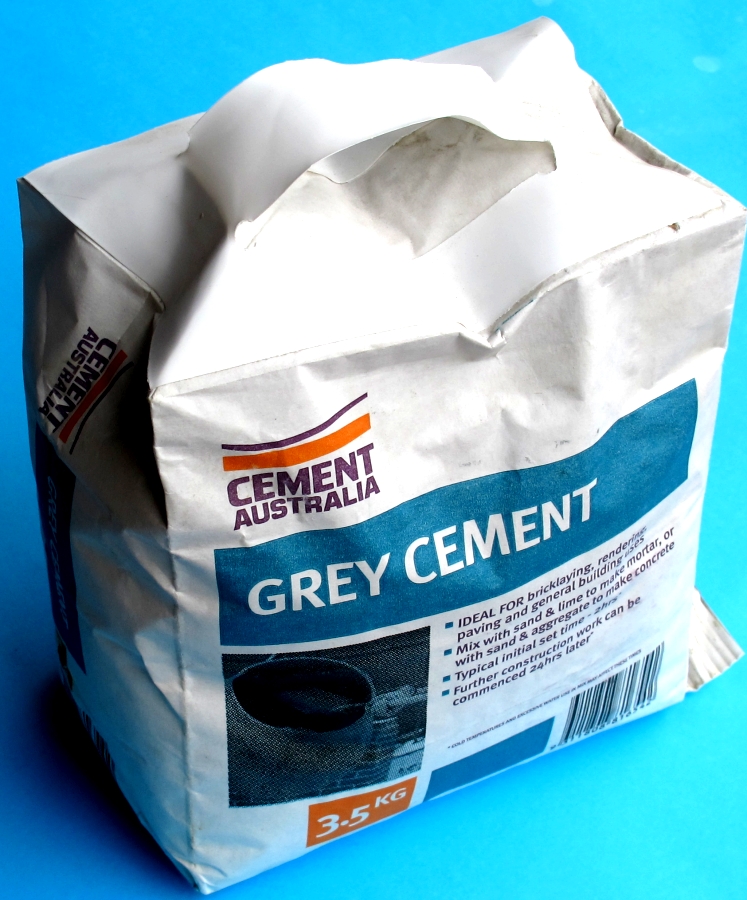
  • and a small bag of grey cement from the hardware store.

In part 3, I will begin the process.

Friday, 2 March 2012

Simulating a fossil, part 1.

Just jumping ahead a bit, this is what the finished product will look like, after
you have followed the instructions. I had to come back and add this later,
 because when I wrote this part, these things were still being made.


I am going to take this in slow stages, in part because I am actually doing this (again), some 20 years after first I developed this method for a holiday activity at the Australian Museum. My aim was to let visitors experience the slow painstaking grind involved in preparing a fossil. The children who tried it quickly lost interest.


Nothing is ever wasted, and this became part of my rather sprawling and now slightly creaky Science Fun web site.

If you want to go straight to it, remembering that it is less detailed, the link to Let's Fake a Fossil is here.

To be fair, the products of that "faking" process aren't a real fake, and that's why I prefer to call the method a simulation.

The first two pictures, the shots above, though, show things that are most definitely fakes, though they start with real fossils. The problem is that the fossils are glued to a thick stone slab. Look for the thick layer of epoxy glue that attaches them to the slab (if they don't fall off).

The shots above were taken in Morocco, where fossil faking is a fine art, and where you have to keep your eyes out all the time.

 Trilobites are the most common fakes, and you will almost certainly end up with a resin cast unless you keep your wits about you. I recommend buying a cheap ammonite (easy to get, and not worth trying to fake).  Then spend some time, tapping it with a finger nail until you know the feel and sound.

Stone goes 'ching!"  Resin makes a dull thud, by comparison. so when you try tapping on a moulded resin "fossil", the feel and sound is quite different.

This blog entry, though, is background about real fossils, like the ones on the right.  Before I explain these, though, an anecdote: I used to work in a museum that was not the sort that had fossils. It had technology, fine arts and other fun stuff, but no fossils or animal bits.

Most museums specialise, but when a member of the public came in with some fossils, seeking an identification, they called me down to the desk as the only likely helper.

I looked at them and commented that he should try the Australian Museum which was the fossil place, adding that the only time I had seen anything like them was on a rock platform near Robin Hood's Bay in Yorkshire, two years earlier.

"Aha!" said the punter brightly.  "That's where I got these!"  The twit had come to the wrong museum, but got lucky, just by chance.

I had identified mine by comparison with public specimens in Cambridge, so I took his phone number, went home, got out the appropriate notebook, and was able to phone him and give him some of the details.  I can't do that for you now, because the notebook is buried in a mass of others, but the fossils in the fourth picture, the one with the ten-cent coin for scale are the real thing.

So are the fossils in the rest of this entry.  I told the story of the last three pictures is a radio talk some years ago, and rather than repeat it here, I refer you to my Devonian Billabong script. You will know when you get to it, because it has larger versions of these three pictures.

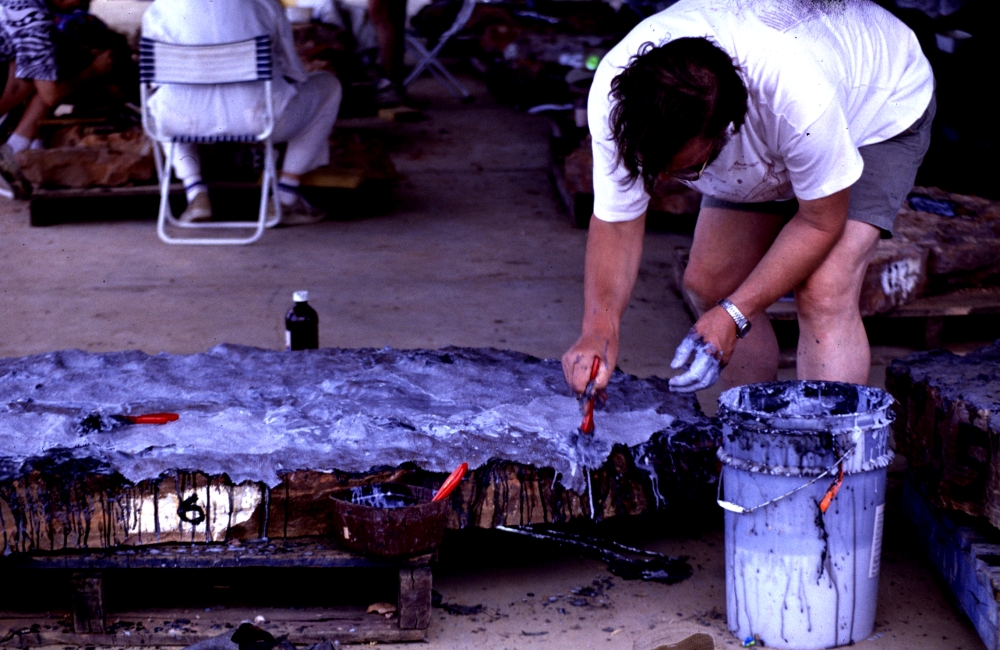
Alex Ritchie painting latex over a slab to make a mould.
We went along as a volunteer family to help clean these up, and that's where I learned one of the the tricks that I will be describing here, cleaning out the matrix that can surround a fossil. In the first picture, the brick wall behind the slab gives you a scale.

The second picture has a 20-cent coin as scale (it is about 28 mm diameter, the 10-cent coin above is about 23 mm diameter).

Lighting is important with things like this: always try for oblique light. I learned that as well.

The last picture shows a key element in professional work with fossils. Alex Ritchie is in the foreground, covering a slab with latex to make a mould, so he can produce casts, multiple copies that can be shared. These are not fakes: they can be shared with other museums, and most of what scientists need to see can be learned from the casts.

And as you will see, the idea of casting came to me, a couple of years later.

Next, I will give you a quick run-down on how fossils are formed, because there is more than one kind of fossil, and I provide you with a shopping list.

Click here for Part 2.  Click here for Part 3.  And here for Part 4,  though it would make more sense to work through in order, getting all the steps!