Search This Blog

Friday, 31 May 2024

The return of The Big Book of Australian History

Well, I finally did it. After four editions of The Big Book of Australian History for the National Library of Australia, and after three years of them shilly-shallying and dithering, I seized control and started on a 
This was the third edition (2017)
magnum opus. From the ~80,000 words in each of the print editions, the new book is just on 250,000 words, with many, many new images from my own files.

Here is a review of the first edition and another of the second edition, both penned by peers at the Children's Book Council of Australia.

Now, being in control, I will be able to tell all of the stories that I felt needed to be told (there's a partial list at the end). The snag is that a dead-tree (print) book of this size, especially as it would be in colour, would be huge, so it is mainly going to be an e-book. To be blunt, printed copies would be somewhere above $100, so I might do it to have copies to give my grandkids, but that was about it. (In mid-2026, after two months banging around Europe, I realise that there will be libraries wanting copies, but I really want the e-book version.

This work (you can get it here) is the title I will wish to be remembered by, because it tells all of the truths that were never shared with we pre-Boomers when we were at school. The governor who owned slaves, kangaroo-tail soup, the observation of Christmas Day in colonial times

Here, I mention people swimming naked (it was the norm for all strata of society until the 1890s, but if somebody saw you, it was indecency). You will also find the first (and probably last) foot race between two ladies in crinolines, and the truth behind Sydney's fabled Flying Pieman, what Lola Montez smoked, and who found gold in Australia first.

Here, you encounter tales of pirates in Melbourne, a cannibal captain, the governor who had his own thief, willing to do his bidding, the time Melbourne's citizens feared they were being invaded, where the very first shot was fired in World War I (Melbourne, again), and why Melbourne ladies stood on chairs and waved handkerchiefs.

I look at how Australians stole Lawrence of Arabia's thunder, Mak Sai-Ying, who arrived on Laurel in February 1818, our first Chinese Australian (he was later a publican), a plan to lure freed slaves from the US to Australia as migrants and a one-legged surf lifesaver.

Having worked in bushfire research, that section is far better informed than the work of any run-of-the-mill historian, and you can learn of teenage boys and girls going exploring, not to mention adult women explorers,  gate hinges, bark huts, fleas, lighting, clothes, Barcoo Rot, drinking water, ingenious tricks, frauds, smoke signals, bicycles, survival, bunyips, marriage, divorce, sports, food, health and quack remedies, plague, ballet, operas, voting, how currency lads and lasses got their name, and much more.

I have no time for the tiresome conservative racists, usually from the Peasant Party who babble about how the blackfellow never invented the wheel: I explain why the geology, biota and the locals' sensible, conservative lifestyle based on trust made such a development most unlikely. At the same time, I record the speed with which these 'savages' learned to use glass.

And if you haven't seen it before, there's a sample chapter, The Lure of Gold.

Contents

To begin at the beginning, as Dylan Thomas commences Under Milk Wood, I start with Laurasia, Gondwana, how we know about them, because you cannot understand Australia unless you understand the biota, and to understand that, you need to understand then soil, and that makes no sense without a grasp of what our rocks are, and why. I also introduce the first people to suspect and then to prove that monotremes lay eggs (and why they were willing to believe this: my first degree had a major in zoology, and we were never taught any of this.

Here's a quick run-down:

1. Ancient Australia
Old rocks made us; The age of giants; Reading the stories in the rocks.

2. The Dreaming
The first people; A surviving culture; Aboriginal artists.

3. Voyages of Discovery
Drawing maps; Mapping the coast; Naming Australia; The hidden map makers.

4. Settling in
The First Fleet; A surprise meeting; The convict system; The law; Aboriginal resistance; Settling Tasmania; The Rum Rebellion; Macquarie’s legacy; Establishing Brisbane and Perth; Starting Adelaide and Melbourne; Clothes, uniforms, hats and shoes.

5. Travelling to Australia
Passage times; The overland route to Home; Travellers; Making a home in Australia.

6. Mapping the Land
Conquering the Blue Mountains; Searching for the ‘Inland Sea’; Following the rivers; Reaching westward; Wrong way, Mr Eyre?; Criss-crossing the country; Crossing the continent; Exploring science; Travelling south with Mawson.

7. The Lure of Gold
The gold rushes; Immigration and gold; The Eureka Stockade; Goldfields life; Golden villains.

8. Settling the Land
Going up the country; Raising sheep; The life of a settler; Settler homes; Australian agricultural inventions; Bushrangers and outlaws; Boom and bust; Looking after the workers.

9. Domestic life in the 19th century
Home making; Food and drink; Cleaning; Shopping; Commerce; Freight; Inns.

10. The Growth of Cities
City life; Sectarian matters; Steam engines; Seeing the light; Moving the masses.

11. Communicating
The hunger for news; The post in the 19th century; Telephones.

12. Federation
Moving towards Federation; Celebrating our new nation; The first Federal Parliament; Who could vote in Australia?; Restricting immigration; Providing social welfare; Selecting a capital city site.

13. Becoming Anzacs
Supporting the British Empire; Wartime leaders; Who was in the Great War?; Australian ‘firsts’ in the war; The Gallipoli campaign; A respected enemy; The home front; Raising an army; Animals at war; The Western Front; Three Australian generals; War in the air; The desert campaign.

14. Modern Times
Turning the radio on; Scientific advances; Government comes to Canberra; Motoring across Australia; Aviation takes off.

15. The Great Depression
The dream fades; The Sydney Harbour Bridge; Doing it tough; The mighty Phar Lap; Bodyline bowling.

16. Defending Australia
The fear of invasion; War approaches…; Training aircrew; Campaigning in North Africa; Looking to America; War comes to Australian shores; Women at war; Rationing.

17. Building for the Future
Displaced persons; The Snowy Mountains Scheme; Australia’s own car; Expansion of the suburbs; Television comes to Australia.

18. Controversial Issues
The Menzies era; The fear of communism; The Vietnam War; Dismissing a government; Conserving Tasmanian wilderness; Fighting overseas; Reconciliation; Aboriginal land rights; Australia Day; Saying sorry; Vying for the leadership.

19. Dealing with Disasters
Drought; Fighting fire; Cyclones; Floods; Lost in the bush; Medical perils.

20. The Sporting Life
The Melbourne Olympics; Cricket; Tennis; Athletics; Swimming; Surfing; Indigenous athletes; Football; The America’s Cup; Other sporting highlights; Professional women’s sport.

21. Being Multicultural
Dropping the White Australia Policy; Refugees in Australia; Chain migration; Multicultural Australia.

22. On the World Stage
Entertaining abroad; Sharing Australia’s stories; Making music; The Nobel winners; Picturing Australia; Australian dance; Australia on film; A hero in his own lunchtime.

23. Education and the arts
Education; Training the next generation; University education’.

Some of the rare facts

Here are just a few of the more unusual events that shaped the way Australian society evolved after the invasion, and this is the hidden underbelly of our history, a random grab-bag of the stuff that was never mentioned when I was at school. How many of these did you know about?  They're all in the book!

In early 1788, Peter White, the sail-maker from Sirius, left the ship, carrying just 4 ounces of “biscuit”, and was lost for four days.

In 1790, the Second Fleet arrived. Contracted out to the lowest bidder, there was a 26% death rate among the convicts.

In August 1795, David Collins knew that an Aboriginal woman had come to the Hawkesbury from the other side of the Blue Mountains: that was 18 years before Lawson, Blaxland and Wentworth got over the top (and that order of names is what Macquarie used).

In 1799 near Cape Moreton, now in Queensland, Matthew Flinders met with local warriors to trade artefacts. The thing some of them really wanted was Flinders’ cabbage tree hat.

In 1803, a regulation in Sydney ordered: “That no Pigs be allowed to run without being ringed, as they destroy the road.” (A pig with a ring in its nose cannot use its nose to dig up the ground.)

In late 1803, Lieutenant-Governor David Collins landed at Sullivan Bay on Port Phillip in Victoria. He later gave it up, and moved to Hobart.

In 1813, on 30 January, the word Australia first appeared in print in Australia.

In 1818, the first Chinese man to settle in Australia arrived, just at the time that Indian slaves were being repatriated from Sydney.

In 1822, a tremendous snake was reported at Liverpool, which, to the best of the reporters' belief, was at least forty five feet in length, and three times the circumference of the human body.

In 1825, squatter was an American term.

In 1826, bushfires were first reported on in the papers. In that year, Sarah Webb was the first recorded woman bushranger.

In 1827, seeds of the Scotch thistle, taken from Robbie Burns' grave, arrived in Hobart.

In 1829, Edward Gibbon Wakefield wrote his Letter from Sydney, a plan for a convict-free colony, and this gave rise to Adelaide. He had never been to Australia, and he was in gaol at the time!

In 1830, Lieutenant-Governor George Arthur had over a thousand soldiers and armed settlers sweep across the settled areas in what was known as the Black Line. Two Aboriginal people were captured and three were killed.

In 1831, Sydney saw its first velocipede crash.

In 1832, the horse-powered boat called Experiment began operating on the Hunter River.

In 1838, an unknown number of Aboriginal people—possibly as many as 30—were killed near Bingara in the New England region of New South Wales. Seven of the killers were later hanged.

In 1839, the Illawarra Steam Packet Company called tenders for building a surfboat: it was to be used for landing passengers and cargo on beaches to the south of Sydney.

In 1841, Eyre undertook an amazing journey, but most drawings show him going the wrong way.

In 1845, Bathurst burr (then just 'the burr') was noticed near Bathurst.

In 1846, men in Sydney could buy cabbage-tree hats, Jim Crow or wide-awake hats.

In 1847, you could buy a telephone in Sydney (but the name meant an ear trumpet!).

In 1849, one Fanny Moyle saw that Joseph Penfold was wounded and said she would fetch a shoemaker to put a stitch in his wound. He went away, fell in a pit and died.

In 1851, Hargraves never found gold: he just conspired with Enoch Rudder to start a gold rush.

In April 1852, pirates boarded the barque Nelson in Melbourne, stealing 8183 ounces (213 kg) of gold.

In June 1852, about 80 white people drowned when a flood arose during the night: two Wiradjuri men, Yarri and 'Jacky Jacky' saved many more.

In the 1850s, Harriette Walters adopted male garb to avoid unwanted attention as she worked on the Melbourne wharves and waited for her husband to arrive in Australia.

In 1853, William Kelly was advised to buy the first class Dublin Diploma of a deceased doctor, as his widow had it for sale. The informing druggist told him the diploma would be excellent for a tolerably smart man, “of good address and general knowledge, with a smattering of Latin”.

In 1855, one 'Scrammy Jack' went one better than those who salted gold claims: he salted a pub.

In 1855, Morris Pell, the University of Sydney’s Professor of Mathematics, recommended higher train fares because ‘otherwise every man, woman, and child would lose all their time and money running up and down the line continually’.

In 1859, Mr Austin of Geelong took delivery of 24 wild rabbits.

In 1862, the first attested case of a redback on a dunny seat was reported.

In 1862, a woman from Ballarat and another from Buninyong ran a foot race, wearing crinolines.

In 1866, the first code of rules for 'Aussie Rules was drawn up.

In 1868, Anthony Trollope could not enter South Australia from Perth without a certificate, issued and signed by a resident magistrate at the cost of one shilling. This asserted that he had never been a convict.

In 1870, the word larrikin first appeared in print. Kookaburra came into wide use that same year.

In 1872, Australia's first photo-bomb happened in central Australia.

In 1877, a cricket game between an All- England team and a group of Victorian and New South Wales players was referred to as ‘Australia v. England’ or ‘The International Cricket Match’.

In 1880, New South Wales and Victoria each set a legal minimum requirement for attendance at school between the ages of 6 and 14.

In 1883, some 80 years after Sir Joseph Banks asked George Caley to see if platypuses laid eggs, William Caldwell arrived to slaughter large numbers of monotremes to get an answer.

In 1883, Emily Creaghe, pregnant and riding across the Top End, wrote “Mr. Watson has 40 pairs of blacks’ ears nailed round the walls collected during raiding parties after the loss of many cattle speared by the blacks.”

In 1886, The Mystery of a Hansom Cab by Australian Fergus Hume was out-selling Arthur Conan Doyle's first Sherlock Holmes book.

In late 1891, Australia was in a depression.

In 1892, the people of Port Fairy allowed ‘bathing in company’.

In 1894, the NSW Bathing Bill of 1894 allowed for mixed bathing (males and females together) during daylight hours on some beaches. In that year, Paterson's curse was first noted as a "new noxious weed".

In 1896, women in South Australia voted for the first time.

In 1897, the VFL competition began.

In 1898, in Queensland, a Labor government held office for one week.

In 1898, Thargomindah got electricity from a water wheel. Yes, way out in the desert (and you will have to work out what was going on, or read the book).

In 1898. Louis de Rougemont revealed his 30 years among the cannibal tribes of unexplored Australia, where he rode a turtle and saw flying wombats. He was a fraud, and his real name was Louis Grin.

In 1899, Steele Rudd's On Our Selection was published in The Bulletin.

In 1900, Sir John Forrest gave the vote to women, in a failed attempt to rort the Federation referendum in WA. Also in that year, Frederick Lane won Olympic gold in an obstacle race that involved swimming under boats in the sewage-rich River Seine.

In 1900, Herbert Thomson and E.L. Holmes had an incident-free drive from Bathurst to Melbourne in a Thomson steam car. They spent a total of 56 hours and 36 minutes on the road, at an average speed of about 14 kilometres per hour.

In 1901, bubonic plague struck Sydney. Later in the year, Melbourne matrons stood on chairs and waved their handkerchiefs. Read the book to find out why (no, it was not about the plague).

In 1901, the number of Australians aged over 65 had increased by about 60%, compared with 1891.

In late 1901, a motor car made the trip from Sydney to Broken Hill, taking a month to get there.

The 1902 Commonwealth Franchise Act gave women the vote throughout Australia

In 1903, the water pipeline to Kalgoorlie was opened.

In 1906, Australia had 46 power stations generating 23,000 kilowatts for domestic and industrial use.

In 1909, Francis Birtles rode his bicycle from Perth to Sydney to check if it was possible to drive a car across Australia.

In 1912, Australia and New Zealand competed at the Stockholm Olympics as Australasia.

In 1914, the first shot in World War I was fired in Melbourne, aimed at a ship called Pfalz.

In 1915, the first identified Anzac Day in Adelaide (it was not on April 25) subsided into riot and drunkenness. The original plan to have two trams smash into each other as part of the show had been dropped...

In 1918, when Major Harry Olden and the Australian Light Horse galloped into the city of Damascus, they infuriated British military adviser Colonel Thomas Edward Lawrence—better known to us as the legendary ‘Lawrence of Arabia’. He had planned to be the first to enter the city, but he arrived two hours after the victorious Australians.

In 1919, scientists first pondered using myxomatosis to control rabbits.

In 1920, a one-legged lifesaver (a shark had taken the other one) entered a surf race in Manly, and came "in the first dozen": he was allowed to start from the water's edge, while the others started at the back of the beach.

In the 1930s, people made sure the rabbitohs had skinned and dressed the rabbit carcasses with the paws still in place, because a cat without a head, skin or paws looks very much like a rabbit. They called the cats roof rabbits.

In May 1931, at the height of the Depression, one Robert Menzies praised traditional British standards of honesty, justice, fair play and resolute endeavour, adding that, rather than give that away by not paying back to British bond holders the loans we had taken out in order to fight their war, ‘it would be better for Australia that every citizen within her boundaries should die of starvation’!

In 1933, Blinky Bill was published, with the intention of saving the koala from hunter's guns.

In 1934, Rev. Father Haydon of St. Christopher’s Catholic Church, Canberra, before a wedding, stopped a girl who was in trousers and ordered her to “Go home and get properly dressed.”

In 1934, there were serious television trials using radio station VK4CM, broadcasting to 18 receivers in Brisbane. In that year, Egon Kisch came to Australia to warn about the threat from Hitler’s Germany, and the Australian government tried to deport him.

In 1934, the ABC developed ‘synthetic cricket’. While it was possible to broadcast from England to Australia by ‘short wave’, the signals were often poor, so the ABC used coded telegrams to let commentators in Australia give a ball-by-ball description of the game over the radio. They used sound effects to simulate the sound of bat on ball or the applause of the crowd. Everybody knew they were simulations, but people still listened in all night, each night.

In 1937, the radio serial Dad and Dave began.

In about 1942, the term ‘World War I’ came into common use for what had been The Great War.

In 1943, the first woman was only elected to the House of Representatives.

In 1944, the last bushranger, Tom Hughes, died. Robert Menzies argued from a powerless position in a broken opposition that Australia needed more universities.

In 1951, it was noted that cane toads were eating Cactoblastis, which had been brought in to control prickly pear,

In 1952, June Gough adopted the name June Bronhill.

In 1965, Gearin O'Riordan's boiling down works still assailed Sydney's airport with an awful stink.

In 1965, students from the University of Sydney went on a Freedom Ride.

In 1966, decimal currency was adopted in Australia.

In 1967, a referendum had 90% of voters supported the necessary changes to the Constitution to limit inequality affecting Indigenous people.

In about 1970, corner shops began to disappear.

In 1975, Prime Minister Gough Whitlam symbolically poured soil into Vincent Lingiari’s hands—as well as giving him the title deeds to land at Daguragu.

In 2017, Aboriginal hopes for a First Nations voice, enshrined in the Constitution were put forward in the Uluru Statement from the Heart.

In 2023, Australia showed the first recorded case of selective community deafness, the ability to hear only hate, greed and fear.


Tuesday, 14 May 2024

A memoir of bureaucratic warfare.

I am working on something different.

To begin at the beginning, as Dylan Thomas put it:

As a young bureaucrat, I did not like meetings: I preferred to get things done, rather than wasting time discussing
Plans for a Policy on getting Things Done, 
but to keep myself from erupting, I carried a pad and a fine pen into each meeting, and doodled. As a biologist, I knew
how to use stipple to draw animals like this one. (Stippling is monochrome pointillism with a pen, and each has no lines, just dots.)

Andronicus, hatless.
Mostly, I began drawing a sphere because I was trying to master shading, but the spheres invariably went wrong, and morphed into strange heads that I changed into birds with bent beaks and often, to hide wrong starts, I gave them crash helmets.

At home, I amused my children with the tales of Andronicus Duck, who wore the helmet due to a fear of low level bridges, and bent his beak when he landed badly. The weight of the helmet meant Andronicus usually needed some sort of flotation device.

I also introduced them to Victor, the Rotorua Moa and a small budget of other dotty characters. 

Back at the meetings, I would comment only occasionally, but this stippling distracted the drones who would otherwise have stopped the meeting going anywhere, and before long, a like-minded colleague and I realised that the idiots sitting each side of me spent more time watching my work than in vapouring and sowing confusion.

As the colleague (Ian Munro) was a true artist, he took to sitting opposite me, between two more clowns while drawing fanciful seascapes. Thus we knocked out four numpties, giving the Sensible People the upper hand, most of the time.

One day, though, I was completing the duck pair on the left, and one of the numpties asked why the following duck was smaller than the other. Ian had made a joke earlier about renting a couple of easels for our work, and I had asked where we might find a lessor of two easels? So I was primed.

I replied “They are actually both eagles in witness protection." Then pointing at the follower, I declared: "And that is the lesser of two eagles."

As Ian and I gained a reputation as doers who could get things going, we were both promoted, and I found myself managing higher-powered people of varying quality. Once, I sat in a committee with two urbane and educated people and one idiot. Having been instructed not to rush an action, I said “So in other words, festina lente?”

The clever ones smiled and nodded, but the idiot chimed in “What does that mean?”

It is worth noting here that I have some facility in Latin, and I use it to confuse. Extreme case, importunate sales types and religious door-knockers are greeted with mater tua caligas gerit, which means ‘your mother wears army boots’. This is clearly more than nonsense syllables, and I have quite enough phrases to make them run away. Latin-as-a-weapon is fun! Excreta tauri cerebrum, vincit.

I grinned inside: I had a Gotcha, and answered. “Get rotten during Lent. It was a favourite saying of the emperor Augustus. These days it just means ‘hasten slowly’.” The clever ones kept straight faces. (They both later found me interesting jobs.)


In those higher strata of administration, I could not really doodle while my betters and superordinates were speaking, but I could make the notes that, forty years ago, set this work in motion.

Think of Ambrose Bierce, brought up to date to take in higher mathematics, lower mathematics, quantum physics, music, art and philosophy, which are all treated with scant respect. Here, there are puns, misleading origins (feghoots, which are like punny shaggy dogs: look them up) and remarkably dubious scholarship, derived over 40 years of sitting in boring committee and board meetings: one learns to look busy, and shows great wisdom.

What is a feghoot? Here are three short examples:
1. A culture vulture is a person who can listen to the entire William Tell Overture without thinking of the Lone Ranger. In passing, William Tell was extremely fast as a runner, and in the Tyrol, whenever somebody is praised for running fast, they will say, self-deprecatingly, ‘If you think I’m fast, time Will Tell!’.

2. law and order. In actual fact, much easier to maintain than the conservative authorities would like to admit. Recent research has shown that a significant number of different events must occur simultaneously to cause a real tumult, and that two wrongs do not make a riot.

3. rabbit. A small and over-sexed mammal. They are rare in some areas, as the female rabbits prefer to mate with roosters, which is the origin of the ‘Easter Bunny’ legend. To achieve this result, a rabbit must first associate with hens, to acquire a suitable smell, after which they move in with the rooster, but it does not last, for a fowl and his bunny are soon parted.


—————————————————————————

* forewarn:

handiped. An unfortunate individual with a birth deformity, resulting in the person having a second pair of arms, complete with hands, where the legs should be. The most famous recorded handiped was an Icelandic Viking called Thorfinn the Legless, who sailed to Greenland with Erik the Red. While he was necessarily diminutive, Thorfinn was extremely dangerous in battle, as he came in low, wielding one shield and three weapons. The mere sight of Thorfinn’s unique helmet with four horns was a cause of fear to other Vikings, giving rise to the saying four-horned is four-armed.

Monday, 13 May 2024

Auroras and flares

It was too cold to photograph the aurora, but we
walked in snow, almost as bad for Australians
Having just returned from Norway after ticking off a bucket list item, seeing the Northern Lights we landed home to find the aurora's southern cousin was about. I pulled out some old notes: In 1716 Edmond Halley suggests that auroras are caused by “magnetic effluvia” moving along the Earth’s magnetic field lines. In fact, we now know better, thanks to a event in 1859, and here I pillage my history of 1859 science, Mr Darwin's Incredible Shrinking World.

Solar flares spout out from the Sun all the time, but at a distance, they are hard to detect, mainly because the Sun is so bright. Sometimes the flares are so massive that they still become apparent. A typical flare has the energy of a few million large hydrogen bombs, and it involves radiation right across the electromagnetic spectrum. In 1859, the known spectrum only extended from infrared, through visible and on to ultraviolet, and the astronomers could only see the visible part, but it was enough.

On September 1, 1859, two astronomers, Richard C. Carrington and Richard Hodgson, were independently  observing sunspots, using filters to limit the solar brightness, when they each detected a massive flare. The gamma rays, X-rays and other hard radiation travelled as quickly as the light, but a huge blast of protons crossed from the Sun at 8 million km/hr and slammed into the atmosphere, shredding the ozone layer, and setting off spectacular auroral displays, all over the world.

The ship Southern Cross left Boston on June 10 and arrived at San Francisco on October 22, a passage of 134 days. They were 23 days off Cape Horn, and that was where passengers and crew saw an amazing auroral display on September 2, thanks to a major solar storm. The storm was so violent that English astronomer Richard Carrington detected solar flares on the Sun, the first time they were seen.

Colourful auroras, usually only seen in polar regions, were visible at Rome and Hawaii. These were admired, but then the damage began. The storm sent a plasma blob hurtling out of the Sun, much faster than any cannon-ball, reaching the Earth in just under 18 hours. One day, another blob will come our way, but the damage next time will be far worse.

In 1859, telegraph wires suddenly shorted out across the United States and Europe, causing fires in many places, but it was comparatively minor damage. A modern solar blast like that of 1859 will cost billions of dollars as phone lines, power lines and communications satellites and earth stations are fried. Even computers and home networks could be at risk.

A couple of weeks after the flares, Scientific American reported that the current generated in the telegraph wires was enough to overcome the telegraph batteries, which in some cases were shut off, after which “ . . . messages were actually sent between Philadelphia and this city by the Aurora.” That is to say, the telegraph keys clattered aimlessly under the influence of stray currents induced in the lines.

The Scientific American reporter could see a hopeful aspect: if telegraph wires could scoop electricity out of the air, so, too, might balloons. What, asked the reporter, if balloons were able to collect and store the electricity and use it? (Scientific American, 17 September 1859, page 193.)

This sort of damage will come again: a 1989 solar flare caused surges that knocked out a Quebec power grid, and as our technology becomes more complex, there will be more lines, more circuits, more satellites and perhaps even more computers that are at risk. The next big flare will travel at the same speed, 5 million mph or 8 million km/hr, giving us about 19 hours to get ready. It won’t be a lot of time.


Monday, 8 April 2024

Post card from Norway #3

This is a stub, to be completed later. It follows on  from #2.

We will begin with Finnkirk Rock. The thing about Norway is fiords. The next thing is cross-cuts, so there are nests and nets of channels, and before there were maps, the early Scandinavians must have had something like what we Australians have learned to call song-lines. That meant naming features, and remember that this area was not just the Germanic Vikings: there were Russians, Sami people (Lapps, if you must), and Finns.

Post card from Norway #2


 This follows on from an earlier post, but it is a work in progress.

Up near the Russian border. there are signs in Cyrillic for the odd border-crosser. We saw a couple of mini-buses coming through, an a girl on  bicycle, who was apparently headed for Russia. Kirkenes was heavily swarmed by Germans and heavily bombed by the Russians, who then liberated it, and apparently behaved nicely enough. For me, the best thing was birch trees,  well north of the Arctic Circle, and more significantly, loads of mistletoe, the clumps in the tree here.

This is a novelty for Australian botanists, because we all know very well that the tree line cuts out where the snow line comes in, and we are far to the north of the snow line. There is even sea ice: not ice bergs as such, but floating lumps.


As we came into Kirkenes, we saw our first sea-ice. These are slim planes of frozen fresh water. At first, they were less than obvious, but then they were more numerous and thicker.

Once upon a time,  ports up here were blocked in winter, but this is growing rarer. We knew about this from complaints in Amsterdam that one could no longer skate on the canals. Shortly after, on Saaremaa, a sand island off the Estonian coast, we heard how the moose that bred on the island could no longer escape over the sea ice in winter. 


I have been amusing myself catching snow flakes in my beard, and leaving tracks in the snow on the deck. After a first walk on snow, wearing spikes as overshoes, we have now mastered the art of spotting and avoiding slippery ice.


Skate-boarding and wheelchair work would be a challenge up here, but I was very much taken by this snow-ready version of a Zimmer frame, and I saw a man scurrying along on a ski-based push scooter.

Back at Kirkenes, I saw a snow cannon in action, and we asked why in such a place of deep snow, they needed to make more of it, but apparently there will be National championships in a ski-based motocross competition.

We nodded sagely, and went to get what we called a Norwegian hot chocolate. At least our sense of the ridiculous has not yet frozen solid.

Here is yet another port that we called into yesterday. Hurtigruten got started as transport for local people and freight up and down the coast, but now it is mainly for tourists. Even in the time we have known the service, the vessels have grown larger and more luxurious. It is no longer rough and scruffy, but that's the down-side of tourism.

That's enough: more later, perhaps. I thought these were puffins, but they weren't.


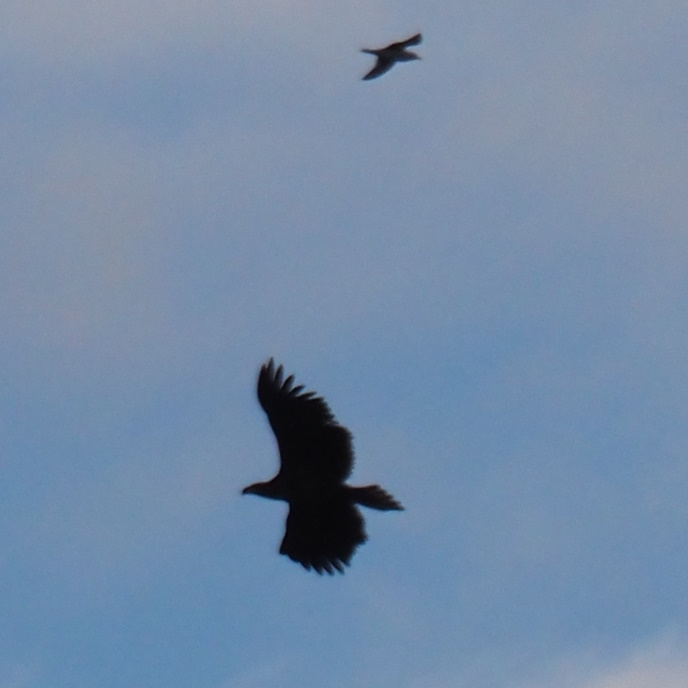
These sea eagles, on the other hand, near Finnkirk Rock, were the real McCoy: I will come to tge rock in #3


And that ends #2

I have already created the stub for #3, but nothing much there, just yet.


Saturday, 6 April 2024

Post card from Norway #1

We are one week into our travels, so its time to show and tell. This will come in dribs and drabs when I find time away from shore excursions (as I start this, we are near Nordkapp, as the very top of Norway. Anyhow, bookmark this page, and drop back in to read more.

We flew Sydney-Dubai -Oslo, got our bags and asked a young man how to get seniors' tickets to Oslo-S, and he said that as seniors went at half price, I should go through the turnstiles at full price, while he ushered Christine around them. We congratulated each other on our joint mathematical genius, and reached Oslo in no time at all.

The next morning, we caught a train to Bergen, which took us over the mountains, where the notion of spring had yet to catch on, as seen by the icicles sighted near Myrdal. Then came the bummer: it was Easter Sunday, the train stopped at Voss ("technical reasons"), and all of Norway was driving back from the mountains, so it took three hours, not the promised hour and a half.

With jet lag biting in, we grabbed a cab, and got absolutely ripped off. That's life...

English is the primary second language of Norway, and they seem to assume that even foreigners will speak it, give this sign from an Oslo bookshop. On the cruise, announcements are in Norwegian, English and German: the French, it seems, are expected to manage to understand the English.

Tours off  the boat are in German and English, though some of the guides give more detail in German. We toured Alesund with a German couple, and got a great deal of social history.

They were a bit short on the humour side, or perhaps they just did not know what skate boards  are, but my delight in finding a troll on a skate board left them cold.
On with the tour  then, we are travelling along the cost of Norway in what was once a freighter line that took a few passengers, and expanded. This is our third visit to Norway, so we know they are very strong on managing and climate change, but when jet lag saw me out of bed before dawn, I snapped this island, and totally failed to se the wind generators out on the ridge behind. Eat yer heart out, Don Quixote!

The next morning saw me also up befores dawn, trying to catch sunrise in the mountain tops, but the intense (to us) cold drove me in before I saw it. There is snow and ice everywhere!

As we had been to Nordkapp in summer (a chilly 18C at midsummer, we gave today's excursion a miss,.

Still, as we pull out from the wharf, we are all being plied with hot chocolate and apple cake, so I will post this much and finish it later. At least you have the pics.

After dinner and slipping in a bit more, this next one marked where we crossed the Arctic circle.


And here is Chris, looking happy, just after we did so.


Interesting to us: trees well north of the Arctic circle. Two typos in that line: time for bed.


We went on a coastal walk. The 'guide' was of little value: failed to point out the barnacles, and gave us a load of old cobblers about a tsunami putting the Dogger under water, when it was a case of melting glaciers.


He also failed to mention the lichens and this moss, and had no knowledge of how Hrafna-Floki used ravens to find Iceland. In short, not much chop!

When people are going into guiding, they really need to be able to stay ahead.


Then again he failed to point out these snow-covered rocks, which tell a very relevant story.

The antique physics teacher in me said nothing, but I certainly thought it.


Back on the boat, this snowy hill was beautifully framed by a bridge. Norway has many, many bridges, and even more tunnels.

Trees, however, are another matter. All the same, this one was north of the Arctic Circle,  as were the ones below, clearly planted to act as an extra snow fence.

This last one in this first tranche is of Honningsvåg, and it reminded me of a style I knew as a child. I thought it might have been like L S Lowry, but an artist mate, Tamsyn Taylor, tells me it is reminiscent of Breughel. See what you think...

Here ends the first round. I ill put a link to the others as they kick off. (The next one is now complete.)