Search This Blog

Showing posts with label wee beasties. Show all posts

Friday, 5 September 2025

Kick-started by a dung beetle

This is one of a series of tales of Australian rural life as I once lived it I have just realised that these were all banjaxed by a treacherous ISP, but I had kept all the bits, and now I am reviving them.

Cootaburra lies quietly, drowsing beside the Corella River, in western New South Wales.  Until recently, little has changed in Cootaburra during a hundred years of slow and gentle decay.  Many of the children still go to school barefoot, as their great-great-grandparents did last century, bantam roosters call the town to wakefulness each dawn, and each barking dog in the night is instantly recognised and cursed by name, as is each squalling cat.

It is a small and compact town.  The people are all old residents, intermarried for five and six generations, with kith and kin scattered all over "the district", an indefinite geographical entity that seems to cover the whole Corella River catchment, the western marshes, and even beyond.

The district is prosperous, for it is surrounded by wheat fields that yielded good crops, even in the recent drought, and vast sheep paddocks that sprawl over the rolling hills.  With the drought a thing of the past, the local farmers are happy, but the town itself has been under threat.  It seemed to be a town without a future, for the farmers of today pass Cootaburra by.

When the area was settled last century, people spread out thinly and took over the land of the first inhabitants.  All land was considered the property of the Crown, and having chosen your land, you paid the Crown for the right to do so, and that was that.  The original inhabitants were largely ignored in the process, although they are now being accorded some recognition, and even some occasional compensation, but that is another story.

The early farmers needed towns, about every sixty miles along each main road (that is, about every hundred kilometres today).  This pattern meant that most farming people could ride the fifty kilometres or so to the nearest town by horse or sulky, and get back again in the same longish day, provided they were quick about their business in town.  The town provided schools, churches, and stores, the main essentials for all but the most distant farms.

Once the car came, the horse was discarded, and the sulky, a light cart, drawn by a single horse, went with it.  A few children still ride horses to school, but they are the children of rich farmers who live close to town, riding fine ponies, not the offspring of the poor, riding four-up on a superannuated plough horse as their grandparents did.  Once the horse was an economic necessity, now the car fills that role.

With the car making it easier to travel long distances, rationalisation was bound to happen, a simple word, but a horrid process to those rationalised.  People today can drive the 100 km between towns in just over an hour, so now they can choose a larger regional centre, which can grow and offer more services, at the expense of the smaller towns.  On the edges of the bypassed towns, houses are deserted, they fall into disrepair, and the town slowly lurches closer to being a ghost town.  There is nothing very rational about being a ghost town.

Once the banks start to cut their losses and move out, once the main store in town has its last sale, once the pubs start closing their doors, when the dentist leaves town, the pharmacist merges with the newsagent, and the local doctor cannot sell the practice, it is only a matter of time before the town dies completely.  Unless the locals start to fight back, that is.

Cootaburra is a lovely example of recovery.  Established during the gold rushes of the 1850s, the town lies on a major highway, and Cootaburra survived on the passing trade: it was a long way, either side, to the next main town.  True, the main fast food chains ignored Cootaburra, but that was all to the good, for locally owned businesses filled the gap.  Truck drivers knew what the food was like, and stopped there for a feed.  Knowledgeable travellers saw the trucks, and stopped there as well.

Now a "government transport initiative" has sealed Cootaburra's fate as victualler to the travelling masses, for a bypass has been installed, and ordinary travellers sweep by on the highway, unaware of the feeding delights that they are missing.  The farming riches of the district were still being spent 200 km away, and the town was slowly bleeding to death.

Most Australian country towns have a Big Something.  The map is littered with Big Merinos, Big Pavlovas, bananas, huge pineapples, cane toads, trout -- most of God's creation and much of human invention can be found, sculpted rough and large, in an Australian country town.  Each naive replica was built to draw hordes of tourists in to gasp with delight at this or that gigantic model, and each is slightly more grotesque than the one that went before.  This seems to be inherent in the genesis of Big Somethings in rural towns.

And here lies the problem that faced the citizens of Cootaburra.  To be really effective, they could not afford yet another naive "attraction" that would soon be overtaken.  They had to take a leap to the really grotesque, while still falling within the apparent range of Big Somethings, Australia-wide.  Enter Bob Rutherford.

Bob is the not the only Rutherford to appear in these chronicles, and he is in fact a cousin of Ernie Rutherford of the Yandackworroby pub.  Bob was in Yandackworroby a year or so back for the running of the highly successful Yandackworroby Cup that I will mention shortly.  I met him while I was down there to have a yarn with Ernie, and I have kept in touch since.

Bob's solution was to have the town build a giant replica of an African dung beetle at Cootaburra.  To explain why they did this, I will first have to discuss a few matters that may distress the more sensitive of my readers.  Trust me, for this exposition is essential to your understanding.

Australia's native animals produce small dry pellets of dung that are dealt with by native dung beetles, but those are quite unable to deal with the massive productions of cattle and sheep.  The result has been a vast increase in the number of "bush flies", right across Australia.  About twenty years back, Australian scientists imported African dung beetles, well able to cope with the productions of elephants, rhinos and hippos, and tested them in small areas of Australia.

The results were outstanding.  The dung beetles cut up the wet plops into little balls which they push away and bury, laying eggs in them as they do.  The buried dung is unavailable to the flies, whose numbers are reduced.  In sheep farming areas like Cootaburra, people no longer need to practise the "Great Aussie Salute", sweeping the flies away, all summer.  In the Corella River district, dung beetles are widely hailed as saviours by people, now able safely to open their mouths during summer, for the first time in their lives.

So Cootaburra has its dung-beetle, a huge scale model in ferro-cement and fibre-glass, standing almost six storeys high, set up and floodlit by night on a low hill, just as you enter the town, and visible from the bypass highway, as well as being advertised on billboards across the state.  Already, a theme park is developing around this coprophilic coleopteran, and the continually rolling "dung ball" has a hatch let into it, so intrepid adventurers can climb into the hollow centre and tumble around.  I will not offend my gentle readers by recording here the name given this ride.  Cruder readers will no doubt work it out.

My friends the Fancelli sisters have recently moved to Yandackworroby (I will have to tell you all about how that happened, some time soon), and they have developed a smaller model of the beetle, where the dung ball is the barrel of a "stone rumbler", in which stones are rolled with abrasive powder until they are polished smooth as glass.  Three of these rumblers are now in operation at Cootaburra, turning gravel from the Corella River into attractive souvenirs.  Then there are the dungball ear-rings, key rings, tea spoons and dung beetles in snowstorm domes, but the true winners are the unintended attractions of the town.

Bob Rutherford had a clever idea, but he never recognised the true glories of the town.  Now the city people are coming for longer stays, they are beginning to ferret out the real oddities of Cootaburra which are the mainstay of the town's economic recovery.  The Acropolis cafe by the railway station offers "capuccino", where the foam is produced by shaking a two-litre plastic milk bottle.  Every kind of steak at the Acropolis is served with a fried egg on top, the only sort of bread is politically incorrect and white, and the Acropolis is always packed by smirking cognoscenti, waiting for some innocent passer-by to react.

Equally packed is the traditional bush Chinese restaurant operating at the town's bowling club, where all of the meals taste like slightly curried sweet and sour monosodium glutamate, just as most bush Chinese food has, ever since the Chinese settled here, after the gold rush days.  City people, seeking their mythical rural roots, delight in such things, just as their real and urban ancestors delighted in other types of freak show.  But freak show or not, at least it keeps the town economically alive.

The Cootaburra annual Arts festival proved so popular that it now runs four times a year, and it may even be pushed into continuous operation -- the locals may be naive, but they aren't thick!.  These items are often claimed by Bob's detractors to be the true basis of Cootaburra's recovery, but without the kick-start from that dung beetle, endlessly rolling its ball of dung, day and night, on the hill over the town, Cootaburra would be dead by now, another victim of economic rationalism.

 Other related matters: 
The Yandackworroby Cup
The Yandackworroby Pub
The Fancelli sisters' castle
The Fancelli sisters' store
The Fancelli sisters' gym and bar
Bringing in the polyestas


Sunday, 25 August 2024

Why the nature of North Head matters.

When the white invaders arrived in Australia in 1788, Manly was one of the first places they named. It already had a name (Kai'ymay), but impressed by the confidence of the Guringai men, who waded confidently out to greet their boat, Governor Arthur Phillip called the beach they were approaching Manly Cove. Invaders like to change the place names...

Before long, things went sour, as a disease that was identified by the invaders as smallpox (I take the view that it was not smallpox, but something else, just as harmful) hit the Guringai people. The original paradise was over, but Manly remains a pretty place, best approached by ferry, and offering a wealth beaches and walks.

I fled Queensland in 1944 at the ripe age of six months (I just knew Queensland and I would never get on), reached Manly, and I never left. In the welcoming spirit of the Guringai, I like to share some of its gems, ones the Guringai would have known, and that means North Head. It is a place of sandstone cliffs and deep sands, blown onto what is now the headland, way back in the last Ice Age.

Look closely at the ridge on the left, and find the sea eagle that photo-bombed the shot.
At the centre bottom, look for the site of  a rockfall, dubbed The Great North Head Calamity.

My favourite animal.

The sandstone is almost 250 million years old, Triassic rock with ever few fossils, and lacking most of the nutrients plants and animals need. It's a paradox, but places with depauperate (poor) soil are hotspots of biodiversity, and there are about 450 species of flowering plants there, birds, mammals, reptiles and a rich fauna of invertebrates.

Would you know this one?

Since I officially retired, I have worked on North Head as a volunteer, weeding, planting and doing other stuff to help maintain a fragile ecosystem, but I am also a lifelong educator, and wearing that hat, I decided to generate a web site about the place, and host it myself. It was to show the casual visitor just how much more was there to be seen.

Once you know this is a spittle-
bug, you will be able to look it up.
Because I always travel with at least a phone and a camera, the web site was soon bloated with pics, so during one of our escape-from-lockdown rambles, I decided to do an e-book version that people could carry around. I added a great deal of extra information, even more images, and some internal navigation, and then, pushed by friends, I did the print version.

For a variety of reasons, the headland has retained many unusual like forms, and while I deliberately do not give detailed locations, the e-book and the print book help the visitor to understand what they are looking at, and provide some background.

A donkey orchid.

A dragon that like grapes.
Why no locations? Because some people cannot resist 'adopting' some of what they see.

If they had to work to find the unusual plant or animal, somewhere on our 250 hectares (that's a square mile for the old-fashioned and Americans), they will care more about it, take just a photo, and leave the plant or animal there...

Finding everything will take a very long time: in the past year, I have found my first North Head flatworm, and only my second centipede. There are things I have missed, but sooner or later, I will find them, just as I found a python.

I stopped the traffic for this one.

In the book, in all its versions, you get the geology, the history of the headland, the tracks that are worth following, and what to look for as you wander along them. I even tell you about these fig trees, and where to get the best views.

Where do you get the book? The cheapest way is as a $2 e-book from Google Play, and at the other end, a full-colour paperback will cost you $50 from Amazon. There is also a $4 e-book from Amazon, which is the lowest price they allow. Get the Google Play one, instead, because they are the same!


Sunday, 23 October 2022

Spittlebugs

 When I was a teenager, the act of spitting was a golly or gollying, and just lately, North Head has been taking a bombardment of gollies, going on appearances. Bushes all over the headland are garlanded like this, with festoons of foam, as though some grubby louts have just passed through.

The 'gollies' are made by small bugs called spittlebugs, and when I say "bugs", I am using entomologist-speak, so my bugs are Hemiptera, insects with piercing mouthparts, like the cicadas, aphids and bird-of-paradise flies (which I will get around to describing one day).

These insects feed on plant sap, and make a sticky foam that seems to keep predators away. Working as a volunteer in a sanctuary, I was asked last Tuesday to prune back some trees that get a bit exuberant. We don't like doing this, but it reduces the fire hazard, so we do it with care. One Monotoca was home to many spittlebugs, and as one of the pockets in my work trousers always has a supply of jars, I snipped away a few of them, and by the time I got home, they had emerged from their foam to see what was going on. So out came the macro lens and the microscope.

First, here we have a juvenile and an adult (some people call them froghoppers): they were both in a Petri dish, which is the curve you can see.

But how big are they? One reason for using a Petri dish is that you cam slip a millimetre scale beneath it: if you let insects loose on a scale, they always seem to run away.

Now let's look at the juveniles:


There's more to say about these beasties, but as I'm flat out (as usual), here's a useful link. I will be playing with these for a few weeks, and this week, I was showing some to Stage 1 kids at Manly Vale, so here are some better shots:


If you want more stuff like this, you could do worse than look into my The Nature of North Head.  The price can be as low as $3 for non-dead-tree versions, $20 for monochrome, but the one in bookshops is colour and dead tree at $50.

Tuesday, 4 February 2020

I like to light fires

No, not bushfires, silly, though as readers of my new book Survivor Kids: get Ready for Wild Australia (released April 1, 2020) will learn, I used to light bush fires for research, under very tightly controlled conditions.

(I was a junior research assistant, supervised by senior scientists, and one of them did the actual lighting. Each day, we had tankers, up to 30 crew, knapsack sprays and tools, and the work we did gave rise to the present six-point bushfire danger scale.)

My recent silence is because I have been in New Zealand, playing with my grandkids and other kids, and thereby lies a tale of lighting a fire in the hearts of three anonymous children.


My wife and I decided to take in the Auckland Art Gallery, a superbly designed building with delightful Jura Grey limestone floors and stairs from Bavaria, all highly polished, and chockers with fossils.

Now as the people who travelled with me last year in Spain, Portugal and Morocco can attest, I keep my head down when on marble or limestone, watching out for fossils like the ones seen here.

(The second is a belemnite, an extinct squid-relative, the others are ammonites, and they are all from the Jurassic.)

I always lay down an Australian 50 cent coin for scale: the coins are 32 mm across.

This often draws attention when people only see me picking up the coin after getting a shot, and I have been known to claim that it's a form of magic, but really, it's just for scale purposes.

Let me tell you, though, that joy is discovering that the floors and stairs at the  are of fossil-stuffed limestone.

True joy is finding a father and three children interested enough to ask what I was photographing.


Sheer blissful joy is walking out the front door later to hear the oldest one, a girl of 8 or 9, giggling with glee at finding yet another fossil in the outdoor paving.


I think I won that one.


So yeah, my hobby is lighting fires.


And by the way, there's another book about to emerge as an e-book, previously announced as Not Your Usual Rocks.


It now has a new name and is now called Mistaken for Granite.  It's for older readers and armchair travellers who prefer not to hike over 3 km of blasted heath in stinging rain, only to be lowered down into a volcano. We did that, for the sake of the book.


Wednesday, 30 October 2019

Ladybird week

This is a piece which will find its way into a book that is just about ready to offer to publishers, under the working title Looking at Small Things.

The book has its roots in a time, 68 years ago, when my profoundly unscientific parents bought me a toy microscope, made of Bakelite, with plastic lenses. I was entranced, but I could find very little to look at, though I did find a ferocious-looking beast on a Dahlia.

Somehow, I managed to learn that this was the larva of a ladybird, but as I could learn no more, and found no more exciting animals in the garden, so I moved onto other things, but a couple of weeks back, they were in my garden again, and I showed them to my twin granddaughters, but it took me a few days to recall what they were.

Over the years, a number of my books have been about finding interesting things to look at, how to catch them, how to keep them safely (for both the keeper and the keepee). I do this, because I had zero support or encouragement, and that simply wasn't right. To give my father some credit, he once showed me an adult cicada emerging from the pupa case, but there was precious little engagement of showing how involved.

My books, like Exploring the Environment and Australian Backyard Naturalist (both out of print, but try libraries) are designed to give adult guides and independent readers the ways and means to do that.

Now, close to ten times my age then, I had an approach from a start-up at Flinders University who had deduced  that I was interested in stuff like that. The upshot was that I told them I would write a guide for them as a pro bono, keeping the rights to any ensuing book. They make a very neat little gadget that clips onto phones and tablets. It is better used on really tiny things, but the second shot above was taken with it.

You can download a free version of a draft of my new book for free, using this link, but it is slanted towards teachers, and is targeted at helping them make sense of the kludgey and totally inadequate "National Science Curriculum".  When the greatly revised  Looking at Small Things comes out, it will be far more child-friendly.


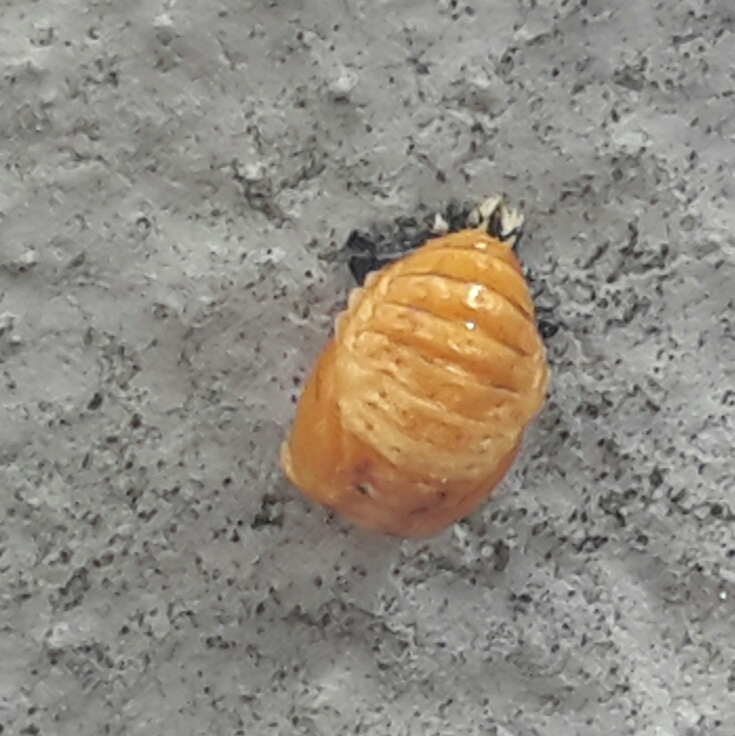
Anyhow, back to my story: the ladybird larvae were everywhere. But then, I notice something: they were starting to pupate on the walls of our courtyard.

At first, I was a bit slow to catch on, but they kept coming in waves, so I got the whole life cycle thing. Here, you can see a number of steps along the way.


In the end, they emerged as adults. Knowing what to look for, maybe you can find these (or similar) beasties for yourself. To get a handle on the scale, the larvae were about 8 mm long, and the beetles below were about 4 mm from side to side.


Friday, 10 August 2018

I have been busy (again!)

Somewhat predictably, but a bit earlier than I expected, the National Library of Australia has decided to publish a fourth edition of The Big Book of Australian History. (By the way, I notice that this link was out of date, so I have updated it: you may need to refresh the page, if it doesn't show the four editions at the start.)

The third edition weighs 1.1 kg, so it is, indeed, big. It contains 90,000 words in 120 articles, covering the key points in the continent's history, from pre-Gondwana onwards: I don't accept that Australia began in 1788.

It comes right up to present day, so I now need to fit in same sex marriage legislation, the Uluru Statement, and keep an eye out in case the Korean War is finally officially closed. I have to get the changes in Prime Minister in, trends in The Yarts, stuff like that.

Meanwhile Australian Backyard Earth Scientist and I note that this was another link in need of updating, so I did that as well. Don't forget to refresh, if you don't see an ISBN.

Another book that has been a little troublesome has been through the editor, but it has yet to get an imprimatur, so I will hold back on saying more just yet. I think it will be useful.

One good thing I have done this year is Going Micro. This is a pro bono work that I did for the people in Adelaide who are behind the excellent Go Micro, a clip-on low-power microscope that works with tablets and smart phones.

If you click on that link, you can get a free copy in PDF format. I retain the copyright in the text, and therein lies my current project. I don't have a publisher yet, but its working title is Looking at Small Things, and it uses the text that was written for Going Micro, but the tools to be used now are hand-lens, clip-on and full-on microscope. Right now LaST is two-thirds complete


I might add that later this term, I will be doing master classes with Stage 3 students at my local school, using clip-ons and also microscopes through a USB camera.

Meanwhile, in parallel, Not Your Usual Rocks (70% complete), a giant history of science (mostly done) and a work currently called A Shore Companion (half-done) are pushing ahead, though the last two may be sidelined for a fun work loosely based on my Science Playwiths website. That is scoped, and most of the text is there.

Why do I have so many things on the go?  Putting it simply, there's no writer's block in this house: I just switch to the next title. To be honest, I think that if I were at school today, I would be diagnosed ADHD.  This is why I don't damn kids who jump from idea to idea: we ADHD people just have superior brains, and can do several things at once.

The best computers use parallel processors, the best minds are capable of multi-tasking, but developing minds are slammed with the libellous label:

ADHD

Another reason: as I approach advanced middle age, I need to ask myself: if I cark it, which works would I be most annoyed having not finished?

In the middle of the night, the answer that comes back is all of them? so I suppose I should get on with it.

Sunday, 18 February 2018

The Microscopist's Mate, part 3 of many

Just for the record, all of what you find here, and in the other blogs in this series, is now available in fuller detail in my e-book Looking at Small Things.  Go to this link to find out more about how to get the free low-resolution copy, or the cheap high-resolution version: I'm a professional writer, so I like selling books, but I'm also a professional educator, so I like sharing ideas.

There's a similar free or cheap deal on offer for my Playwiths ebook as well, and to see what else I have been doing (LOTS!), go to this link.

Here are the links to Part 1 and Part 2.

Today, I will be talking about a neat little trick for lighting, not the green slime I said I would be on about. What I actually write about here depends on what I am working on, and yesterday, I had an idea.

There are going to be times when you want to shine a light through a specimen, especially when they are looking at slide mounts. I have messed with a few rigs, and I will be building a more sturdy one, one of these days, but here’s a quick and dirty version.

The good thing about quick and dirty versions is that you get the wrong steps thrown in as well, because that detail will help you make a better model for yourself. here's how I started this adventure, by gathering the items below:

What you need: a jar, a headlamp with LEDs, scissors, and some translucent plastic cut from a milk bottle.
 After I took this shot, I added sticky tape to the list. I used a 400 gram jar, because you can sit a microscope slide on top. These next four pictures tell the story.


I realised as soon as I tried this out that the camera microscope was focusing on roughness in the plastic, so I replaced the plastic with a piece of tracing paper and stuck that to the jar.

In my final version, I plan to have the diffusion layer (the plastic) 2 cm below the slide, but for now, I am using this arrangement to steady the camera.

Remember that one of my major concerns will always be camera shake. The Go Micro clip-on is resting on a microscope slide that is across the jar. It’s primitive, but it works!

The first rule of gadgeteering, though, is never to give up while you are ahead. The next morning, I spied one of those clear plastic throw-away containers that, typically in our house, had not been thrown away, but been used to store something important, like pieces of string too short to be of any use. Anyhow, it was pressed into operation, but an image of the base showed through:


I could work around that, but  I went straight to Mark III, seen in the second and third shots. This one uses a square flexible plastic box that is just sturdy enough.

 And here is how it looks when i light the head lamp:

The thing is, though, that the morning I did this, I had some sand samples that were dry enough to look at, and for most purposes, you don’t want back-lighting on sand (yes, I have some plans to work with crossed polarisers later, but this is now). So needing a light from above, I reached for the original Mark I and a bit of black cardboard, and took these next two shots.


I could have done without the slide here, just laying the sand on the cardboard, but I had something else in mind. Using the paint brush, I spread the sand out and got the shot below, a 9 mm diameter field of shoreline sand taken from St Heliers Bay in New Zealand.


I am conservative about the biosecurity of specimens like this, so even though marine sand is not an import that must be declared, all my samples were both microwaved and baked in an oven before they came anywhere near Australia. Sand from freshwater lakes, on the other hand, must be declared, but my interests are fully taken up with marine sand.

Anyhow, that has solved most of my present lighting problems, and I hope it has helped with yours!

Maybe next time, it will be green slime time, but then again, it might be sand or pill bugs, which used to be sold as a cure for all sorts of ills.

Friday, 16 February 2018

The Microscopist's Mate, part 2 of many

Just for the record, all of what you find here, and in the other blogs in this series, is now available in fuller detail in my e-book Looking at Small Things.  Go to this link to find out more about how to get the free low-resolution copy, or the cheap high-resolution version: I'm a professional writer, so I like selling books, but I'm also a professional educator, so I like sharing ideas.

There's a similar free or cheap deal on offer for my Playwiths ebook as well, and to see what else I have been doing (LOTS!), go to this link.

This follows on from Part 1, obviously. If you don't read that first, you will be lost.

Today, the topic is sand, and microscopy using a cheap clip-on lens with a Samsung tablet.
The first sample is wind-blown sand from St Helier's Bay, Auckland, New Zealand.
No digital zoom, with the Go Micro

Full digital zoom applied to the Go Micro. This is part of the same field.
I got curious about the make-up of sand some years ago, when I tried to work out why some beach sand squeaks, when you walk on it.

That was when I discovered that there’s quite a lot of shell grit in some sands, little broken-up fragments of shell, as you can see in this shot of sand from Coller’s Beach near Mollymook in NSW. The shot on the right was taken with a fairly high-end microscope.

Fast-forward, and I was on a beach in New Zealand, two weeks ago, sampling up and down the beach. I had a thought: why not sieve the shoreline sediment and see what bits are there? For that, you need a sieve, and I remembered one of my favourite gadgets, a sieve jar: here’s how to make one.

A sieve is just a screen that only lets through something smaller than a certain size. A cat flap is a sieve that lets cats through, while stopping Dobermanns. Gardeners use a garden sieve to take out rocks and pebbles from garden soil, and so on.

I think I got the inspiration for the sieve jar from a gadget another scientist was using to investigate tardigrades. I use a 400-gram Vegemite or a 400 gram plastic peanut butter jar for this because these jars have a wide mouth, they are a good size and their lids are made of soft plastic.

To make my sieve, I take a soft plastic top from a jar, set it upside down on a piece of scrap wood and used a hammer and a small (1 to 1.5 cm) chisel to make a set of cuts that let me remove the flat top, leaving just an open ring. 

(Left) Cutting out the top of a jar lid to make a screw-ring. 

Then I used a square of flywire and attached it to the bottle, as shown in the picture below. Then, all I have to do is half fill the jar with leaf litter, and shake it gently over a white dish, watching to see what drops out, pootering my finds up so I can examine them. 

(And what’s a pooter? Try this link.)


Trim the corners, and you are ready to go. There is just one warning: small hands and jars made slippery in water, near rocks: can you see the problem? Plastic peanut butter jars make safer sieves for young users!

Most beach sand has just a few interesting shells, along with a lot of small sand grains, but I will come back to that when I get to looking at sand. This new use of the sieve jar occurred to me in February 2018: I expect that my readers will find new uses in their turn, just as I still do.

Once you have a sieve jar, the rest is easy, but choosing the right sort of beach is hard. Ideally, the sand grains will be fine enough to pass through the sieve, leaving you with a collection of broken bits to work through. I seem to get the best yields in sand 10 cm down in the wave zone.

This is the kit I take out with me, along with a notebook so I can
record where each of the jars was filled.
The trick is to fill the jar ¾ full of sand, rinse off the sand around the rim, screw the lid down, and then shake the sieve vigorously in the water. I put my other hand under the jar, so I can tell when sand stops falling out, then I tip or wash my catch into a second jar. I have a toolbox that carries six labelled jars and the sieve jar.

In the next shot below, I can see a quartz pebble, top right, a brown glass fragment, 1/3 of the way down, 1/3 of the way in from the left, and a small brown and white conical snail, 2/3 of the way down in the middle, fragments of dark blue or purplish shell, probably from cunjevoi.

I can also see several sea urchin spines (you may not see them, but you will see them below, shortly), bits of limpet shells, and somewhere in there, there was a tiny fish vertebra, or backbone segment. 

If you know the rocky shore shellfish, you will also see Bembicium, Melanerita and limpets, but who knows what else is hidden under the surface?

The trick to finding all the treasures is to spread the grit out as a thin layer in a white dish, and let it dry in the sun before you push the pieces around.

You can use a small paint brush for that, but I prefer to use tweezers, so that when something good comes up, you can pick it up and drop it into a Petri dish. There are sea urchin spines in the dish.

 In the pictures above, there was actually a bit much material, but it was still wet, so I just dumped it in there to take the shot. Notice the white dish, the tweezers and the Petri dish. The jar on the left is what I carried my catch home in.
   
My standard white dish is also good for sorting. The interesting bits go into the Petri dish, and now, you can see the sea urchin needles quite easily, but they will be clearer in the next two shots.


Now all we need is a microscope!

Shells are well within the reach of the Go Micro clip-on, or even a hand lens, so sand-sieving is one of those activities that can be adapted in many ways.

All of the pictures after and including the picture on the right were taken with a Go Micro clip-on — and these shots are just the beginning! Move in on your local shells, and see where it leads.
   
The shell is about 5 cm across (left, above), and on the right, it is as revealed by the Go Micro.
 
Looking at shell fragments

Now follows is a picture essay. First, here are the original subjects for the first batch:

Now here are some of them as seen with the Go Micro: the pictures represent an area of about 1 cm x 1 cm. From that, the reader can work out the magnification as they see it.


(Left and centre) sea urchin spines, (right) an unknown shell, possibly a limpet.


From the left, an unknown snail, a limpet and a piece of bottle glass. The identification as glass is confirmed by the stripy fracture pattern, called a conchoidal fracture.

A small limpet: specimens like this can be a bit disappointing.


When you find a shell with a small hole like this one, the animal that lived there was killed by something like an oyster-borer, also called a mulberry shell or Morula. The specimen on the left may have been killed by one of its own species, but we have no idea of how the specimen on the right died.

And by the time you are you are finished with examining sand (and maybe looking at some soil), your pond water should be ready to look at.  Next time, I will probably be looking at green slime, as I have had a set of culture bottles going: notice how they all get a free flow of gases, but are mosquito-proofed.


In other words, to be continued...