Search This Blog

Sunday, 8 March 2020

Bolters, part 1 of many

I have finally got my study of peculiar rocks, previously called Not Your Usual Rocks, into print as Mistaken for Granite, so I am back to Australian history for a bit, looking at the people the Australian vernacular calls bolters—escapees, in other words.

My father had a B.A., mainly in philosophy and Latin. Nine decades ago, that made him “educated”, but he had no notion of what mattered to a boy whose interests were centred on things mechanical, natural and scientific. Even though he never expressed it in as many words, I think he would have endorsed poet Matthew Arnold’s words when, according to Lytton Strachey, the idiot banished science from the curriculum at Rugby school thusly:

Rather than have Physical Science the principal thing in my son’s mind, I would rather have him think the Sun went around the Earth, and that the stars were merely spangles set in a bright blue firmament.

One Christmas, my father gave me a book called Great Escapes, a collection of essays and excerpts that introduced me to a self-important Casanova, who made a great fuss of his escape from the Leads, a prison in Venice, and Winston Churchill’s equally exaggerated account of his escape from the Boers in Pretoria. Luckily I was an info-sponge, and any book would suffice because I always turned to the practical aspects of what I read.

I passed over the narcissistic excesses of two boastful liars and soaked up the escapes from World War II German camps. These people forged travel documents that would pass even close examination, but the escapees said that most of the time, German officials gave the papers scant attention.

Enter my practical side, and while the statute of limitations has probably run out, I admit nothing, but assert without comment that officials are indeed lax in their scrutiny of paperwork. I always had the legitimate documents with me, which would have saved my bacon, but I admired the escapers, who lacked a safety net.

I fashioned keys with coat hangers, nail files and pliers, acquired useful skills that I do not disclose (and never got to use), and kept the escapers high in my Pantheon of Clever People. Had things turned out differently, I was well prepared to emulate them, because escaping is an art, not a science, and I had my bachelor’s in those arts long before I gained a real B. Sc.

Because I am Australian, it was appropriate for me admire escapers, because the original Australians were good at dodging the white hunters who pursued them, and on the Gubba side, some of the invaders were keen to escape as well. Most of these would-be escapers were convicts, and one of those felons was active, even before any of them reached Australia.

The ships of the First Fleet left Portsmouth on 13 May, 1787, and reached Tenerife in the Canary Islands on 3 June. There, they bought musket balls and paper for musket cartridges (somebody had forgotten to bring these!), but security was slack, and a convict saw his chance while working on the deck of the convict transport Alexander in Tenerife harbour. John Powers slipped over the side and rowed away in a jolly boat, a smallish skiff, which had been carelessly left in the water, with oars.

The fugitive got ashore and fell asleep near the boat, which was unwise. Next morning Marines found the boat, then they found Powers, and took him back to the ship, where he was “heavily ironed”[1].

The masters of the transports would have taken extra care of their involuntary passengers after that, because, as an assistant surgeon, Arthur Bowes Smyth noted, ships’ masters had to land the convicts safely and deliver them “into the Care of the Governor … under the penalty of 40£ for every Convict that was missing”. [2]

In Sydney, in November 1788, John Powers received 200 lashes for stealing some boards, presumably to make another boat, but after that, he seems to have disappeared. Perhaps he just died and nobody bothered to mention it. Then again, he may have stolen some more boards, made a boat and headed out to sea, but if he did, he probably drowned.

At the end of 1793, David Collins listed the losses in that year: two settlers, seven soldiers, seventy-eight male convicts, twenty-six female convicts, and twenty-nine children had died. Added to that, there had been other deaths: one convict was hanged; another was found dead in the woods; one was killed by the fall of a tree and two more were killed by lightning. That was an escape of sorts, but there were some real escapes as well.

To this decrease may be added, four male convicts, who found means to escape from the colony on board of some of the ships which had been here. [3]

Not all of the early escapees were white, though. In May 1795, an Indigenous warrior named Pemulwuy speared a convict “…within half a mile of the brickfield huts” (800 metres from where Sydney’s town hall stands today), and ran off. Soon after, the convict known as ‘Black Caesar’ (also a frequent escaper, as we will see shortly) claimed to have killed Pemulwuy, but in March of 1797, Pemulwuy was shot and wounded, and put in hospital, where he recovered and escaped, still with an iron shackle on his leg.

The escapes kept on coming. In September 1803, a party of 50 under Lt. John Bowen landed at Risdon on the Derwent, and struggled to establish a settlement. A few weeks later, Lieutenant-Governor David Collins landed at Sullivan Bay on Port Phillip with a party including marines, free settlers and convicts. One of the convicts was William Buckley, who escaped, and later lived with the local people, surviving to meet the next wave of white settlers in 1835. After that, he moved to Hobart.

And so far, we have yet to view the full richness of Australia's many, many bolters, and their many, many motivations, but those matters will be addressed in due course.


[1] David Collins, An Account of the English Colony in V, volume I, Introduction, page lxiv.
[2] This is from the transcript of page A1085095 of the State Library of NSW copy of Smyth’s journal. It is missing from the version in the National Library of Australia. (This often happens when one of the versions was the original, and another is a “fair copy”. Scholars say the State Library version is probably a fair copy, and the National Library version is probably the original…)
[3] David Collins, An Account of the English Colony in NSW, volume 1, 332.


Monday, 17 February 2020

Do libraries need non-fiction books?


I'm busy on several almost-finished books right now, hence the dearth of essays here, but a teacher-librarian list I lurk on has just raised this issue. I remembered that I had written on this, went burrowing, and here's something from 2008. Note that this means the count of 14,000 in schools is probably much higher now, but the points remain the same.
"Another damned, thick, square, book . . . always scribble, scribble, scribble! Eh, Mr Gibbon?" 
Tradition has it that the Duke of Gloucester or some other minor 18th century Royal showed his insight into the writing process with those words. His Grace had no need of, or want for, such books. Anybody who has read a book feels qualified to express opinions about books.

Sadly, some of those people want to do away with books. The latest fad is replacing all the non-fiction books in a library with computers loaded to the gills with Internet access. "Books are old-fashioned. School libraries don't need non-fiction books," they bleat. They are wrong.

School libraries will continue to need non-fiction books for some time to come, and when they don't need non-fiction books, they will need works in some other format that are produced with the same care and commitment that books receive today. You cannot replace a resource with a nothing, and a palimpsest is no substitute for a considered and crafted work.

I write non-fiction, so perhaps I might be accused of bias, but I also understand the publishing industry. According to a recent count by the Educational Lending Rights folk, 14,000 books that I wrote or part-wrote were to be found in Australian school libraries at the end of the last financial year. That involves 18 titles and five publishers — but I also own a web page that pulls half a million visits a year, I spent six years writing for an online encyclopaedia, and I contribute to Wikipedia.

So I am no Luddite when I say that we need non-fiction books, but I understand what is involved in developing both the new and the old media. The whiz-kids who want to bustle in and do an "out with the old, in with the new" job simply do not have those insights. To all intents and purposes, they are functionally illiterate in precisely those areas where they wish to set the agenda, where they wish to be hailed as world leaders of shining excellence.

I also understand the education industry, from the classroom perspective, as a coordinator and as a bureaucrat. Along the way, I noticed how people on the make like to destroy, in the hope of getting the credit for the imposing pile of pieces that is left over. I have seen empire-builders and back-stabbers, and observed them at close range, but always just outside of stab-range. I distrust all grand plans that begin with the demolition of something that works.

Sensible folk can see good things coming with the web and new media, but the more subtle among us wish to see an orderly progression, so that if wondrous new media emerge, they can sit alongside the old media, and replace them gradually. It is too soon to march in and throw out.

It is clear that the simpletons who think "the Web" will replace books have simply no idea of what is involved, from research, to drafting, to writing, to revising, to editing, to designing, to marketing.  It all takes time, careful planning and money. If people think a web page knocked up in five minutes can compete, it may be wise of them to think again.

Those who would jettison all non-fiction books have committed the same error as those who, having taught somebody to drive, think they know all about teaching. Or those, who having written an account of a basketball match for the local paper feel that they are journalists. They aren't.

It's like saying "I cured a cold with lemon-juice and rum last week -- this medicine stuff is a doddle. Nurse! Send in my next brain surgery patient!" Who among us would fall for that? Our reaction and disdain should be the same when people suggest that web pages created by amateurs can replace print pages which have come from seasoned professionals.

Writing a book is not the same as writing a shopping list, and web pages are far closer to the shopping list end of the writer's continuum. There are ideas and concepts that cannot be usefully expressed as bullet points, but only those who have tried can know this within them.

Making a book, a detailed package of information, is mostly about money. When I wrote a history of rockets in 2002, I needed to get to the Smithsonian Aerospace museum and the Library of Congress in Washington DC, to Baltimore to see Fort McHenry, which was attacked with rockets in 1814, to Worcester Massachusetts to read pioneer rocket scientist Robert Goddard's personal papers, to a rocket plant in California to see where they fill solid boosters and chat to rocket scientists, then to Woomera, for the launching of the University of Queensland's Hyshot, the world's first scramjet.

I funded most of the travel out of my advance from the publisher, though a contract from the ABC for a report (on their web site!) funded the Woomera trip. Web page writers of the future probably won't be able to draw on funds like that, because there is no viable funding model, no plan for the writers to be rewarded. Keep in mind that the greatest attraction of "the Web" to the new visionaries is that it is seen to be free.

The high cost of textbooks is cited by many of these self-anointed experts, who seem to think the cost is all in the paper. Having negotiated improved paper on a past project, I have an insider's insight into the realities, and paper is not a big cost: getting stuff to put on paper is what costs.

The big-ticket items are in the production. A good author can expect around 50 cents a word for researched, polished, finished product if they are paid a fee for writing something. Then there is editing, proofing, illustrating, typesetting, design, advertising, publicity and sales.

We hear that information wants to be free. Oddly enough, we don't hear that beer wants to be free, or even that petrol wants to be lower-priced, we only hear that information wants to be free. There is just one snag: information providers want to be paid.

Any competent writer producing an electronic form of a textbook is entitled to expect similar payment levels for a similar effort, and the same support effort will be needed to get the "book" ready to be released. Result: the good stuff will never be free.

Funding issues will ensure that sustained narratives and detailed sequences of instruction will still go into books, or not be written at all. Make no mistake: there is an art, a science and a craft involved, and the makers of the book need to pour all three into every book, one way or another. One or two of those dashed-off web pages may pass muster, but the vast majority will be no more than amateur drivel.

Some of the remainder will be professional drivel, and in the end, only a few of the pages and web sites will be effective replacements for what can now been found in books. Most of these are not available, and we face many years of the plaintive chorus "Are they there, yet?".

Web sites generally fail to deliver a sustained narrative or a sequence of instruction, but that does not mean the web and new digital media have no role. I fully expect that in the future, the web and new digital media will allow publication of the previously unpublishable. I also anticipate that a work may be released simultaneously in more than one medium, or sequentially in several media.

Reference material on, say, "Goldfish of the Gobi Desert" will be available as PDFs for either print-on-demand, or to be read on some clever interface, but the histories-of-things that I write, known in the trade as narrative non-fiction, do not fit there. They are not created as reference works.

There is a place and a need for digital materials, indeed, two of my published books are now available in digital versions, which serves to satisfy a small but steady demand from specialists and enthusiasts who do, indeed, use them mainly as references. One of them, and a more recent work as well, have been turned into "talking books". Yet the digital and audio versions would not be saleable if they had not been through a complex process of editing and production.

Libraries need room NOW for digital storage, and the need will grow, but for the time being, they would be most unwise to dispense with their bookshelves, or their books.

Now I'm off to find a web page on DIY surgery so I can lop off my legs. I mean, I've trimmed my toenails before, so I know where to start, and scaling-up can't be hard. In this modern age of the motor car, legless people need less storage space, and I can drive to where I want to be. Let's get with the future!

* * * * * * * * * * * * * * * * * * * * * * * * * * * * * * * *

Peter Macinnis is the author of the digital work "Self-decapitation For Fun and Profit: Better ways to Avoid the Poll Tax", available from all good snake-oil retailers.

Tuesday, 4 February 2020

I like to light fires

No, not bushfires, silly, though as readers of my new book Survivor Kids: get Ready for Wild Australia (released April 1, 2020) will learn, I used to light bush fires for research, under very tightly controlled conditions.

(I was a junior research assistant, supervised by senior scientists, and one of them did the actual lighting. Each day, we had tankers, up to 30 crew, knapsack sprays and tools, and the work we did gave rise to the present six-point bushfire danger scale.)

My recent silence is because I have been in New Zealand, playing with my grandkids and other kids, and thereby lies a tale of lighting a fire in the hearts of three anonymous children.


My wife and I decided to take in the Auckland Art Gallery, a superbly designed building with delightful Jura Grey limestone floors and stairs from Bavaria, all highly polished, and chockers with fossils.

Now as the people who travelled with me last year in Spain, Portugal and Morocco can attest, I keep my head down when on marble or limestone, watching out for fossils like the ones seen here.

(The second is a belemnite, an extinct squid-relative, the others are ammonites, and they are all from the Jurassic.)

I always lay down an Australian 50 cent coin for scale: the coins are 32 mm across.

This often draws attention when people only see me picking up the coin after getting a shot, and I have been known to claim that it's a form of magic, but really, it's just for scale purposes.

Let me tell you, though, that joy is discovering that the floors and stairs at the  are of fossil-stuffed limestone.

True joy is finding a father and three children interested enough to ask what I was photographing.


Sheer blissful joy is walking out the front door later to hear the oldest one, a girl of 8 or 9, giggling with glee at finding yet another fossil in the outdoor paving.


I think I won that one.


So yeah, my hobby is lighting fires.


And by the way, there's another book about to emerge as an e-book, previously announced as Not Your Usual Rocks.


It now has a new name and is now called Mistaken for Granite.  It's for older readers and armchair travellers who prefer not to hike over 3 km of blasted heath in stinging rain, only to be lowered down into a volcano. We did that, for the sake of the book.


Sunday, 12 January 2020

I Aten't Dead Yet

That title is for the people who know who Granny Weatherwax is, who know that STP is not necessarily Standard Temperature and Pressure.  If you aren't one of that elect band, just treat it literally.

I have been somewhat distracted by the need to get some product out the door:

The first is Going Micro: Foundation to Stage 5, which is free gratis and for nothing. The constant reader will have been aware that this has been taking up my time since January.

These are teaching ideas that can also be used by hobbyists, but once I have drawn breath, I plan to convert them into a straight-out guide for hobbyists and naturalists.

If you scroll back a few entries, you can find out what all of this is about in the Microscopist's Mate series. If you didn't come in through the front door of the blog, use this link to see #7, with links to the previous six. Or go back and find the front door...

The main point to take on board: Go Micro is FREE! Just grab it.

Next, one of my less successful publishing deals was with Five Mile Press, who published two of my books in a slip case: these were Not Your Usual Bushrangers and Not Your Usual Gold Stories.

e-book cover
paperback cover
They released Bushrangers as a single title, but having failed to release Gold, I was getting ready to treat them roughly and seize back the rights to the work on the legitimate ground that they had failed to publish the work, when they told me they were folding, going under, turning into dead parrots, and the rights were mine.

So in the past week, I have prepared and published Not Your Usual Gold Stories as both an ebook and a Print on Demand paperback through Amazon.

Here is the link for the paperback version, US$12 plus postage, rather less than Five Mile charged: https://www.amazon.com/dp/198309207X

And here is the link for the ebook version, US$5, no postage, and with 236 hot links to the key sources: https://www.amazon.com.au/dp/B07DK4MZVZ

Draft cover, A Shore
Companion
In between, I have reverted to another of the jobs that has been on the drawing board for a while.

Originally called A Shore Thing or Shore Things, as you can see, I have changed the name, but it may well change again. Specifically for Australian readers, this is a book to dabble in while you are around rocky shores, sandy shores and any other wet-and-dry places: estuaries, mangroves and all that stuff.
Cover, Australian Backyard
Earth Scientist

It covers biology, geology, hydrology and all their interactions. There will be some familial overlap with the book on the right, one of two books that are with the publisher.

Australian Backyard Earth Scientist is now fully edited, designed and indexed, and a professional proof reader will be let loose on it: it will show up on the bookshelves in January next. Targeting ages 8 to 14, it is suitable for ages 8 to 94: most of my kids' books go down well with grandparents, possibly because I am one of them myself.

After that, there's only one title I have to do before I cark it. As things panned out, that work was half-written several years ago, so I have the structure and all of the illustrations sorted.

I put it on hold and drew on a few bits of it for Australian Backyard Earth Scientist. Just bits, mark you: Not Your Usual Rocks is for adults, and it looks at weird rocks all over the world, in a rather more technical way.

Note to file, January 2020: Not Your Usual Rocks is now Mistaken for Granite, and fast approaching completion


Monday, 23 December 2019

Australian Christmas 2

This must have been written thirty years ago, maybe more. We're a tad more weary and wary now.

"Angels on the steps, shepherds on the grass," announces the liturgical lady.  "Joseph and Mary, are you ready?"  She scans the supply of angels and shepherds.  "Are there any more angels?"  She pauses, and calls again, trying to keep the traces of desperation hidden.

A few more small boys with tea-towels head-banded to their heads give off wrestling each other, a scattering of girls in party frocks with tinsel wreaths trickle away from their families, some of them a little doubtfully.  One or two are led forward by parents to take the hand of the Boss Angel and Boss Shepherd, both adults who look like seasoned campaigners at this lark.

It is 7.30 on Christmas Eve, the cicadas are shrilling in the trees, birds swoop in and out of the last of the sunlight, and overhead, flocculent clouds catch the first colours of sunset, and offer us a threat of storm that once again does not come.  Most years we get this threat, and most years it holds off.  About 700 people are gathered in the garden of a local church for an outdoor mass.

The Jesuit father told me when I phoned last night that this is the children's mass, but that is fine by us, even though it is obvious that he is working his way into a case of laryngitis.  Better that than a whisky priest, straight out of the pages of Graham Greene, working his way into a case of Scotch, I want to tell him, but I am uncertain how well his sense of humour will be holding.

The service is a simple telling of the story of Christmas, a few simple carols, and back into the streets just as the street lights are coming on.  We sit on the grass for the service: most people know to bring a rug, Chris and I are canny enough to bring low folding seats that give back support.

First, a messenger arrives to announce that Caesar Augustus has called a census, then Joseph and Mary, a young couple of the parish, walk along the path to several young inn-keepers, find their stable, and quietly produce "baby Jesus" (actually their daughter Anna, but that's OK, Jesuits are more relaxed about such things).  The three wise men pop in for a chat, and one of them is a girl, but that's cool as well.

Then the shepherds are called.  They arise, one scratching his rear in relief at losing contact with the grass.  The smallest shepherd panics, and runs for his family, and someone mutters something about the need for a sheepdog, but the lost shepherd is returned to the flock of shepherds, and they withstand the confronting angels.

The priest explains that with his laryngitis, he will need to be brief, and tells a short story about a boy who wanted to play Joseph, but was ordered to play the Third Inn-keeper.  On the night, he plays along, right up to the point where Joseph asks for a place to stay.  He pauses, then announces "She can stay, but you can get lost," he tells the rival who succeeded over him.  What is the meaning of Christmas, he asks.  Picking up Anna, he introduces her to us.  This is the meaning of Christmas, he answers.

By now the colours are mounting in the sky, the white cockatoos have fled, and a cricket has started chirping near one of the microphones, but it is all just part of a summer Christmas.  Then the mass is ended, and the priest announces that there will be small presents to those under 10.  There is a stirring of joy among the shepherds and the angels, but they are instructed to lead Joseph and Mary and baby Jesus out.  To the strains of "Joy to the World", they walk reluctantly away from where the three wise men are preparing to dish out small parcels of sweets.

There are trembling lips as they pass us by, for all the little heathens, the non-shepherds and non-angels are already lining up, and the shepherds and angels know well what the meaning of Christmas is to them.  Just as we finish singing, a small tidal wave of mixed angels and shepherds pours back up the path, where the three wise men demonstrate just how wise they are, by pulling up a reserve supply, especially set aside for the angels and shepherds who had all, it appears, been counted.  We adults leave, happy that children have not been disappointed.  To us, perhaps, that is the real meaning of Christmas.

Thursday, 19 December 2019

School geology notes part 2

There appears to be a limit to the number of pics, so I had to split the entry in two.

  Once seen, never forgotten. Two examples of joints near Fairlight.
Geologists don’t really know how joints are formed, but they think it has to do with stresses being released as rocks above weather and erode away. And THAT brings us to weathering.

Weathering

All rocks break down in what geologists call “weathering”. This involves the decay of the rocks, combined with all the ways the planet has found for moving rock debris, erosion in other words, are both necessary for the rock cycle to operate. A lot of the most spectacular scenery emerges because some parts of the rock resist weathering, like Drawing Room Rocks near Berry, down the coast.

Here, the sandstone has accumulated an iron-rich layer near the top, but at a guess, water was able to get in through the joints, rock chipped away, and we ended up with this sort of pattern, with ‘occasional tables’.

In geology, nothing is completely permanent. For starters, there is no such thing as insoluble. Many of the minerals in rocks resist being dissolved, but over time, given enough time, no mineral is ever totally insoluble. Some minerals are rather more soluble, and if one mineral in a rock breaks down and washes out, it will only be a matter of time before the hard rock begins to crumble.

Air, heat and cold also play a major part in this breakdown, which is referred to as weathering. Geologists recognise two types of weathering: physical weathering, though this is sometimes called mechanical weathering, and this name probably tells us more about how it works.

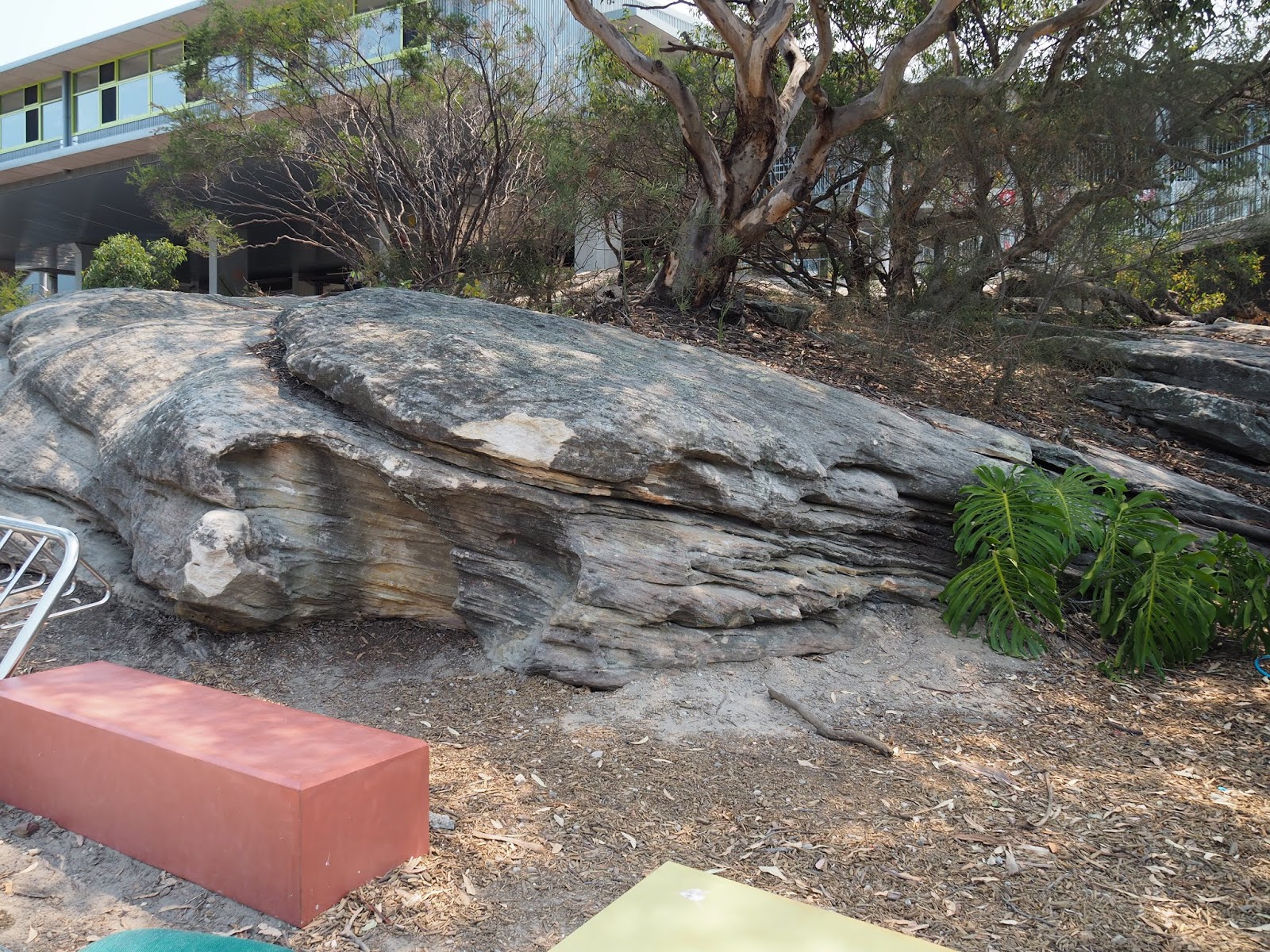
All of the sandstone around the school shows clear signs of weathering. The sandstone face below and east of the library is a good example of one form of physical weathering caused by feet.
In 1969, just after major fires in the Royal National Park, I was sent out, in full ranger uniform, partly to see if the old tracks were visible, but also to ‘show the flag’. Where a track passed over sandstone, the path to walk was much lighter than the other rock: human feet had weathered the rock.

Lightning

There used to be a poor example of a lightning strike in the old nature area, but I think we lost that. No matter, it was unimpressive unless you knew what to look for.


Around the world, there are about 100 lightning strikes, somewhere, each second. That adds up to a lot of energy hitting things.

When lighting fails to hit a building, a tree, a foolish kite flyer or an unwise golfer, it usually hits rock. Lightning often comes with rain, and when the water has already soaked into a rock, the instant heat of a lightning strike turns that water to steam, flaking off a surface layer. Once the rock is in small pieces, other weathering effects can take over.

Note that these blasts happen on high places in storms. The traces are best sought for in good weather. If you are on a high place in lightning, move away! The danger signal comes when long hair starts to float up into the air, but by then, it may be too late…

And now for my favourite rock forms, which appear in the school grounds only in minor and beginning forms, visible only to a prepared eye.

Honeycomb weathering

Geology shapes our scenery, sculpting the rocks around us, and one of the delights of my home area is honeycomb weathering, sometimes called alveolar weathering by people of French background, while others call it fretting, stone lattice, or most poetically, stone lace.

Honeycomb weathering in Hawkesbury sandstone, some of it cross-bedded, near Box Head, north of Sydney.


Much of the best-exposed sandstone near Sydney is close to the coast, and around the world, it is common to blame salt spray for honeycomb weathering. The idea is that salt spray lands on and soaks into the stone, but when the water evaporates, salt crystals are supposed to wedge sand grains off.

There is definitely more to the picture and that, and while salt spray probably plays a part, as a young man, I saw honeycomb weathering in the Budawang Ranges, 40 km from the nearest sea coast. I have no surviving photographs from that time, but I do have something rather similar from the flanks of Uluru, on the far side from where the climbers used to start.


A curious but entirely natural weathering effect on the side of Uluru.
   

Ant lions

Ant lions were the first insects I ever studied, and they make neat pits in sandy soil. There used to be lots of them under the old demountables, and there should be some under the trees. They are the larvae of lacewings, alias Myrmeleontidae (Neuroptera). The name ‘lacewings’ describes their pretty wings quite well, but ‘ant lion’ is a good name for the larval stage. Instead of hunting like lions though, they dig pits in the sand and sit at the bottom, waiting for an ant to fall in.
I once saw one of these animals capture a small weevil, but usually, they eat ants. Whatever the prey is, once the unlucky animal reaches the bottom, the ant lion seizes it in its pincers and sucks it dry. In the end, it flicks the empty husk of the prey out of the pit. Ant lions are neat!

To find these curious creatures, look for a small conical pit, 1–3 cm across in dry sandy soil. The soil may be close to one of those gum trees with sap that kills grass, or inside a hollow tree, along the edge of a building or under a rocky overhang. Sometimes, you can even see ant lion pits, right out in the open in the dry season on Cape York, in the summer around Myall Lakes in NSW and in dry areas. All they need is dry sandy soil.

A large ant lion can be 6 mm long, but 1.5 mm of that length may be the nippers that it uses to seize its prey. It digs a pit by backing into the sand and moving in a circle, flicking sand out with its head. Recent research on fossils in amber suggests they have made pits for 100 million years.

Dry sand only piles up to a certain slope, called the angle of rest, and this is the slope of the sides of every pit. At this angle, the sand is unstable and ready to tumble down if a small animal walks near the edge. As soon as sand grains hit the bottom, the ant lion starts flicking sand up from the bottom of the pit. Some sand falls down again, knocking its prey down the slope, but if the ant lion flicks enough sand out from below, the whole slope begins to slide down, carrying the food animal with it. Ant lions are easy to keep but they aren’t geological.

A moral tale for kids:

Whenever people in the outback dug a well in a sandy river bed or climbed a dune, they were in the same position as ants, except that there was no monster waiting to grab them and suck them dry. The real danger came as they dug down close to water, because damp sand will hold together, and they could dig a steep-sided hole. Then when the sand dried, it would collapse.

Each year in Australia, one or two children are killed when a sand cave collapses on them. No explorers were ever killed that way, but probably a few needed their companions to dig them out.

As you can see, in science, everything is connected. We teach them to read the rocks, and weave a web around them!

*****************************************

A small advertisement: some of the illustrations appearing here will be in my upcoming Not Your Usual Rocks. This is now moving into final editing, and will either be the subject of a contract for a coffee table book by mid-June, or it will be issued as a delicious e-book by April 2020.


School geology notes part 1


I work as a volunteer 'visiting scientist' at a local K-6 school, and the last two years have been turmoil as it was rebuilt to meet climbing population figures. In the process, some beautiful nature was destroyed, but the place is bouncing back, and I saw that there was now some exciting sedimentary geology to play with.

Today was the last day of the year, and I was there to show the teachers what is available to use, and I wrote these notes before I went.

Stories

Rocks tell stories, and some of these stories are at a simple THE CAT SAT ON THE MAT level. Other stories that the rocks have to tell are more like Virginia Woolf on a bad day.

Getting kids started on reading is a bit like edging them onto a slippery slope on a bicycle and keeping them on an even keel as they get up to speed, carried along by natural forces. OK, that’s a stretched analogy, but slippery slopes are one of my long-term temporary obsessions. All you need, in order to play is a sand dune, but a Vegemite jar half full of sand will do as well.

Once seen, never forgotten: I had to learn this sort of stuff for myself, but each bit, once I acquired it, became part of my ongoing observations. The linking theme here is that sand that is piled up collapses to form a fixed angle (for that sort of sand), and that angle shows up in dunes, rocks, sandbanks, pits and holes in dry sand and more.

When we try to pick out anything by itself, we find it hitched to everything else in the universe.
—John Muir, My First Summer in the Sierra, Boston: Houghton Mifflin, 1911, chapter 6.

A slippery slope in a jar

The thinking for this began when I had an idea to try something. I was getting ready to work on the track with Stage 2, I think. Our topic was flowers and stuff, but I spotted the rock on the right, and saw one of my favourite simple stories: current bedding or cross bedding.


I will explain what that is shortly, but let’s walk before we gallop down the slope, OK? Just watch how all of the bits come together, in the end.

Advancing dune, Sahara
Ant lion pit, coin for scale
Current bedding, as I prefer to call it, tells us something odd about sand. If you tip dry sand out of a funnel in the sandpit, it will
form a conical pile, and I can predict to within a couple of degrees the angle that the sand will lie at. We call this angle the angle of rest, and that’s the last bit of jargon.

Angle of rest in a jar. Use a cylindrical
and clean, very dry sand.
Ant lions (I will talk about them later) make pits in dry sand, like the one on the left, and the sides also lie at the angle of rest, as does the front of an advancing dune in the Sahara.

So there I was, clutching a Vegemite jar, half full of dry sand. I always carry this in case somebody happened to need a jar of dry sand, and a full jar is too heavy… I bounded onto the rock, declared that I was sitting on a 205 million-year-old fossil, then moved among the kids and showed them the jar, rolling it.
I explained that when sand is pushed along by wind or water, it gets pushed over the front, and this creates (drum roll please!):

Current bedding

Once you know what you are looking for, it’s everywhere, and any kid who has been shown the secret will be able to share it with others. Any cutting, any cliff is likely to reveal beds of sandstone, laid down as sand banks: the picture geologists have of Sydney in the Triassic (~205 million years ago) is a giant sandy river delta, a bit like Bangladesh today.


Three examples of current bedding: (top) Old Man’s Hat, Inner North Head; (centre) Sydney Road Fairlight, Manly side of the shops; and Malabar.
The shots above are easy to spot: the ones around the school need a trained eye. Let the training begin!

(A note to my teachers, less relevant to others: In all of these shots, I have left background in place, so you can come back and look at them.)


As you can see, the layering is more subtle when it comes to bush rock. The right-hand shot éabove is on the cycle track, and every cyclist going along there is running over 205 million-year-old fossils.

But how do we know the age? We don’t, not really, but the rock is Triassic, making it between 180 million and 220 million, and the sandstone is early to middle Triassic, so 205 million years is near enough for government work. Talk to me if you want more, because explanations require lots of hand waving..
 
On the western side of the school, the sawn stone has nice banding, and this is a Virginia Woolf sort of story, so here’s the Classics Illustrated/Cliff Notes version/. Iron occurs in compounds in two forms that old chemists called ferrous, which is soluble and ferric which is insoluble.
Banded iron in sandstone.
The ferrous form is now called Fe2+, and the ferric form is Fe3+. The key thing is that one can change into the other, Fe2+ seeps away, but when it changes to Fe3+, it stops where it is. Chemists say that iron II is oxidised to iron III and iron III is reduced to iron II.

Iron banding and Liesegang patterns

I didn’t find any Liesegang patterning around the school, but this is the same iron II/iron III story.


The same explanation applies to the iron banding we can see, and some of that is spectacular:
 

Joints


I was tricked when I thought I had found a joint in the sandstone. Joints are planes of weakness that are seen in most rocks, but they are particular important in the shaping of Sydney, because when sea levels fell, streams and rivers were directed along the jointing patterns, which is why the city has so many east-west and north-south valleys.

When the sea rose at the end of the last Ice Age, it flowed into those valleys, and we say that the fern leaf pattern of the harbour is a drowned river valley. Anyhow, those ‘joints’ were cut with a saw, but they give you some fresh rock to look at. There are no joints that I can see in the school grounds now, but below are some local joints:

  
Above: three examples of joints: (top) Old Man’s Hat, Inner North Head; (centre) Sydney Road Fairlight, north side; and on the way to Fairy Bower.

There appears to be a limit to the number of images I can insert, so this is continued in part 2.