Search This Blog

Monday, 21 October 2013

South Coast trip, part 1

This portion of my blog will be in about half a dozen parts.  Each will be packed with photos taken on a recent trip down the NSW coast, mainly about geology, though we will start off with some biology, because that was how it panned out.  This is general research and backgrounding for a couple of books that are in the pipeline

Our centre of operations was Bermagui, about 400 km south of Sydney, and the purpose was to gather material for an upcoming book.

We worked known geological sites, and prowled the areas to see what else was around.  Please note: I am not a geologist, and my conclusions, while reasonably informed, are open to question.

Our first beach was Barragoot, south of Bermagui, and that was mainly to look at the dunes there for yet another book. Still, no sooner had we set foot on the southern end, where a lagoon feeds into the sea, than we had a major find:

 These four pictures show (I think) a male red-capped plover. My confidence was increased when I managed to get the next two shots:


I believe that the bird on the left in the first shot, and on the right in the second shot is a female. This plover is classed as endangered: it nests on the open beach. We learned about it on a previous field trip when we mistook another bird for this one.

Well, that messed up our plans for the beach a bit, because we needed to stay off the dry sand at the back of the beach, but we headed several hundred metres down the beach before veering up, once we had left the parent birds well behind.  Even so, we were very cautious.

We worried, though, because of some strange tracks that we found, the ones you can see here to either side. They appeared to be made by a heavy animal, perhaps hopping on one leg.  For the most part, they were too indistinct for us to recognise.

We followed them along until we came to these, which looked rather more like a four-legged carnivore. People are usually barred from walking dogs in areas where the plovers nest, but there were no accompanying human tracks.

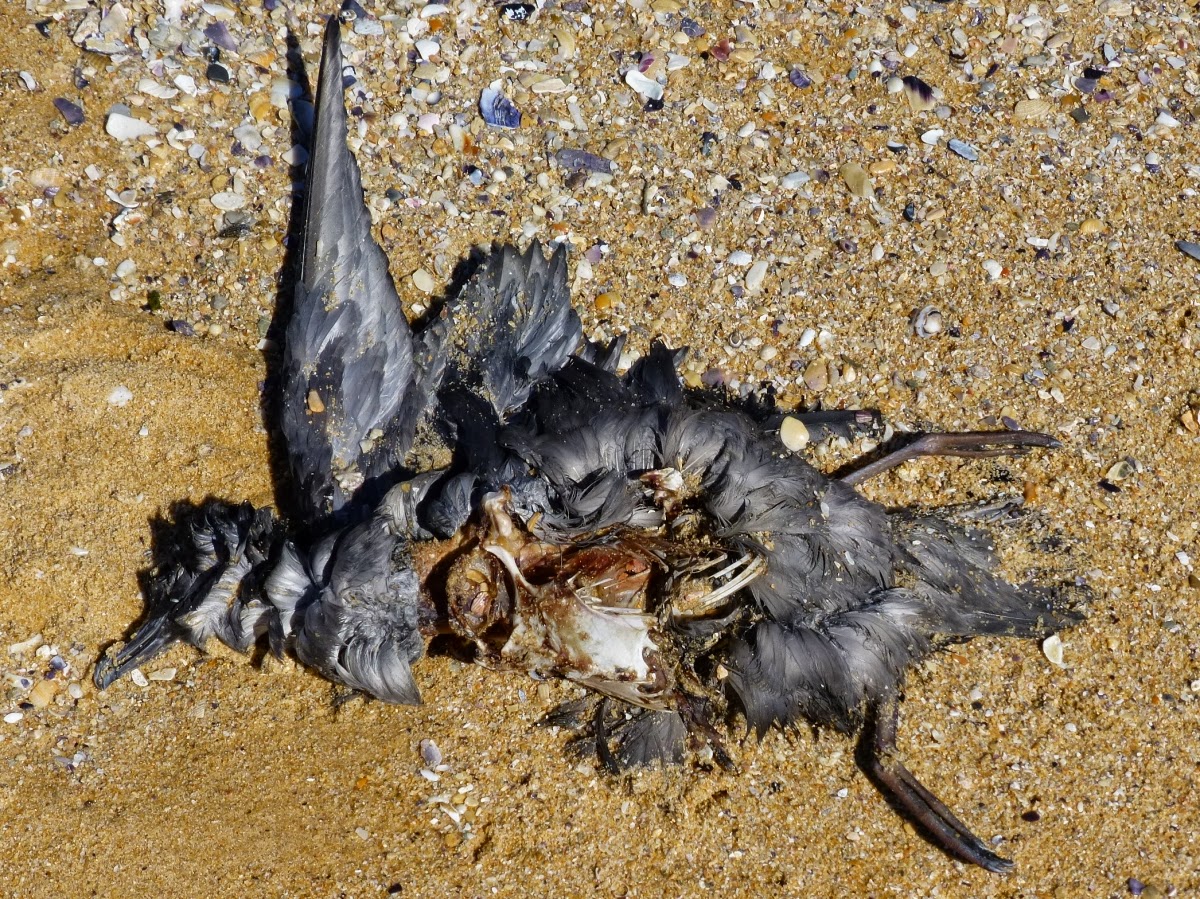
I just hope the birds are OK. There were quite a few birds on the beach that were not OK, and it seems that quite a few shearwaters (alias mutton birds) have been dying off the coast.

These wash ashore and provide food for a variety of life forms: small land shrimps, about 4 mm long, small earwigs, and also crows.

Life goes on.

So did we, having sated our interest in matters biological, we headed on down to bother the rocks at the southern end.

The rocks of the south coast are curious. At Myrtle Beach, near Durras Lake, the base of the Sydney Basin rises above sea level, and I will come to that in a later post.

All of a sudden, we go from early Permian, maybe 300 million years old, to Ordovician, perhaps 450 to 500 million years old. That means the rocks we were looking at had a great deal of history: they had been formed, buried, heated, run through by hot liquids, maybe even by molten rock, they have been bent and bashed, so there is always some mystery there.

The veins you see here have to be quartz, because I succeeded in scratching a glass bottle on them, but I confess my ignorance as to what that means.

More Research Needed!

Next time: folds and faults at Aragunnu, bird-covered rocks, a dyke, an intrusion, and some columnar-jointed rhyolite at Mimosa Rocks.

For more stuff like this:
I add tags to all of my blogs, and my tags are fairly WYSIWYG. Look further down, and click on one of the links.

Or

See also:

* Sapphire Coast Geo Trails, part 1, Bermagui and North.

* Sapphire Coast Geo Trails, part 2, Bermagui to Tathra.

* Sapphire Coast Geo Trails, part 3, South of Tathra.


Links to the other four parts:


Part 2
Part 3
Part 4
Part 5

Sunday, 20 October 2013

Dr. Livingstone I presume?


That quote says it all.  Stanley and Livingstone met in the African wilderness, 140 years ago.  We all know the quote—but how did it come about, and what really happened?

In reality, it was a bit different from what we assume—or presume.

I have been away, down the coast, bothering rocks for the past week, and there  will be more on the rocks later. I took my favourite delving book, A Bedside Nature, with me: it is a collection of interesting excerpts from that stalwart of the scientific trade, Nature.

And so I found, again, the true story. Here is how it really happened, before the myth-makers ran off with the yarn and concocted a farrago from it:
The well-dressed British explorer.

"In an instant, he recognised the European as none other than Dr Livingstone himself; and he was about to rush forward and embrace him, when the thought occurred he was in the presence of Arabs, who, being accustomed to conceal their feelings, were very likely to found their estimate of a man upon the manner in which he conceals his own. A dignified Arab chieftain stood by, and this confirmed Mr Stanley in his resolution to show no symptoms of his own rejoicing or excitement. Slowly advancing towards the great traveller, he bowed and said "Dr Livingstone, I presume?" to which address the latter, who was fully equal to the occasion, simply smiled and replied "Yes". It was not till some hours afterwards, when alone together, seated on a goat skin, that the two white men exchanged those congratulations which both were eager to express, and recounted their respective difficulties and adventures." 
— Nature, 6, 184, 1872.

So it wasn't Victorian middle-class reserve at all, and there was no sang froid. There was no stiff upper lip involved.

They were simply making cultural assumptions about their audience.

You know, you might just be able to win a beer at the pub with something like that.

Next post: our less-than-well-dressed  explorations of some Australian geology on the south coast of New South Wales.


* * * * * * *
This blog covers quite a few different things, so I tag each post. I also blog about history, and I am currently writing a series of books called Not your usual... and the first two have been accepted by Five Mile Press, The offcuts appear here with the tag Not Your Usual... . For a taste of Australian tall tales, try the tags Speewah or Crooked Mick.   For a miscellany of oddities, try the tag temporary obsessions. And language us covered under the tags Descants and Curiosities, while stuff about small life is under Wee beasties.


Saturday, 12 October 2013

A bit down

Looking down from one of Australia's smallest mountains, now
just called Comerford's hill to the Hunter River.  The story of this
downgraded mountain is, however, another story. I must remember
to write it down when I get some down-time.
No, not me, personally—I'm not down, never have been, never will be. It's just my metaphorical pen that's about to be down, because I have been going like a mad thing for the past two weeks.

My wife has been away, so I have been laying down large slabs of pre-prepared text for an extremely large history of science with a few excursions into technology. It started as part of the Not Your Usual series, but I don't think it will quite fit that mould.

More of that project later, but my pen will be down for a week as we take a bit of a break. I will probably be messing around the edges of the project, but we are going to be out and about, enjoying the good weather.

Now about down: this word came to us from the Celtic word dún, meaning a hill fort, also seen in the old name for Edinburgh, which is Dunedin, a name now preserved in an intensely Scots city in New Zealand, and Florida has a Dunedin as well.

The word 'dune', as in a sand dune, is also part of the same family, though it came into English in the 18th century from French, but the French got dune in this sense from the Dutch, who obtained it from the Celts.

Today, the word lives on in the lexicon of ecologists and also of those environmental despoilers who drive dune-buggies, which must surely have been invented in America, for English buggies have just two wheels, while American buggies have four wheels.

At the same time, the word lived on in its original form in Old English, where dún was an adjective meaning mountainous or hilly, so dún-land was hilly or mountainous country, while a mountainous road was a dún-stræt, a down-street, where down was used in the sense of the Downs in England, which, confusingly, are also called uplands.

In late Old English, the form dūne (meaning 'from the hill') was weakened to the form adūne, which appears in Marmion by Sir Walter Scott in the form 'His gorgeous collar hung adown'. Later, adūne was shortened to just dūn, and came to be spelt doun or down by the Norman clerks, who also wrote hūs as house.

Both forms were used in Chaucer's time, and in his version of Troilus and Cressida, we read:
Adoun the steyre anoon-right tho she wente
In-to the gardin, with hir neces three,
And up and doun ther made many a wente,
So how did the hill come to be a direction consistent with the force of gravity? Simple: adúne, in the sense of from above, became the now archaic term 'adown', meaning in a direction off the heights or the hill. Then came a process that James Murray, the creator of the Oxford English Dictionary called aphesis, a shortening by the loss of the first syllable.

The word 'squire' is merely an aphetized form of the older 'esquire'. If you prefer, 'squire' is an aphetic form of 'esquire', just as 'down' is an aphetism derived from 'adown', and 'escape' sometimes becomes 'scape'. We are still in the process of aphetizing 'around' to 'round', it seems, so the phrase 'he came and looked round' for 'he came and looked around' is still anathema to some.

Then there is 'down' as in the old Marx Brothers gag, "How do you get down off an elephant?" followed by "You don't get down off an elephant, you get down off a duck." This 'down' comes from the Old Norse dunn, just meaning down, as in the first feathers of a bird, while the adverbial 'down' in Old Norse is indicated by niður reminding us of the English word, 'nether' (or the Dutch neder, for that matter). In a similar vein, today's Norwegians have a delightful term, nedenunder, which means 'downstairs'.

In England, 'down' took on a new meaning in the 19th century, when all trains going away from London were 'down trains' (except to Dr Spooner, who may or may not have said "Sir, you have hissed all my mystery lectures, and must leave by the next town drain") and trains approaching London were seen as going up to London, so they were 'up trains'.

Aside from the adjectivally down trains, one can down a drink or an opponent, walk up the downs, or stroll down a hill. Surely only a few words in any language can ever play the role of adjective, noun, verb, and adverb? And if that isn't enough, the word can also be used in the refrains of songs, where it has no meaning at all.

Hey-down-down, ho-down-down . . .

Saturday, 5 October 2013

And don't end a sentence with a preposition

Pedantry is not necessarily a bad thing. [1] For example, I am pedantic in my spelling, my research is meticulous, my planning is exemplary, and I never start a sentence with However, because, at the age of 11, my history teacher told us that writing history was about writing with style, with respect for the English language. There were few hard-and-fast rules, he said, but "however" should only be used as a marker that two things were being contrasted.

I recall thinking to myself "However you look at that, there are probably times when it's acceptable...", but I said nothing: it was probably the first time I showed a glimmering of wisdom. The second was when I adopted the rule — and I have stayed true to it.

Why? Easy: in most cases, sentences that begin with that word are clumsy and incompetent, so I have a personal rule that reflects John Rae's thundering ex cathedra statement. When I start beginning a sentence with the H word, that is a coded indication that I am suffering brain damage.

As a rule though, if you will forgive the expression, rules are made to be broken. Infinitives may be split asunder or prised apart with a crowbar, or participles may be dangled threateningly over yawning chasms in contravention of the Geneva Convention, and nobody will even blink. Still, there are two rules that you breach only if you have no fear.

The one rule which every dull and unaccomplished member of the lumpenscrivenariat knows is that a sentence must not end in a preposition when you are writing in English. Second-rate pedants and fourth-rate teachers have drummed this 'rule' into the thick-boned skulls of countless generations as an item of rote learning which has about the same validity as revolutionary slogans chanted by the masses.

Working writers know this 'rule' has no validity, but cowed by the bellows of the outrageous and outraged herd, they are likely to avoid ending a sentence in a preposition, if only to avoid the accusations emanating from the more bovine sort of reader. The true masters of the language have never had any problem with this rule, which was pilloried most delightfully by Winston Churchill, when he commented that ending a sentence with a preposition was something " . . . up with which we shall not put".

These days, it is worth our while to ask a simple question which could not have been answered in the past, but which is easy to tackle today, using machine-readable texts. That question: how do the experts of the past stack up? H. G. Fowler told us that just about every English writer of any merit ended sentences in prepositions, but how common was the practice? Was it an occasional lapse, or the regular thing, just as it is in everyday spoken English?

These days, with so many classic texts available in machine-readable form, finding the answer is easy. William Shakespeare's complete works reveal quite a few sentences ending in prepositions. The endings are 'over' (6), 'under' (2), 'up' (79), 'down' (77), 'to' (45), 'for' (45), 'by' (38), 'with' (21) and 'from' (2). All in all, Shakespeare did not seem to think it wrong or inglorious to end a sentence with a preposition.

The King James Bible, generally regarded as a foundation text of modern English, setting many of today's standards, is also available in electronic form. A pass of the global exchange mechanism in my computer reveals the following sentence endings: 9 overs, 1 under, 68 ups, 39 downs, while 'to' ends four sentences, while 'for' ends two sentences. There are 9 sentences ending in 'by', 2 ending in 'with' and 2 ending in 'from'.

Search where you will among the works of classical writers of English, the heroes of literature, and you will find them joyfully breaking the 'rule' that never was. Chaucer did it, Charles Darwin did it, so did John Bunyan and Jonathan Swift, and the Reverend Gilbert White, in his Natural History of Selborne. In fact, no author deemed worthy of electronic storage by Project Gutenberg seems to be entirely free of this wicked sin of ending a sentence in a preposition. As a law of careful writing, it seems only to be honoured in the breach.

And while we are at it, what about that second crime against good language, according to the lowest grade of pedant, the act of commencing a sentence with a conjunction (as I just did)? If that is a true law, then breaking it cannot be a grievous and heavy sin, for the translators of the Bible for King James start some 12,500 verses with "And . . .", and about 1400 of their verses begin with "But . . ."

But then again, maybe they did not know the fabled bishop who supposedly first ruled that sentences in the English language may not end in prepositions, or perhaps they knew that the bishop in question was not averse to starting sentences with a conjunction, that it was something he would readily put up with.

———

[1] Mind you, I once got into trouble for explaining, in a footnote in an official government publication that "a pedant is a footnote fetishist", a comment that brought guffaws from all but the pudgy-brained pedants it was aimed at.

* * * * * * *
This blog covers quite a few different things, so I tag each post. I also blog about history, and I am currently writing a series of books called Not your usual... and the first two have been accepted by Five Mile Press, The offcuts appear here with the tag Not Your Usual... . For a taste of Australian tall tales, try the tags Speewah or Crooked Mick.   For a miscellany of oddities, try the tag temporary obsessions. And language us covered under the tags Descants and Curiosities, while stuff about small life is under Wee beasties.


And home again

I got back in last night after driving about 750 km, mainly on freeways.  It was leisurely on Wednesday as I made my way to Goulburn.

I was on my way to Canberra to offer two workshops in two ACT  libraries, related to my Australian Backyard Naturalist, which, as attentive readers will be aware, was joint winner in the Children's Literature category of the W A Premier's Book Awards.

The workshops were actually planned for the start of the year, but I injured my back working on the latest book, seen above right.  Not, not in lifting it, though The Big Book of Australian History weighs in as a hefty 1.7 kg or 3 pounds 12 ounces.

Basically, I was sitting the wrong way and doing exercises to strengthen a dodgy knee, but doing the exercises the wrong way.  So the workshops were delayed.

I know the road fairly well, and I had a number of target locations along the way, where I planned to collect wee beasties and some leaf litter and vegetation to use in the workshops.  I also got some good geology shots, like the above cutting, not far from Berrima.

I also stopped to buy a few books at Berkelouw's Book Barn.  I have been dealing with them for more than fifty years, starting with old Henry, who was a rogue. The family say he would never have been naughty, but he offered me good money for a document that I was about to return to public hands.  He backed off sharpish when I said "Henry, I think you'll finds this comes under the Archives Act", words he had not expected to hear from a naive stripling in his early twenties.

I had established to my satisfaction that the object, a large ledger, had been stolen in the 1930s, and had come to me as part of a deceased estate.  I had only showed it to him as a matter of interest as I headed for the Mitchell Library to put it back.

That's a side issue.  I got to Goulburn, gathered some spiders with a sweep net, and rested up. Thursday morning, I drove on to Canberra, a bit over an hour away.  Driving along Lake George, I saw this storm coming:


No matter, I got through the mixed rain and slushy hail, and got to my first workshop and set up at Erindale.  Some writers see book tours as a way of promoting sales, and while my publisher probably has that in mind, I am largely indifferent to sales, because I am paid a fee to do these books, and no royalties.  So my aim is to promote ideas and ways of thinking.  If my listeners buy my books, that's good, because they will acquire more of the ideas, but that's as far as it goes for me. Forget the dollars, I want their hearts and minds.


So for me, the trick in workshops like this is to show young minds things they can do, adopt, and use in their own ways.  The materials I use are deliberately homely, mainly discarded jars and containers, along with rubber bands, flywire, sticky tape, cheap plastic tubing, plaster of Paris: all stuff you can get at the local hardware shop.  Notice the bucket with the rope above: that's a collecting tool!

What I show and teach is grass roots science, where you can satisfactorily make your own equipment. For examples, see The Collector's Art, A home-made rain gauge, Thinking about slugs and snails, Close-up photography, Adventures in the leech trade and Leech-wrangling—and follow the tags on those articles (or on this article, for that matter)to find more of the same.  I plan to add some more of these.

 It was cold in Canberra, as this shot of my car's rear window on Friday morning attests:

My hand-writing is definitely getting worse!  Anyhow, it warmed up, we did another workshop at Kippax Library, and then it was off  home.


The trip had a number of pluses for me, the main one being that I have rejigged and greatly my plans for Not Your Usual Science. So now I'm getting back to that.

Saturday, 28 September 2013

Romeo, Juliet and me

I suppose I didn't approach the Sydney Theatre Company's production of Romeo and Juliet at the Drama theatre in the Sydney Opera House with the right reverent attitudes.

Of course, I am rather keen on C. J. Dennis' The Sentimental Bloke, written a century ago in Australian vernacular—and in particular, the part where they go to see said play.  Here's an excerpt, but the whole of this portion is here: strongly recommended!

'Wot's in a name?" she sez. 'Struth, I dunno.
A still from the Raymond Longford's 1919 Australian
silent movie of The Sentimental Bloke.
Billo is just as good as Romeo.
She may be Juli—er or Juli—et ——
'E loves 'er yet.
If she's the tart 'e wants, then she's 'is queen,
Names never count ... But ar, I like "Doreen!"

A sweeter, dearer sound I never 'eard;
Ther's music 'angs around that little word,
Doreen! ... But wot was this I starts to say
About the play?
I'm off me beat. But when a bloke's in love
'Is thorts turns 'er way, like a 'omin' dove.

This Romeo 'e's lurkin' wiv a crew ——
A dead tough crowd o' crooks —— called Montague.
'Is cliner's push —— wot's nicknamed Capulet ——
They 'as 'em set.
Fair narks they are, jist like them back—street clicks,
Ixcep' they fights wiv skewers 'stid o' bricks.

That aside, there were warnings in the foyer that there would be bangs, flashes, smoking and nudity.  Clearly, this was to be a modern production, and I am a bit of a traditionalist.

I grimaced slightly at this news, and declared that if Friar Laurence got his kit off, I was leaving.  No worries there, it was only R and J who disrobed—and they kept their knickers on, mainly because all the actors were miked (!!) and they needed somewhere to hide the battery pack and transmitter.  Sadly, the microphones did nothing for their diction, but that was OK because they were messing about with the script.

Anyhow, it being Grand Final season in Australia, when the non-round-ball football codes (we have a number of them, but Rugby League and Aussie Rules are the worst in terms of making the fans silly) send out their stupidest alpha males to maim each other, and all the bogans go mad.  So I asked Chris if we should barrack for the Montagues or the Capulets, and then things started to degenerate.

I think it was two of the men (Capulet and Paris, as I recall), playing a sort of gentle squash game with tennis racquets and a tennis ball against one wall of the revolving set while they chatted. The revolving set was at rest at the time, and it worked well—it was actually two concentric revolving floors.  Apparently it has had some teething troubles, but now all is well.

Then again, maybe the rot in my mind started earlier.  Even before the opening, a ladder somehow got involved with a part of the audience as it was carried down off the stage before being taken back into the wings, and I expressed the hope that they would enliven the proceedings by a short excerpt from 'Pyramus and Thisbe', re-scored for two choruses, with the ladder playing the part of Wall and offering a plethora of chinks for the chorus members to use.  That would have been good, I said, and after the play—but only then—she agreed.

Still, we had no such luck getting a look at P&T, but hope springs eternal, and just after Friar Laurence slipped in one of the sonnets (116: "Love is not love which alters when it alteration finds ...") as the marriage lines, I began to hope for a proper pastiche.  (This is named after Jean-Luc Pastiche, the inventor of the Hashed Mashed Potato Treat.)

(I might add that Friar Laurence was seen on stage, puttering around in a garden of ferns, collecting flowers from them!  Some botanist and druggist he'd be!  Mind you, they were probably GM ferns, so I suppose anything's possible.)

Given the sonnet cross-over, I began to hope for a cage fight between Macbeth and Macduff (didn't happen), a cream pie fight between Titania and Oberon, formation nude bathing in a bird bath by knights in armour, a cameo role for Caliban and a kraken (all ditto).  It wasn't my fault: with dodgy diction, I had to fill in the gaps for myself.

I began to long for Sir Andrew Aguecheek on roller skates or the return of the ladder to retrieve helium balloons that had escaped in the party scene, with Bottom and Falstaff as the retrievers, dancing on the ladder to the rock music playing for the party.  Again, no luck, but all the party-goers wore white rabbit masks and that was a plus.

Mind you, it wasn't hard to spot Capulet, though, because he had a greasy pony-tail that looked silly at the back of a rabbit. They drank a lot but ate nothing, making it unlikely that we would hear Puck's immortal line:

"Lord, what foods  these morsels be!"

But at the end, Juliet was still alive, and she had a gun, and apparently knew how to use it.  I'm fairly sure that's not how it happened in the 1600s.  I hoped she would fire a shot into the fly loft, with two rubber chickens falling to the stage, but Paris had used three shots to try and kill Romeo, Romeo got the gun and used one to kill Paris, and she must have wanted to make every shot that remained count, so no rubber chickens.

Still, when a pantomime horse crossed the stage, followed by a hunchback crying "A Norse, a Norse, my Kingdom for a Norse", a flood of slaughter ran through the theatre when we realised he was doing a Danish accent and waving a skull.  We were a sophisticated audience.

Actually, that last bit might not have happened (but it should have), or if it did happen, it might have been a flood of laughter that ran: my notes are hard to read, and by then I was concentrating on the structure of the next book, and trying not to echo 'The Bloke' in the fight scenes:

"Put in the boot!" I sez. "Put in the boot!"
"'Ush!" sez Doreen ... "Shame!" sez some silly coot.
Well might we all say, "Put in the boot" to this performance.

Next time, I want a re-run of Charley's Aunt.  If it has nudity, I want the actors on skates, on ice, and juggling, so as to improve the chances of a satisfactory and fundamental shock to them, rather than to the audience.

Wednesday, 25 September 2013

A quick travel tip

I am putting this in as a warning to other intrepid travellers who may foolishly rely on the standardisation of the EU.

The issue I have is with electric plugs, and the adapters one uses to get power out. I am cunning, and I carry an Australian-standard power board with four outlets, and one adapter for each country I plan to visit.  We often have two cameras, two tables, one netbook, one iPod and two phones with us, so four outlets isn't excessive, but it's enough, provided we can plug the powerboard in, hence my tale.

I have edited and/or prepared 16,000 words of text in the past four days, and my mind is turning to goo, because it's all about serious physics stuff.  So I am doing some file-gardening, and I came across two pictures of EU standard adapter plugs, both of which work in Italy.


In theory, one adapter should do for the whole of the EU, because they are standardised.  The practice is different.

The problem is that the fat one is the EU standard, but the Italians often have skinny socket, and if you ram the fat plug in, you may break the socket.  A few of the sockets take both, but you need an adapter for the adapter, and these aren't easy to find in the middle of a city like Rome, because hardware/electrical stores are not in high demand among tourists.

The plug on the left is an adapter for the adapter, and they fit together like this:

Don't be alarmed, but do be wary!

Sunday, 22 September 2013

The camels are coming, hoorah, hoorah!

I am busily working away on my Not Your Usual series, and I have been getting a few odd reactions from people. friends even, who hear that I am planning them as e-books—and that I will be self-publishing.

Part of my reasoning is that I can get my ideas out faster and more cheaply as e-books, but mainly, I don't see paper vs digital as a wholly either/or dichotomy.  I see e-books as something different, and rather more fun, and I have been thinking this way for a while.  What now follows was largely written in September 2000, just as the Sydney Olympics kicked off. I came across the text while selecting content for Not Your Usual Science, which I will have more to say about later (basic message: we need a general survival-level look at science and how it works).

The bits from 2000 make up most of this blog entry, but the comments on the new series weave through it, and are obviously a more recent application of long-standing views. Not that it matters much that I have held these views for a while: what matters is that I hold them now.

First up, e-books need not be bad, even if they are self-published, but they need to be looked at in a different way to print books. Here, I need to recall one of the truisms of research in this area, as explained by Lee J. Cronbach, in the 1970s, back in the days when my main trade was educational measurement.

If you are going to compare a horse and a camel, said Cronbach, you need to compare a good horse and a good camel; the researcher should not just take two camels and saw the humps off one of them. In this case, the hump-sawing is minimal, but no attempt was made to use the special advantages of electronic communication.

A fair test of two media would involve giving two content experts the same amount of time to take a set of information, and develop it into a worthwhile use of the selected medium, rather than holding a contest between a horse and a bicycle, and deciding that neither is very useful for crossing deserts.

I submit that, for the most part, e-books, especially self-published ones, are no more than amputated camels.  The writer of an e-book needs to spend a bit more time on the design and redesign of saddles, bridles and other bits for the animal that is created.

In the next week or so, I expect to see the simultaneous release of two editions of the same book, the Big Book of Australian History, one on paper, and the other as an e-book.  I haven't seen either, yet, but when I prepared the way for the e-book version, I found some 500 hot-links to go in the text, taking my readers directly to the references and sources.

The next few years will see a number of publishers engaging in what Marshall McLuhan called 'rear-view mirror driving', the sort of thinking that saw a steam locomotive called an 'iron horse', an automobile 'a horseless carriage' and labeled radio as 'wireless telegraphy'.

This was the sort of thinking that led Hollywood to put vaudeville performers on the large screen, that led television producers to put radio performers on the small screen, and led the British Post Office to say that telephones would never take off, as people had messenger boys to do all that.

The e-book medium will shape itself as time goes on, and many of the early standards will fall by the wayside. The bad Dickens e-book will be the text of one or more novels and no more.  They are what some of us used to call shovelware.

The good Dickens e-book will explain why dinosaurs are mentioned in the first paragraph of Bleak House (it was published just after the Great Exhibition of 1851 in London, where dinosaurs were first made popular), what 'wards in chancery' were, and so on, with hot links in the text or marginal links.

A truly excellent Dickens e-book would offer a way of electronically folding the page corner, a character list, and so on. (Yes, well, we have most of that now.)

The brilliant Dickens e-book might offer Gustav Doré's pictures of the poor in London (two on the left), and perhaps New York's 'other half' of Jacob Riis (right, above), contemporary maps and illustrations, newspaper reports, and so the list would grow.

The point always would be to provide an optional broadening of the base, comparisons, correlations, the links that assemble factoids into knowledge.

Scholarship, now seen as a fairly odd and obscure habit, would begin to pay off, not only for the scholars, but for those who have the chance to follow in their footsteps and really enjoy what Dickens has to offer, putting things like coal-whippers in a proper context.

The same applies, vice versa and mutatis mutandis, in other realms.

Thursday, 19 September 2013

In praise of Ada Jackson...

Or as she was known in Perth society, Mrs. William Fawcett, after her marriage in late 1929 or early 1930 (the papers are a bit confused about this) to a Sydney managing director called William Fawcett.

By then, Ada Jackson had, unusually for her time, acquired a Bachelor of Science in zoology, and even more unusually, she had an M. Sc. for a thesis on worms of some sort.

She had a daughter within the first year of marriage, but where she had been prominent in the press, gadding about with her sister Nina (they lived in Forrest Street, Peppermint Grove, which says the family was well-off), after her marriage, she disappears from the social scene, a bit.

Then in the 1940s, she published two books, Seashore Swamp and Bush (1941), and Beetles Ahoy! (1948). The illustration you see here is from Beetles Ahoy! and scanned from the cover of my own copy. As you can see, it looks a bit old-fashioned now.  Don't be too unkind: I used to look like the boy (and some might say I now look like the old man).

Ada Jackson's two books were well received and praised, and Beetles Ahoy! was highly commended at the Children's Book Council of Australia  (CBCA) awards.

I received my copy of that book in about 1951, and I was immediately entranced. It was told as a story, where two children found that their next-door neighbour was an expert on wee beasties, or as we call them now, minibeasts.

My own book, on the left, was directly inspired by Ada Jackson's book, though I chose to write in a straightforward fashion. It goes in some detail, into the ways that ant lions live, and that was something I learned about from reading her book. The main difference was that I explained how to wrangle ant lions.

Australian Backyard Naturalist was, I had hoped, likely to be short-listed for the CBCA factual books category, but winning is always going to depend on the tastes of the  judges, and so I missed out, even though I had been the winner in the same category with a similar book that I thought had less to offer, two years earlier.

Still, I was over in Perth this week to share first prize in the W.A. Premier's Book Awards—and in Ada Jackson's own backyard, so to speak!  (By the by, my co-winner, Pookie Aleera is Not My Boyfriend is a charming and totally worthy book, and a number of librarians that I know were annoyed that, while short-listed in the CBCA awards, it did not win its category.  I was pleased to keep company with it, and delighted to meet the author at a CBCA function in 2014.)

So I was delighted to have the chance, in my acceptance speech, to sing the praises of Ada Jackson, who died in 1996, without my ever having met her.  But if we never met , I have taken on her mantle, and with luck, I will help ensure that other generations gain, at second-hand, her inspiration. Styles change as technology makes new things possible, but underneath, there remains a golden thread of simple delight.

(I am now, in 2017, a "visiting scientist" in a local school, looking more than ever like the old man on the cover, and I am busy lighting fires under my 500 new grandchildren.)

Every book bar the first book owes something to what went before, and that first book had its roots in the oral tradition.  I dearly wanted to take my first serious adult history to Oz Worboys, my old history teacher, so I could place a copy in his hands and say "This is all your fault, you know!", but he had died five years before the book came out.  Now I know when Ada Fawcett died, I realise that I could have caught up with her.  I wish I had.

Friday, 13 September 2013

Gems among the put-downs

Not Radulph Glaber...
This post came about because I was reading a history of Sicily, a Kindle book, on my tablet, as I was coming home today, and encountered this:
…one, the notoriously unreliable monk Radulph Glaber (the wildness of whose imagination was rivalled only by that of his private life, which gives him a fair claim to have been expelled from more monasteries than any other littérateur of the eleventh century)…
—John Julius Norwich, The Normans in the South, 1016–1130, 1992.
Perhaps that was malicious, perhaps it wasn't. It was certainly fun to read, and I'll bet it was fun to write. I have committed one or two like that (but I'm not telling where), and I know how it feels.  And normally, the author can offer a claim of truth and public benefit.

Then I recalled that I had a few more barbed comments, not too unlike it, at home, on file. So I just opened the file, added the Norwich one, then pulled out the others for sharing. I was going to call this selection "literary malice", but a few of them don't quite fit the description "literary", and not all of them were malicious.
I have no doubt of your courage, Sir Robert, though you have of mine; but then consider what different lives we have led, and what a school of courage is that troop of Yeomanry at Tamworth — the Tory fencibles!  Who can doubt of your courage who has seen you at their head, marching up Pitt Street through Dundas Square onto Liverpool Lane? . . . the very horses looking at you as if you were going to take away 3 per cent. of their oats.  After such spectacles as these, the account you give of your own courage cannot be doubted . . .
— Sydney Smith (1771 - 1845), in a letter to Sir Robert Peel, June 20, 1842, quoted in Charles Mackay (ed.), A Thousand and One Gems of English Prose (n.d.), p. 400.
Mr Henry James has written a book called The Secret of Swedenborg and has kept it.
— William Dean Howells (1837 - 1920).
Born in Warsaw in 1838 and died there in 1861, aged twenty-three.  In this brief lifetime she accomplished, perhaps, more than any composer who ever lived, for she provided the piano of absolutely every tasteless sentimental person in the so-called civilized world with a piece of music which that person, however unaccomplished in a dull technical sense, could play.  It is probable that if the market stalls and back-street music shops of Britain were to be searched The Maiden's Prayer would be found to be still selling, and as for the Empire at large, Messrs. Allan of Melbourne reported in 1924, sixty years after the death of the composer, that their house alone was still disposing of 10,000 copies a year.
— Percy A. Scholes, The Oxford Companion to Music, 9th edition, 1955, page 64.
On behalf of Australians everywhere, I declare that last one to be malicious!
In retrospect I think my essay on Teilhard was good of its kind, but I confess that when on the insistence of an American writer friend I read Mark Twain's 'Fenimore Cooper's Literary Offences' I bowed my head in the presence of a master of literary criticism.
— Sir Peter Medawar (1915 - 1987), Plutos's Republic, introduction, 22.
These are fun:
Andrade is like an inverted Micawber, waiting for something to turn down.
— Sir Henry Tizard (1885 - 1959), recalled by C. P. Snow (1905 - 1980), Science and Government, 1960.
The hatchet is buried for the present: but the handle is conveniently near the surface.
— Sir Henry Tizard (1885 - 1959) on Lord Cherwell, recalled by C. P. Snow (1905 - 1980), Science and Government, 1960.
And Snow himself is always good value:
It would have been more accurate for Leavis to say that there has been no debate between him and me.  There has not: nor will there be.  For one simple and over-riding reason.  I can't trust him to keep to the ground-rules of academic or intellectual controversy.
— C. P. Snow (1905 - 1980), The Case of Leavis and the Serious Case, 1970.
Critics like Leavis always take a pounding, but so do others, and so does criticism:
You ought to be roasted alive, not that even well-cooked you would be to my taste.
— J. M. Barrie, to George Bernard Shaw, in response to GBS's criticism of his plays. 
When I am dead, I hope it may be said:'His sins were scarlet, but his books were read.'
— Hilaire Belloc (1870 - 1953), 'On His Books' in Stories Essays and Poems, Everyman Library 948, 1957, 413.
And then there was the one attributed to Sibelius, I think, to the effect that nobody ever erected a statue to a critic: I have yet to get a reliable source for that, so it isn't in my files. The same goes for the alleged Max Reger letter to Rudolph Louis. Louis was a critic for the Münchener Neuste Nachrichten and Reger allegedly wrote: 
I am sitting in the smallest room of my house. I have your review before me. In a moment it will be behind me!"
("Ich sitze in dem kleinsten Zimmer in meinem Hause. Ich habe Ihre Kritik vor mir. Im nächsten Augenblick wird sie hinter mir sein.")
It's all over the web, and even in Wikipedia, but I am still checking. Now, one last poisonous put-down, to which there was (and is) an antidote:
It was very good of God to let Carlyle and Mrs Carlyle marry one another and so make only two people miserable instead of four.
— Samuel Butler (1835 - 1902), quoted in Henry Festing Jones, Samuel Butler, a Memoir, 1920.  Butler, by the way had been a sheep farmer in New Zealand, for what that's worth.
Here is an alternative view on one of those Carlyles: the Jenny mentioned below was Jane Carlyle, the same Mrs. Carlyle mentioned by Butler.

Jenny kiss'd me when we met,
Jumping from the chair she sat in;
Time you thief, who love to get
Sweets into your list, put that in:
Say I'm weary, say I'm sad,
Say that health and wealth have miss'd me,
Say I'm growing old, but add,  Jenny kiss'd me.

— (James Henry) Leigh Hunt (1784 - 1859), Rondeau.

When I visited the Carlyle's house in London's Chelsea in 2010, the chair was still there, but I was neither allowed to sit in it nor to photograph it, the repulsive, anal-retentive toads!  All I have to recall it by is that small verselet.  There's plenty more in that commonplace quotes file that I should share.

Hmmm.  You know what?  I think I have just found another title for the Not Your Usual... series. I just checked, and there are more than 73,000 words in that file.  A bit of judicious weeding and I'll have a nice collection for injudicious reading!

Update, a few hours later: trimmed to 70 000 words, roughly banged into epub, mobi and pdf formats. A bit of cleaning-up to go, a bit more weeding...


* * * * * * *
This blog covers quite a few different things, so I tag each post. I also blog about history, and I am currently writing a series of books called Not your usual... and the first two have been accepted by Five Mile Press, The offcuts appear here with the tag Not Your Usual... . For a taste of Australian tall tales, try the tags Speewah or Crooked Mick.   For a miscellany of oddities, try the tag temporary obsessions. And language us covered under the tags Descants and Curiosities, while stuff about small life is under Wee beasties.


Tuesday, 10 September 2013

What's wrong with having a bit of attitude?

I have just finished drafting the Teachers' Notes for my next book, due out on October 1, the nicely titled Big Book of Australian History. The notes are still to be edited, but here are some excerpts from the introduction: this is the Director's Cut, so to speak.
These notes offer one old teacher's ideas on some of the more interesting avenues to explore. I have never allowed myself to be bound down by a mere smear curriculum if that threatens to get in the way of educating in the widest sense.
Indeed, as a teacher, when asked what I taught, I would always grin and say, brightly, "Children!". I hope that attitude is visible here. There is time in a child's life for both the prescriptions laid down in the curriculum, and the joy of wondering.
So if a question occurred to me and it seemed interesting, I took the grandfather option—all the fun, and none of the responsibility—and you can see this as early as the very first question posed for chapter 1!
The question I most like being asked as a story-teller is "What happened next?" If we can plant, encourage and feed the habit of asking that question, we will have won.
In writing the book, I used a lot of historical newspapers from the National Library of Australia's digitised collections, because I have been using them for some years and know my way around them. That aside, this book was written for the National Library, and aims to showcase the holdings of that library. You can access Trove's newspapers at <http://trove.nla.gov.au/newspaper> if you or your students want to explore them.
More to the point, I have added most of my sources to public lists which are accessible to anybody. There is a master list that can be accessed in two ways: the URL is <http://trove.nla.gov.au/list?id=31895>; but as that can be hard to recall, I created a shortcut, <http://tinyurl.com/ozhistory>, and that takes you to the same place. If you are handing that link out to students, you can also give them <http://preview.tinyurl.com/ozhistory>, which is always safer, as it allows the user to see where they are about to go.
I have in mind that sometimes teachers won't hand out the links: they will look through the lists I have created, select one or two items from it, and use those. As Harvey said to Butch Cassidy, "Rules? In a knife fight? No rules!". 
<Snip> 
Australian history cannot be studied without looking at where we came from, and where Australia came from. The once commonly-heard dismissive comment that Aborigines did not invent wheeled vehicles can best be seen as profoundly ignorant when you look at Australia's lack of suitable draught animals. Equally, the lack of Aboriginal agriculture (as we think of it) is understandable when you consider Australian climate, soils and plants, which simply don't lend themselves to farming.
Everything is connected, and the details are everything!
So that's how I spent the election weekend.

Oh yes, I forgot to mention: it's going to be both a print book and a very-hotlinked epub e-book. I'm looking forward to seeing that one, because the target age is primary, and the hotlinks take the reader straight into contemporary newspaper accounts and other original sources.

Saturday, 7 September 2013

A variety of ships


Sydney is going to be invaded by a huge fleet in a couple of weeks.  I rather think it's to do with the centenary of the Royal Australian Navy, but for some odd reason (given that they are all on the water), these vessels will cause traffic jams.  All the would-be audience, I suppose.

Anyhow, it's a while since I wrote: I have been busy with literary lunches for children, re-editing Not Your Usual Bushrangers, soon to be an e-book, and getting the Teachers' Notes done for The Big Book of Australian History, which will be both a print book and an e-book. How the world changes!

But that coming invasion got me thinking about ships.

"Scholarships not battleships" was once a political slogan, created with mischievous misuse of two different types of 'ship'. Such a play on words is a venerable one, and when Sir Joseph Porter explains how he became First Lord of the Admiralty in H. M. S. Pinafore, he sings (in part):  
Of legal knowledge I acquired such a grip
That they took me into the partnership.
And that junior partnership, I ween,
Was the only ship that I ever had seen
But that kind of ship so suited me,
That now I am the ruler of the Queen's Navee!
 The marine sort of ship in Old English was a scip — still pronounced like 'ship', but spelt that way, and Sir Joseph's first ship was not. Somewhere along the way, the word scip divided up into two pronunciations: 'skiff' and 'ship', with a size difference entering into calculations, so that any craft which could be hauled on board another craft was a boat, and any craft too large for that was a ship. It is not such a good definition now we have cranes that can lift even an ocean-going vessel onto the deck of a still larger ship.

Captain Donovan's brig Vision was definitely a boat, but I leave it to the reader to look that one up.

The division in pronunciation also happened with scyrte, an item of clothing which was a short garment, what we would now call a kirtle originally, but it developed into two forms and the meanings of the two pronunciations diverged, so that scyrte gave us both 'skirt' and 'shirt'.

Mind you, the OED disagrees about skiffs, saying that the French have an esquif, while the Portuguese have an esquife, and the Italians have a schifo, all with similar meanings, but then it traces all of these back to the Old High German word scif, which is a ship or a boat, so we are just about back where we started.

Usually a skiff is a small light boat, well suited to sailing or rowing, but the term can also be applied to a long skinny boat of the sort only used in rowing races. Some people call these boats 'sculls', but this is a transfer of name from the oars, which are properly 'sculls', probably because the race is sometimes referred to as 'lightweight sculls'. 'Sculling', though, is done by one oar, over the stern of a small dinghy, with the blade travelling in a figure-of-eight. This is hard to do, which is why boating people do it, to cock a snook at landlubbers.

Now back to our scholarships, battleships and partnerships. The '-ship' ending that we see in marksmanship and dictatorship is an old English ending equivalent to -scape in landscape, or -shape in shipshape, for that matter. It comes from three Old English endings: sciepe, scipe and scype. It comes originally from an Old Teutonic form skapiz, meaning to create or ordain or to shape something. In fact it has come to be used in a variety of ways, as in 'hardship', 'authorship', 'lordship', 'courtship', and the like.

In English place names, we find yet another form of 'ship', where the word is a corruption of 'sheep' (scéap in Old English), so Shipbourne is a 'sheep burn', a stream where sheep were washed, and Shipmeadow needs no explanation at all. But Shipton is not, as many people assume, a town with many sheep — the '-ton' ending on English place names actually means 'enclosure', so Shipton is a sheep enclosure.

The word 'township', on the other hand, is a carry-over from Old English, when it was túnscipe, the only surviving example of a way that the Anglo-Saxons made a new word by adding '-ship' to make a collective: in this case, the inhabitants of a town.

Which possibly sheds a new light on the expression 'ship of fools'.

Friday, 23 August 2013

Not your usual bushranger

A note added later: this title ended up coming out as a print book, after all.  The principle remains, and some of these books may end up as e-books.  I have too much to say before I drop off my twig.  Hooray, though, for Five Mile Press who are less penguinish than most.

One of the things that I planned for the e-book version of Not Your Usual Bushrangers was  a handy set of hotlinks to the footnotes, so rather than waste it, these links are now online as a freebie. Please, now read on.

Tom Roberts' Bailed Up, one of the clichéd
items that is trotted out far too often.
I think I have already mentioned my dissatisfaction with print publishers at the moment.  They are slow and nervous, like penguins on the edge of an ice floe, waiting for some penguin to jump in first, to test the waters for sea leopards, lurking under the ice.  They stand there, they get cold feet, and they do nothing.

So I am jumping in on the e-book thing.

I have something like fifty print books to my name, published over 40 years, but I am getting on, and I want to say a few things before I get too old and boring.  So I have gathered up all my research notes, and come up with 27 titles that I may well write.  Probably 20 of them will get done, and if they sell as print books for $40 each, I will get $4, eventually.  I can sell them as e-books for much less. and still get the same return.

I plan to publish them all as e-books, as a series, with titles starting Not Your Usual...  First cab off the rank is to be Not Your Usual Bushrangers, and it is an attempt to get away from the usual five or six.  That one is definitely suited to the curriculum, though I am writing for adults rather than children: I am targeting the teachers and the parents. Some of the other books I have in mind will be less relevant to the curriculum, but they will all be packed with good yarns, and links to more information.

And I am publishing them myself, as e-books, through the Australian Society of Authors, which does the hosting and marketing for a 20% commission. They will be in mobi, epub and pdf formats, with no DRM,and the ASA is working on a way of selling site licences to school libraries.  I can sell for $5 and still get $4 each time, and much faster.  They will have ISBNs, and I will be open to print publishers picking up any of the titles. If they don't, I am hoping to put a dent in their sales, and make them match me in the e-book game.

If others follow suit, my initiative might just be a game-changer, but my plan relies heavily on the honesty of ordinary people. I will have more to say about this on a dedicated page on my writing site.

Moondyne Joe: after his
escape, he dressed himself
in marsupial skins
Now about those bushrangers: is it not more interesting to read of Moondyne Joe, who once escaped from gaol, dressed only in his flannel drawers, and who was later pardoned for his crimes by the governor because he was such a good escaper?  Or would you rather read of callous thugs?

The simple fact of the matter is that bushrangers were almost as common as bushflies and more of a nuisance, but most of the detail is buried.

I will have to deal with the career of the Kelly Gang briefly, but only to show how they were defeated by technology. Hall, Gilbert, Dunn, Morgan, Gardiner, Moonlite and Thunderbolt are all overdone, unlike Sam Poo, the Chinese bushranger, and Black Caesar, our first-ever bushranger (except the ones in January 1788, who are in there as well).

Anyhow, here's a sample, the tale of a rogue who never did anybody any harm (except, perhaps, himself and a naval lieutenant who probably deserved what he got).  I need to add here that in the book, this follows on from the tale of one William Page who was hanged for his crimes.

The whole idea is to inject some new life into an area of discourse which is sadly stultified.  If others pinch my ideas, I will have won.  That's what writing is about, really: changing and enlivening the content!

* * * * * * * * * * * * * * * * * * * *

The life and death of diver Fitzgerald

Almost as soon as there were newspapers in Sydney (or at least that have survived until today), people knew about John Fitzgerald who, along with John Taylor received corporal punishment (a flogging). Fitzgerald got his "stripes" for insolence to a Superintendent, while Taylor's whipping was for disobedience of orders. Back in 1803, nobody bothered to record in print how many lashes the two men took. Lashing was an everyday thing.

In January 1806, Fitzgerald fled from a gaol gang. The next day, Henry Kable's farm at Long Cove was robbed of clothes, food, a handsaw and a musket. A man who looked like Fitzgerald was seen nearby, and people drew their own conclusions.

On the following day, somebody robbed William Page's favourite target, John Harris, but Fitzgerald was soon captured. He promised to behave, was given a pardon for those offences—and immediately bolted once more. On January 25, he had been caught again. The magistrate ordered that he receive 300 lashes, and work in irons after that.

Although it wasn't mentioned in the report, Fitzgerald was sent to King's Town (which is now Newcastle). True to form, before long, he had escaped, together with one Bartholomew Foley. They made their way back to Sydney, where they were caught again in May. Their punishment: 300 lashes, and Fitzgerald was also ordered to work in the gaol gang, which meant he had fewer chances to escape.

In June 1808, he was on the loose again, as one of a gang of five "bolters", but as he was not one of the ring-leaders, Fitzgerald got off with a mere 200 lashes when he was caught. Was he downhearted? Far from it: in April 1809, he was posted again as an absentee.

He was taken again in August 1811, but in July 1812, he was back in the newspapers after he and Bartholomew Foley escaped from the brig Lady Nelson, while being carried to Port Dalrymple, near Launceston. In 1814, a reward of £10 was offered for his capture, and he was described in these terms "John Fitzgerald, a Prisoner of the Crown, and now a Runaway Bush-Ranger, [who] stands charged with divers Felonies and Misdemeanors..."

The reward was still being offered in April, 1815, but he must have been caught soon after that, because the reward advertisements ceased. Still, whatever happened, he was loose again in January 1816. He was still posted as missing in June 1816, after which he disappeared from the public record until his death in 1817. At some point, he must have been arrested yet again.
On Wednesday last John Fitzgerald, a character well known in the colony for a number of years past, was accidentally drowned abreast the King's Wharf. The body has not yet been found. 
The Sydney Gazette and New South Wales Advertiser, Saturday 27 September 1817, 2, http://trove.nla.gov.au/ndp/del/article/2177483
A week later, there came a longer report in the Gazette which gave a different picture of Fitzgerald. He was, said, the paper, a simpleton of no real wickedness. He was a man who had taken his punishment without reacting very much, and his thefts were minor, more to do with surviving than anything else.

He just got restless, and took off, said the reporter. Proof was offered for the view that the man was simple: whenever he was captured, there was no need to interrogate him, because he would happily tell all the details of his crimes, they said.

They also say there are none so blind as those who will not see. Fitzgerald was an Irishman from County Cork, and the southern Irish knew how to pretend to be simple. They used to do it deliberately as a way of making fools of their English overlords who always fell for their acts. Indeed, this is why people tell "Irish jokes", even today.

Perhaps we should keep that in mind for the next few paragraphs, because if Fitzgerald was truly simple, how did he manage to escape so often? When I could see no evidence that his body was ever found after he was apparently drowned, I began to wonder if he had really died.

Fitzgerald was "the best diver in the Colony", so when the anchor of the brig Endeavour became snagged at her moorings, he was sent down to sort the problem out. He examined the situation and reported that the anchor was caught up with two others that had obviously been abandoned by earlier ships. By now, he said, he was determined to fix the problem, and dived down again with an extra rope so the Endeavour's anchor could be pulled free.

Fitzgerald had been known to stay down for three and a half minutes. After four minutes, he was seen on the surface some distance away from the boat, but he sank again, and never seen again. 
(The Sydney Gazette and New South Wales Advertiser, Saturday 4 October 1817, 3, http://trove.nla.gov.au/ndp/del/article/2177497/493520)
And that was the end of Fitzgerald—or was it?  Most of this sort of history is driven by the newspaper records, because those are easily searchable with a computer. That was how I found that in 1825, a John Fitzgerald and a Bartholomew Foley were each sentenced to receive 300 lashes each, and sent to the gaol gang.

It began to look to me as if Fitzgerald  might have surfaced from his dive, took a deep breath before diving again, to swim under a wharf and hide. It was quite possible that if he had pulled a trick, his later recapture might have just failed to make the papers, as other arrests had done.

The name John Fitzgerald was common enough in colonial Sydney: there were at least two others of that name in Sydney in the 1820s, so there might be some confusion there, but Bartholomew Foley must surely be a less common name?

Sadly, elaborate theories like that are most easily undone. There must have been at least two Bartholomew Foleys in the colonies, because one, almost certainly Fitzgerald's friend, was hanged for sheep stealing at Port Dalrymple in 1814. So John Fitzgerald probably did drown, after all.

If he did, it is probably because he used hyperventilation, taking a series of deep breaths to charge the blood with oxygen. Hyperventilation can work for a while, but sooner or later, it ends up killing the user, and that must have happened to him.

Footnote:
A curious story about Fitzgerald emerged in 1857. The Hobart Town Courier told a tale concerning Governor King and the ship's bell on board the Lady Nelson, which was then moored in Sydney Harbour. These events happened in 1803, and Governor King suspected that the watch on the vessel was not as alert as it might be. He decided to set a thief to catch some slackers. King was not only the colony's governor, he was the senior naval officer.

He sent for Fitzgerald, even then recognised as a good swimmer, who was brought to him in double irons, suggesting that he had recently been naughty. The governor ordered him to swim to the ship during the night. Once there, he was to go on board, remove the ship's bell and bring it to Government House.

In those days, each half hour in each watch on board ship was signalled by the sounding of the bell. Even if a thief got on board and made off with the bell just after the bell was rung, the theft should be discovered in no more than half an hour—if the ship's guards were alert.

The point King wished to make was that the crew of Lady Nelson, were expected to watch for signals that might come at any time of the night from the Governor, and pass them on to the other naval ships in the harbour, Supply, Reliance, Buffalo and Investigator. There could be no slackness on the ship, just in case there was an emergency.

Fitzgerald swam out to the ship safely, even in double irons, but he needed the help of a constable to make it back to shore again with the bell. He was rewarded with two gallons of rum and one set of irons was removed from his legs. When the lieutenant who commanded Lady Nelson handed in his report in the morning, stating that the bell had been rung every half hour, he was punished for submitting a false report.

Looking back on Fitzgerald's later 'career', it is all too likely that, having found favour with the slightly eccentric King, he may have been tempted to persist in his waywardness, which seems to have started around then.

* * * * * * * * * * * * * * * * * * *

Other contemplated and partly-planned titles, high on my list of 27:
Not Your Usual Medicine; mainly quack cures and theories, patent medicines. (Written, in revision.)

Not Your Usual Manufacturing; mainly about 19th century materials.

Not Your Usual Inventions; mainly eccentric inventions. (Written, in revision.)

Not Your Usual Rocks; rocks that float, bend, tilt, melt, polish up and more. (Being worked on in early 2016)

Not Your Usual Wee Beasties; the things in your garden, your house and on you.

Not Your Usual Power Sources; 19th century power supplies.

Not Your Usual Gold Seekers; the ordinary people who went looking for gold. (Due out in print in 2016.)

Not Your Usual Measures; the ins and outs of fast and slow.

Not Your Usual Place Names; Famous Beach, Useless Harbour and others odd places.

Not Your Usual War Poems; The ones that don't get read on Anzac Day, but should.

Not Your Usual Consequences; Serendipity and Things That Went Wrong.

By December 2015, there were potentially 35 titles—and if you liked this unusual bushranger, I have just added another one.