Search This Blog

Friday, 28 June 2013

Postcards from Plitzvicke Jezera

For those unaware of it, I am at present in Croatia, near the Plitzvice Lakes, today.  This is a world-class wetlands area that gets more than a million visitors a year.  One is transported from place to place by a neat little train-bus, and by barges, all covered in the entry price.  As you will see, it's a place worth visiting.

Hint: I saved the best pictures until last.

  
There are about 16 lakes, interlinked by waterfalls.
and waterfalls...
...and waterfalls,
with water in between...

with fish.  No fishing is allowed, so they are tame as tame can be.


By the way, i had a polarising filter, but I was too busy having fun to stop and fit it.


See what I mean?


That's all for now...  more later.

Friday, 21 June 2013

Writing for the younger reader

I am in Zagreb in Croatia, doing some general digging for several books, and my spare time has been taken up fighting the zombie armies who masquerade as "support" at the St George Bank.  In the end, I showed the what steely stuff we Old Writers are made of, and terrified the poor dears.  I will get back to how this is done in a few months, because as an old bureaucrat, I know how to spook the timid majority.

 This is a skill I owe it to humanity to share, but not right now.  Here's something I prepared earlier.

It was written for the Children's Book Council of Australia, NSW Branch journal, formerly News and Views, now iRead. You can find that version here, after about the middle of June, but this is a revised version.

During the Sydney Writers' Festival in 2012, I attended a sort of master-class-cum-workshop with a few other writers. It was conducted by Mal Peet, who suggested ahead of time that we read his Life: An Exploded Diagram, to provide a common point of discussion. (It's a brilliant book, by the way.)

Reading his book prompted me to ask in the workshop: what makes a book "a YA book"? We concluded that even if there is probably no such thing as a YA book, there are books that work well with that readership, because, like Peet's example, they offer a degree of insight and reassurance, and deliver notions in a logical way. That's the Short Manifesto.

We discussed Martin Amis' infamous "If I had a serious brain injury I might well write a children's book…". Collectively, we sneered, though in fairness, the ageing enfant terrible (he's 63) was not being as offensive as we thought. He actually went on to say "…the idea of being conscious of who you're directing the story to is anathema to me, because, in my view, fiction is freedom and any restraints on that are intolerable." So he's ignorant, but not malignant. Every book written by anything past a novice is written in a minefield, surrounded by restraints.

The world of writing is like a church. Novelists want to be the Deity, but are accorded the status of cardinals. Essayists and critics are bishops, writers of hard-back, glossy-paged non-fiction are priests, writers of children's fiction are seen, by the cardinals, as mere ushers. Writers of juvenile non-fiction stand lower than the ushers, at about the level of the church cat—or something it dragged in.

With my deputy assistant mouse-catcher status, I hate it when people ask me if I will ever write "a real book". Like Amis, they know nothing of my craft. Every writer must consider who the reader(s) will be. My primary trade is as a science writer, writing for adults. On a given day, I might describe the qualities of rocket fuels, the operations of certain insidious poisons within the cell, or why quantum physics tells us mobile phones can't cause cancer.

If I were in the security services, somebody preoccupied with high explosives, readily-available deadly poisons, and lethal radiation would be a worry. I'm not a spook, but I worry about me, too, and that is why the material I write is informative and leads to understanding, but omits key elements. Let me put it this way: I don't do recipes.

I know who my story is directed at, but I also know who else might be reading. And I don't just mean Bad Guys, I mean potential young hell-raisers such as I was in my younger days. I explain the principles, the ideas, the features, but I hold back on the plumbing. (I'll explain plumbing shortly.)

For a writer, no subject should be off-limits, and that applies equally when I am writing for younger readers. Perhaps even more so, which is why my first reading is from the Book of Jerome (that's Jerome S. Bruner in his The Process of Education, 1960):
We begin with the hypothesis that any subject can be taught effectively in some intellectually honest form to any child at any stage of development.
Talking with Mal Peet, we agreed that sex scenes were not necessarily off-limits for teens. After all, teenagers can get porn if they want it. In books, it's better to deal with feelings and to leave out what I dubbed "the plumbing", the IKEA assembly manual of carnality. Love and sex are part of life, and it is better to acknowledge them sensibly and move on: no prurient dwelling, and no nervous-Nellying, either.

Younger readers are less patient with nonsense, more demanding, probably more knowing than we realise or would like (let's be honest: we all feel the need to shelter the young, just a bit!). They also have massive gaps in their knowledge and experience, and that puts extra demands on those writing for a young audience. Fill the gaps, but fill them with Good Stuff!

Now, a short rant: some 59 years ago I had to memorise this: Dawson, Mackenzie, Isaacs, Suttor, Burdekin, Lynd, Mitchell, Gilbert, Norman, Flinders, Leichhardt, Roper, Alligator. I won't reveal what this vile and useless catalogue of trivia reflects, but my cohort had to memorise it. The list failed to impress me then, and I retain it to this day only as a party trick few can emulate. The young deserve better of their elders than to be set tasks as foolish as learning that list.

Adults know me as a science writer, but my satiable curtiosity about how and why things happened pushes me to be a story-teller who dwells on historical facts for younger readers. I don't sell them short, or "dumb down" for them, I am an honest dealer—except when it come to roping them in, captivating, entrancing, winning their hearts and minds, because then, like any good story-teller, I get in touch with my inner huckster. For example, see the second item in my Big Manifesto.
So: four things are required:
*  careful, considered, logically structured writing;
*  interesting content (or useful content or both); and most of all,
*  a guided journey into curiosity and wonder.
Last, there's the hook, the grabber. Think how many of your favourite fictional tales begins with a hook (though I gather that the jargon term for this is "portal"). It involves a trip through a wardrobe, a looking-glass or a TARDIS. Where is the rule that says non-fiction should be different? (Those four things are the Medium Manifesto.)

My writing always involves a pursuit of the curious. It might be a question like: what made people think rockets would work in a vacuum? Or what was the Clown in The Winter's Tale doing, planning to buy sugar when Shakespeare died before Britain settled Bermuda? Or how does ricin kill? Or why did so many sports begin in 1859 ±2? I got a whole book out of each of those questions.

To take a recent case, and this time I was writing for Year 5, I can not only prove that Hargraves didn't discover gold in Australia: I can also prove that he did something far more useful, because he and Enoch Rudder conspired to get a gold rush started. This is a good story, and soon I will use it in a larger work, written for adults, as well. (Actually, I started writing the adult book first, it went ugly, so I side-lined it and did the kids' version. Now I can go back and write the Big People version.)

Again, while doing a book for Year 4: I wondered who the oldest and youngest First Fleeters were. I'll stay with this one for a bit, because it shows how dogged pursuit puts the story into history. You can read more about this stuff in About Those Convicts, but here's the short version.

I knew that Elizabeth Hayward and Elizabeth Beckford were the oldest and youngest female convicts in the First Fleet. I looked them up at Old Bailey Online. Then I browsed the other cases heard that day, and found Samuel Burt, who steadfastly spurned having his death sentence for forgery commuted to transportation. I thought this a good yarn, a neat angle: a literate and well-spoken youngster who preferred to swing rather than go to the Antipodes. He must have been scared!

Well, I was wrong. Yes, Samuel yearned for the gallows, but it was because he lacked either the resolve or the depravity necessary to top himself. Thwarted in love, he committed a forgery and handed himself in so the hangman could turn him off. I knew then that I had a really good yarn. I dug and I dug then, asking the story-teller's favourite question: and then, what happened?

I found the answer buried in a 1790 issue of The Times: Samuel's lady relented and agreed to marry him. He allowed his sentence to be commuted, she came to visit in Newgate, caught gaol fever and died. His fate was sealed: he came out in the Second Fleet, was a model prisoner, and by 1794, he was pardoned and had a grant at Bulanaming near Sydney's Newtown.

Now here's the best part: I can't find Samuel anywhere after that! He may have left the colony, or settled into a quiet life, drowned himself or died in the bush: I have nothing else on him. So far. It will be out there somewhere, but I am satisfied with what I have. Half a story, when you are writing for the young, may be better than none, but half a story is definitely better than a whole polished one.

That story-teller's favourite question: and then, what happened? works two ways: it's good for us to pursue, but it's even better when the listener takes up the cry, the question, and joins in the hunt.

So with due respect to Mr Amis, by far my superior as a Lord Cardinal Novelist, this mere rodent control agent says, "serious brain injury" means no-mucking-about, hole-in-the-head stuff. Just try doing what I do, with a hole in your head! When you write for the young, you need to keep your wits about you, not have them leaking out to be scattered on the floor around you.

Martin, mate: Peter Kemp's 2010 review in The Times of The Pregnant Widow drove you into the foetal position, and your tantrum over his panning is famous. We speak of little else in our cheap and dingy garrets. Now, we writers for children know we write for the harshest, most forthright critics alive and we advise due caution. Keep writing for adults, old son, because no amount of brain injury can insulate you from the roasting our attentive young readers would give you.

Now here's the Big Manifesto, still a Work-in-progress: 

THE BIG MANIFESTO: 

A draft recipe for young people's history

I believe a good history for young readers should contain most of these:

• Facts and figures that resonate (i.e., should be memorable);
• Gross and gruesome bits (a sprinkle of ugh! factor makes for memorable);
• Lists offering perspectives and insights (several, logical);
• People's stories with different viewpoints and perspectives;
• Key events, seen from several different perspectives;
• Logical sequences that help readers understand how the story unfolds;
• Dates for readers to do timelines (maybe 16, sprinkled through, not essential);
• Comparisons: viewpoints, lifestyles, social and living conditions;
• Interpretations and reasons for things: insights on what was different back then;
• Unexpected details (contrasts with today, paradoxical bits etc.);
• Policies and practices that drove or determined events;
• Social conditions that influenced or facilitated behaviour;
• Economic and commercial considerations that drove decisions;
• Methods, technologies and techniques that made things possible (steam, germ theory etc.).
Now you really want to know what that list was?  Those names were the rivers encountered by Ludwig Leichhardt in 1844-45, as he explored northwards, in order.  It is totally useless for anything at all, other than as a frightening example of what comes from completely futile "education".
Footnote:
You will see signs of that in a book to be published on October 1 by the National Library of Australia.  It is to be called The Big Book of Australian History, and it will be available in both print as an epub-formatted e-book with loads and loads of links to original sources.

Tuesday, 18 June 2013

On being a fast learner of Slovene

We zigzagged from Sydney to Hong Kong to Paris to Zagreb, where we were got at by an ATM at the Zagreb airport.

I put my St George Visa debit card in the machine on the right and requested 3000 Croatian kune.  The machine did nothing but rejected the card.

To test it, I put the same card in the Bankomat machine on the left, and got my 3000 kune, which indicated that there was nothing wrong with the card, and that the first transaction had not registered: if it had dome, I would not have got my money because the amount was close to the daily limit.  Being canny, I took out the tablet and took a shot of the two machines, with my case in between.

Roll on a day or two, when I went to use the card again in Ljubljana (Slovenia), and it was refused. I tried it the next day on another machine.  It still didn't work.  My canny photography was now about to pay off.

Clearly, the St George Bank in Australia had decided that there is something suss going on.  That's careful of them, but you'd think they might ask first, and if not, then when the customer complains, they might do something about it.

24 hours on, I am still waiting.  I have followed up and told them that I want a response from a named officer, willing to use his or her initiative to think outside the box, as I have done.  All I have is one automated response.

In this, the St George Bank treats its customers with contempt. It requires you ring a number using a "freecall" number that is far from a free call, and phones here are hard to access in any case.  So I emailed them.  I told them I had photographed the two machines, with my suitcase in the middle, asked them to consider that my language should show them I am not an Eastern European crook, offering to send a pic of me, with the same bag, AND the card in question.  I referred them to where the pic was visible on Facebook.

I got back a stupid response telling me to call at a local branch (in SLOVENIA??) or to call their "free" number, and indicating that they could not give out personal details (which I had not asked for!).

Having an email address, I replied, attaching  the pic above

Luckily for me, this is one of three sources of funds available to me, but as the others are not through St George, the St George people don't know that.  A customer of thirty years' standing is thrown to the wolves.

Now the question is: will they pull their fingers out?  If they do, I will come back and edit this.  Note added July 8: while I put the fear of God in the media people at the bank, and got action, the "web support" people are still giving me the run-around.

Meanwhile, we are in Slovenia, and slowly gathering a few words of Slovene.  The Slovenians are the most western (not the most eastern, as I said) of the Slavic nations, and have a common border with Italy, but the language is wholly Slavic.  We saw a bearskin with a saddle on it, outside the WCs at a rural gostilna (restaurant) yesterday, and I established that a bear is a medved, which is also the word in Czech (and I think also in Russian).

This comes from two root words: one is med, meaning honey (think mead!) while the other is ved, knowledge, as in the Vedas.  The bear is the honey-knower.

Sadly, there are few helpful bits like this.

It msy not matter in a century from now.  The local languages are probably at risk: most people have some English, young people have excellent English, and half the TV channels are in English with subtitles, most ads have some English words in them and many of the songs are in English.

In a slightly academic discussion on language and politics, a Slovene explained  that the Serbs were disliked because they came to Slovenia, and because they could be understood when they spoke (the similar) Serbian, they failed to learn Slovene.

How, I asked them, were the English speakers any different from the Serbs?

Somebody commented in one of the papers I read that it is time to find a less loaded name for "English".  I happen to agree.

Tuesday, 11 June 2013

Desert Island Books for travellers.

Forget about sitting on a desert island.  I am about to rack up 34 hours of air-travel and layovers as I zigzag to Zagreb from Sydney, by way of Hong Kong and Paris.  I want something that will sustain and amuse me in flight, and I'm not sure how fully I can recharge my Android tablet that I use to read e-books on the go, so I need a few books of the paper variety.

The problem with a new book is that it might not be what you hoped for, and an old book, well, it might not be as much fun the next time around.  It also needs to be compact.  The best thing about e-books is that they weigh almost nothing.

One advantage of approaching advanced middle age (as I soon will be) is that you forget who done it in a murder mystery, at least if it's a murder of quality, the sort that P. D. James writes, the sort George Orwell was hankering for when he wrote The Decline of the English Murder.

Ah, now there's a possibility: Orwell's essays, or one of his social memoirs, but they're all a bit depressing.  They are all a bit gloomy, a bit intense, a bit like today, in fact.

Down and Out in Paris and London still shapes one of my habits: Orwell said that the person handing out leaflets has to stay until they are all gone, so always take one he said, whatever they are.  It appeals to my tastes as a conservative anarchist (we're the ones that don't believe in blowing people up).

Not that violence is Out.  I have a few murders on the tablet, which has readers for every sort of e-book known, and I have some J B Priestley social essays, so strike those.

I am tempted to take T. E. Carhart's The Piano Shop on the Left Bank, which was recommended to me by a bookshop manager who knew my tastes.  Forget The Decline of the English Murder, somebody needs to write The Decline of the Quality Bookshop, the sort where the staff actually read some of the books and make mental notes about who will like it, based on what else they like.

I took it down off the shelf: it appears to have been overseas with me once before, because the bookmark in the book is a ticket from the Wiener Riesenrad, that Ferris wheel sort of thing that is always showing up in films set in Vienna.  Well, I know I liked the book last time, it's compact, so it's on the short-list.
Roughly where we expect to be annoying the rocks
over the next two months.

The other tension is that when you are travelling, books tend to be discarded, and that means taking a Really Good Book isn't good, either.  Maybe what I need is one lightweight, compact, loved book that will last and some fat Airport Book.  Carhart weighs in at 240 grams, most of the other contenders are about 400 grams.

One of the books I am working on at the moment has the working title Not your usual rocks. It's one of a series that I am writing, most of them using up research that is left-over, but this one requires fresh material, so I am heading for mountains, caves, coasts, volcanoes, and with luck, some obsidian in situ.

They talk about things being stone dead, we hear of stony silences, but the funny thing is that rocks mostly tell interesting stories.  Hopefully, I will get some interesting new stories from my travels.

Anyhow, there may be a somewhat geological cast to my mutterings over the next two months.  I may even have something to say about the Silex Piano (you can trust that entry, as I provided most of the information that is there).

Sadly, my chances of seeing a real, live Silex piano are low. but you can't win them all.

Friday, 7 June 2013

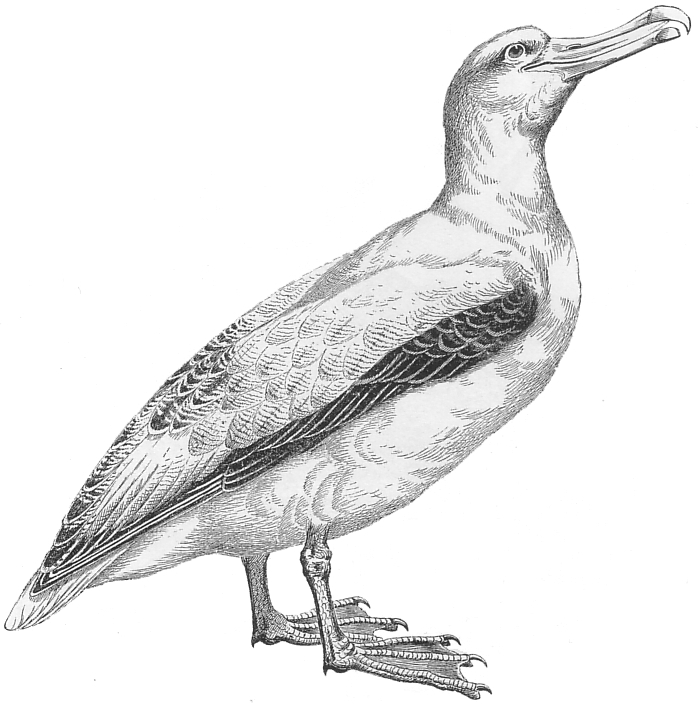
About the albatross


The albatross has a name that comes to us from Portuguese, where it is alcatras, and while the vowel change that might yield us alcatros is understandable, the changing of the third letter is most unusual.

Most probably, somebody decided that the albatross, being a white bird, should be given a name containing alba, the Latin word for 'white'. It is also odd that the Portuguese name for the albatross should be so similar to the Spanish name for a pelican, alcatraz, known even to those with no Spanish as the name of a certain Californian prison island.

The same word that gives us the first part of albatross also appears in an album, which is a blank tablet with nothing yet written on it, and so gave its name to the sort of blank book we use to stick in photographs or stamps (incidentally, many stamp collectors who care about their craft specialise in collecting forgeries, since imitation is the sincerest form of philately, but I digress).

The alb, of course, is a white tunic worn by a priest, the white of an egg is the albumen (albumins are a class of water-soluble proteins), an albino is a person or animal with a lack of skin pigments and hair pigments, so they appear white, and albata is another name for German silver, a white alloy, while albite is a white mineral.

One of the few alb- words that breaks the pattern is a fish, the albacore, which supposedly comes via the Portuguese albacor, from the Arabic al bukr, which means a young camel. The albedo of a planet on the other hand, is its reflectivity, the extent to which its atmosphere reflects radiation from nearby stars. According to current theory, if an asteroid strikes the earth, the mud and dust which is blasted into the stratosphere will produce something not unlike a nuclear winter.

When the dinosaurs were wiped out by the increased albedo of our planet, caused by the Yucatan asteroid, or the volcanic activity of the Deccan traps of India (which may have been caused by the asteroid in any case), theory says they froze to death, or starved to death because there was no food available for them.

Some biologists think that a few of the dinosaurs survived, because they were warm-blooded and had feathers, and that these dinosaurs are with us today, only now we call them birds. There would probably have been some food in the sea for a considerable time after the earth went dark, perhaps enough to feed a few primitive sea birds until the dust settled and the sun returned.

It may be impossible to test this theory out, but we certainly have seabirds of high albedo today, like the albatross, named for its whiteness, and then there is the penguin, which sounds remarkably like the Welsh pen-gwyn, which would translate as 'white-head'.

The problem, though is that penguins only pass the equator at one point, near the Galapagos Islands, while for the rest of the time, they live only in the southern hemisphere, while the natural habitat of the Welsh until recent times was the northern hemisphere. And to cap that, most penguins have a black head.

It seems that the name 'penguin' applied originally to the Great Auk of the northern hemisphere, sometimes referred to as Pinguinis impennis, which did indeed have a white patch on its head, and that the name was later transferred to those cute and somewhat similar southern birds in waiter's uniforms of black and white — except that almost every species of penguin has a small patch of yellow, which has to serve some useful purpose, though I have yet to find anybody who could tell me what it is.

Puffins, Lunga, Hebrides.
I for one will keep an open mind on how the penguins got their name, since they have a layer of fat below the skin, and 'pinguid' is a rare but valid English word meaning 'fat'.

In fact, so fatty were the penguins that their dried carcases were used as fuel for the boiling-down of seal fat in the South Atlantic in less civilised times, but that stopped before we lost all of the penguins.

The great auk, however, went extinct in the 19th century, hunted into extinction by eager egg and carcase collectors, selling into a trade which cared more about ownership than conservation. I have some notes on that somewhere, so I shall return to the demise of the great
auk later.

Right now, the penguins of the world are holding their own, but the same cannot be said for the albatross, because too many of them are drowning when they try to take the bait from long lines set by fishing boats. Once they are hooked, the magnificent birds drown on the line. This usually leaves a mate on the nest, who must eventually abandon the nest, meaning even more albatross deaths.

Monday, 3 June 2013

A life of pie

The pie, as a pastry-surrounded food item, was certainly known to Chaucer, who tells us of the cook in his Canterbury Tales:
He koude rooste, and sethe, and boille, and frye,
Maken mortreux, and wel bake a pye.
The mortreux, (today, we call it a mortress), is a kind of soup or pottage of bread and milk, or else of assorted meats, and the rest should make reasonable sense if it is read slowly, but what sort of pie did Chaucer know?

There was at least one more, for in the 'Reeve's Tale' Chaucer tells us that the wife of the miller was 'peert as is a pye' — as pert as a pie, but this was no ordinary pie, but the bird we now call a magpie. The Wife of Bath says her fourth husband was 'Stubborn and strong, and jolly as a pie', or in Chaucer's language, 'Stibourn and strong, and joly as a pye', which is back to the magpies again.

The Prologue to the 'Cook's Tale' refers to a Jakke of Dover that the cook has sold after it has been twice hot and twice cold, probably endangering his customers. The Jack of Dover, as we would call it today, was probably a pie, but the rest of Chaucer's pies are all of the feathered, avian variety.

Shakespeare offers us a wide variety of pies, and in Henry VIII, Buckingham complains of the Cardinal of York: "No man's pie is freed from his ambitious finger", but here, too, we find chattering pies, obviously the birds again, while Macbeth announces the apparently alarming news that
Augures and understood relations have
By maggot pies and choughs and rooks brought forth
The secret'st man of blood. . .
Here, though, we have a remnant of an old habit of according names to birds: Tom Tit, Jenny Wren, Jack Daw, and in America, Jim Crow, and in Australia, Willy Wagtail. A proud member of the clan is Maggot Pie, or as we might say, Margaret Pie. It is curious that so many of the birds with given names are largely black, but that is a side issue: does this have anything to do with the 'four and twenty blackbirds, baked in a pie' of the nursery rhyme? Probably not, but the bird known as a magpie in England, and un pie (pronounced, roughly, 'earn pea') in France, is very like the bird generally known as either a peewee or a peewit in Australia.

Shakespeare also has several people swear 'by cock and pie', which is a pre-Reformation set of rules about what to do when church events coincided. Shylock speaks of how Jacob had from Laban ' . . . all the eanlings which were streak'd and pied', which is a sense of 'pie' that lives on today in our 'piebald'. The Bard also offers us references to the edible form of pie, which seems more often than not to be a mince pie, a pie made with dried fruits.

So the clown in A Winter's Tale plans warden pies for a sheep-shearing-feast, and his ingredients include sugar, currants, rice, saffron, mace, dates, nutmegs, ginger, prunes and raisins. Petruchio, however, speaks of 'a custard-coffin', in The Taming of the Shrew, but here the coffin is just a pastry casing for a custard pie.

A coffin is also the carriage of a printing machine, and we find pies enough in the printing shop as well. Pie or pye is a jumble of type, mingled together higgledy-piggledy when a forme of type has been broken down, and all the handset letters have gone all over the place. And that brings us back to birds again, because this meaning of 'pie' comes from the medieval Latin pica, and that is also the name of the genus into which the magpie fits.

And then we are back to printing again, for Pica is a type size, equal to about 12-point type in today's language, and also a measure of distance in printing, but in medicine, 'pica' is a craving for non-food items such as minerals. Given the small amount of meat that is usually found in the meat pies served to shearers and others in Australia, this possibly chance connection seems entirely appropriate.

By way of a footnote, the clown's ingredient list for warden pie inspired one of my books. Bittersweet.  I started wondering where the clown in Shakespeare's time would have got sugar, and ended up tracing sugar back to where it started, in New Guinea, 9000 years ago, more or less.  But that's another story...one you can buy for your Kindle, if you wish.

Thursday, 30 May 2013

Not your usual colonial poet

Yes, another hint about what I am up to, though it also serves to mark National Reconciliation Week.

I am in pursuit, this week, of a mysterious Hugo.  He (or she, but I will use "he" hereafter) burst into print twice in Sydney in 1831, and I have reproduced his first poem below.  It is curious: in the first of the two poems, he uses an archaic spelling of waratah, he is clearly familiar with the plants of the area, and he shows a strong empathy with the Aborigines. These were not common characteristics in colonial Sydney in 1831.

Hugo's second poem suggests that he was quite religious, but I can't think of anybody in that era who fits the bill. I think 'Hugo' was a currency lad (or lass), but what happened to him or her?

The poem was first published as "Original Poetry" in The Sydney Gazette and New South Wales Advertiser, Saturday 16 July 1831, 4.

The Gin
"Where spreads the sloping shaded turf
By Coodge's* smooth and sandy bay,
And roars the ever-ceaseless surf,
I've built my gunya for to-day.

"The gum-tree with its glitt'ring leaves
Is sparkling in the sunny light,
And round my leafy home it weaves
Its dancing shade with flow'rets bright.
A waratah ('warretaw'), Telopea speciosissima.
This is quite a large shot: click on it to enlarge it.

"And beauteous things around are spread;
The burwan*, with its graceful bend
And cone of nuts, and o'er my head
The flowering vines their fragrance lend.

"The grass-tree, too, is waving there,
The fern-tree sweeping o'er the stream,
The fan-palm, curious as rare.
And warretaws* with crimson beam.

"Around them all the glecinæ*
Its dainty tendrils careless winds,
Gemming their green with blossoms gay,
One common flower each bush-shrub finds.

"Fresh water, too, is tumbling o'er
The shell-strewn rocks into the sea;
'Midst them I seek the hidden store,
To heap the rich repast for thee.

"But where is Bian?—where is he?
My husband comes not to my meal:
Why does he not the white man flee,
Nor let their god his senses steal?

"Lingers he yet in Sydney streets?
Accursed race! to you we owe,
No more the heart contented beats.
But droops with sickness, pain, and woe.

"Oh ! for the days my mother tells,
Ere yet the white man knew our land;
When silent all our hills and dells,
The game was at the huntsman's hand.

"Then roamed we o'er the sunny hill,
Or sought the gully's grassy way,
With ease our frugal nets could fill
From forest, plain, or glen, or bay.

"Where sported once the kangaroo,
Their uncouth cattle trend the soil,
Or corn-crops spring, and quick renew,
Beneath the foolish white man's toil.

"On sunny spots, by coast and creek,
Near the fresh stream we sat us down ;
Now fenced, and shelterless, and bleak,
They're haunted by the white man's frown.'

She climbed the rock—she gazed afar—
The sun behind those mountains blue
Had sunk; faint gleamed the Western star,
And in the East a rainbow hue

Was mingling with the darkling sea;
When gradual rose the zodiac light,
And over rock, and stream, and tree,
Spread out its chastened radiance bright.

So calm, so soft, so sweet a ray,
It lingers on the horizon's shore;
The echo of the brighter day,
That bless'd the world on hour before.

But sudden fades the beam that shone,
And lit the earth like fairy spell;
Whilst in the East, the sky's deep tone
Proclaims the daylight's last farewell.

"Fast comes the night, and Bian yet
Returns not to his leafy bed;
My hair is with the night-dew wet
Sleep comes not to this aching bead.

"The screeching cockatoo's at rest;
From yonder flat the curlew's wail
Comes mournful to this sorrowing breast,
And keenly blows the Southern gale.

"Avaunt ye from our merry land!
'Ye that so boast our souls to save,
Yet treat us with such niggard hand:
We have no hope but in the grave."

Thus sung Toongulla's wretched child,
As o'er her sleeping babe she hung.
Mourning her doom, to lead a wild
And cheerless life the rocks among.

Their health destroyed—their sense depraved
The game, their food, for ever gone;
Let me invoke religion's aid
To shield them from this double storm

Of physical and moral ill;
We owe them all that we possess
The forest, plain, the glen, the hill,
Were theirs;—to slight is to oppress.

Hugo

Notes
The following terms, asterisked above may need some translation. I am a passable botanist, but glecinæ had me beaten for quite a while.

Coodge: Coogee
burwan: burrawang
warretaw: waratah
glecinæ: probably  Glycine sp., a member of the Fabaceae

This poem represents early instances of several words like gin, gunya and waratah, but as I have a strong interest in such things  I have since found an even earlier case of waratah from 1804. Oddly, there seems to have been no other mention of the plant until 1826, when the modern spelling first appeared. By 1831, Hugo was out-of-date.

I continue to wonder who Hugo was, but I am working on it.


Thursday, 23 May 2013

Not your usual bushranger

Well, I seem to be clear of the last of my commitments for the Big History Book, so more hints, of sorts, about where I am headed.  It's not the whole story, but I am looking at bushrangers at the moment.

People seemed to have a soft spot for them, but for the most part, things ended badly for the bushrangers.

To my extreme annoyance, most studies of bushrangers do no more than scratch the surface, so I am looking for the unusual tales that surround them. Quite often, they got shot, like Ben Hall, seen on the left (above) as he was depicted in the press of the day. Others, like Ned Kelly (right, above) went to the gallows.
A shoot-out involving the Clarkes in 1866: bet you never heard of them!!
Shoot-outs, however, excited the most interest, I have found.  The amazing thing to me, though, is the huge number of bush rangers who were around, and the number who died with their boots off, reformed characters, so to speak.

For the most part, they had pretty miserable lives, and that's part of the story I plan to tell, but even those who weren't bushrangers could have a nasty time of it.  That brings me to Frederick Turner, who fell foul of the Bushranging Act in 1838—and he wasn't even a bushranger!

Frederick sailed to Hobart  in 1832 as a cabin boy on the Norval, and then left the ship with his employer's agreement, worked in several jobs before taking a 12-month post with Doctor Imlay of Twofold Bay. He completed his contract, and as workers had to do in those days, he had Imlay write him a certificate to say that he was a free man, not a runaway of any sort, and headed for Sydney looking for work.

In a statement that he made later, which was published in The Sydney Monitor and Commercial Advertiser, he explained that this certificate said something like:
''The bearer, Frederick Turner, who arrived in the colony a free immigrant, has served me for twelve months at Twofold Bay, and is now on his way to Sydney to seek employment.''
Arriving in Goulburn, he was offered work as a waiter at the Goulburn Inn, at a weekly wage of twelve shillings, which was reasonable pay.  He liked the work and might have stayed, but after three weeks, a passing walloper quizzed him.

He answered frankly that he was a free man, and on the request of the mounted policeman, produced his certificate, but the law's officer dismissed it with "Oh! this will not do anybody can carry about a thing like this!" and had another constable haul him off to the watch-house, where he was locked up for the whole of that night, then taken before a magistrate called Stewart who had the "runaway reports of New South Wales and Van Diemen's Land" checked, but no matching runaway was on the list.
Descriptions like these were issued for all prisoners who absconded: in those
days, with no photography, this was the best the authorities could do.
Source: The Sydney Monitor, 15 September, 1836, page 1S.
Well, said Stewart, the fellow must be a runaway from the Hyde Park Barracks in Sydney Town: he must go there and be examined.  So it was back to the watch house for Frederick, where his hair was cropped close to the skull before he was thrust into a crowded cell, about 13 feet by 12 in dimension. Here, there were  some 25 to 30 convicts and felons living upon bread and water.

Each night, they were handcuffed and chained to each other in a hot cell at the end of summer (it appears). After a fortnight, nine of them were chained up, and they set out to walk to Sydney, some 200 km away.  Each night, they moved from lockup to lockup: Bargo, Stonequarry  Creek, the Cowpastures, Campbelltown, Liverpool, Parramatta and Sydney.  At the Hyde Park Barracks, Mr. Ryan, the Chief-Clerk, referred to the records, but could not find any runaway of Turner's description.

That ought to have been that, but Ryan declared that he must detain Frederick until he could produce some respectable person to identify him as a free subject.  After a fortnight detained in the Barracks, he recalled that a Mrs. Collins who had come to Australia on the Norval should be in Sydney. He named her, she came, identified him, and he was released with no money, little in the way of clothing (he had sold most of his clothes to get food on the way to Sydney), and no papers.
It occurred to me to ask Mr. Ryan for the certificate which Dr. Imlay gave me, and which I had been compelled to deliver up to the Police Magistrate of Goulburn. Mr. Ryan evinced not the least feeling for my misfortunes, though he now knew, that I had been brought down 150 miles in handcuffs innocently; for he told me rudely and roughly ''to be off,'' not condescending to say whether he or Mr. Stewart of Goulburn had my certificate in his possession.  Yet Mr. Ryan must know, that if with a certificate I had been thus imprisoned three weeks, and put in irons as if I had been in an ironed gang. I was more liable to the same treatment without a certificate.
Turner had been banged up for five weeks, and now he was tossed out on the street. Two constables questioned him, but unlike the Goulburn push, they believed his story, and advised him to see Mr. Mitchell, the Chief Constable, who they said would probably do something for him.  Instead, he went to see the Collinses, and Mr. Collins gave him shelter and found him work the next day.

This wasn't an isolated case, he said. He explained that two other free men were confined as well as himself at Goulburn, and one of them was actually flogged for what was deemed insolence to the Magistrate.

So if that was how they treated free people, who can be surprised if a few felons went, well, just a bit feral?  I have been searching for later traces of Frederick Turner, but it's a common name, and I have no traces that I can link to him directly.  But I wouldn't be at all surprised to learn later that as soon as he could raise enough for a passage, or find a berth, young Frederick Turner quitted the colonies for good.

I will, however, be looking further into George Stewart, P. M. at Goulburn, appointed in 1836, because I know a little of the magistrates in the area, and there isn't a lot to admire.

I doubt, though, that I will ever embark on a work called Not Your Usual Judges, because, to be blunt, there was no standard of normality among them, not in the early days.  There's just too much material altogether.

Now I'm going back to look more closely at that subset of bushrangers who managed to get pardons, men like Walmsley (a murderer), Frank Gardiner (a bit of a thug) and Moondyne Joe, a lovable rogue who was pardoned for being good at escaping.

Once, Joe shot through from Fremantle Gaol in his underwear, and somehow managed to acquire a suit made of "marsupial skins" (or so he claimed).  That story explains his peculiar garb in the only extant photograph of him.

That's him, there on the right.  I lifted it from Wikimedia Commons, which claims that it is in the public domain.


Sunday, 19 May 2013

Not your usual treatment

Keep an eye on that title.  It introduces a new theme that will pop up from time to time over the next couple of years.

No, there will be no more than that, because you know what they say about the best-laid plans, but if it comes to fruition, this is where it all began.

One aspect of that is quacks and quack medicine.  I will be mining that vein on and off, as part of the grander plan, for the rest of this year.

I plan to look, for example, at Perry Davis' famous Painkiller, even celebrated in Tom Sawyer:

One day Tom was in the act of dosing the crack when his aunt's yellow cat came along, purring, eyeing the teaspoon avariciously, and begging for a taste. Tom said:"Don't ask for it unless you want it, Peter."But Peter signified that he did want it."You better make sure."Peter was sure."Now you've asked for it, and I'll give it to you, because there ain't anything mean about me; but if you find you don't like it, you mustn't blame anybody but your own self."Peter was agreeable. So Tom pried his mouth open and poured down the Pain-killer. Peter sprang a couple of yards in the air, and then delivered a war-whoop and set off round and round the room, banging against furniture, upsetting flower-pots, and making general havoc. Next he rose on his hind feet and pranced around, in a frenzy of enjoyment, with his head over his shoulder and his voice proclaiming his unappeasable happiness. Then he went tearing around the house again spreading chaos and destruction in his path. Aunt Polly entered in time to see him throw a few double summersets, deliver a final mighty hurrah, and sail through the open window, carrying the rest of the flower-pots with him. The old lady stood petrified with astonishment, peering over her glasses; Tom lay on the floor expiring with laughter.

That Painkiller really existed, and it was apparently just as painful as Twain made out: I have the word of a New Zealand shepherd for that, by way of one Lady Barker, but I will hold that in reserve for now.

The claims made for patent medicines were completely uncontrolled.  In the 1890s, (Heinrich Hermann) Robert Koch had made quite a name for himself as a meticulous discoverer of bacteria like the cholera germ. Using his name like that was fine, because they didn't claim that it was the same Dr. Koch: they just threw the name up and waited for the punters to make a false inference.

If there was any Koch involved with the nostrum on the right, I doubt that it was he. This one cure seems to be able to defeat viruses like smallpox, bacterial infections like consumption, erysipelas, gonorrhea and syphilis, cancers, deficiency diseases like scurvy, and even physical problems like piles and sciatica.

About the only thing that it failed to do, it seems, was cure snakebites.  Still, in colonial Australia, there was a wonderful range of snakebite treatments, and I am looking into those as well, for another chapter.

Whoops!  I just blew it.

Ah well....that's only a small corner of the Grand Plan.

Friday, 17 May 2013

Macro tricks in Word, part 2

This completes a series that started with a previous series that began with Effective Science Writing Part 1.  The other three parts of this second series are listed at the end of this entry.

I will now return to less brain-hurting stuff in the next few posts, because I am currently in pursuit of bushrangers, rocks and crash remedies and all my hurt brain facilities are overloaded.

Creating a macro

A macro is simply a collection of recorded key strokes that can be run again, using a shortcut. These are created in a form of Visual Basic that looks quite worrying if you try editing a macro, so don't bother (yet), just be aware that you can create and record complicated sequences without knowing anything at all about how they are coded.


The starting point is Tools - Macro - Record New Macro, but before you get to that stage, you need to know what you will name it, so you need to do some experimenting to see what macros already exist for you, created by the Microsoft boffins. If there is a standard shortcut like Control-C for copy, and you overwrite it, that can be really annoying.

Macro ideas

The first thing to be said is that it is hard to keep track of the macros and what they are called. It is also important to know that some of the special key commands like Control-C, Control-V, and Control-X, (copy, paste and cut highlighted text, respectively) are valuable. Word is set up with those (effective) macros ready to run, and you need to experiment to see if you need Control-I, Control-B, or Control-U, which convert highlighted text to italics, bold and underline.


I give every macro a name that makes sense and also tells me what keystrokes bring it into operation. Macro names cannot have spaces in them, so I capitalise every word when it starts.

Note that macros can call macros, so if you build up a good library, you can wreak major havoc - until you know what a new macro does, always save your work before you test it out!

Paste unformatted text, PasteUnformattedCtrlU-my only failure

From time to time, you will get text such as HTML or fields and if you insert a table of contents into a document, the table is not real text, which can be a nuisance in some cases. The same thing applies if you are using Excel, and later want to paste material into Word: if you hit Edit-Paste Special-Unformatted text, you can avoid this, but I have never yet been able to make a macro to do this. If any reader succeeds, please tell me how you did it!


Note well: If you copy a text cell from Excel use Control-V, you will end up with the text in a table which then has to be converted.

DegreeSymbolCtrlShftD

As mentioned above, this character is something I need all the time, so I have a macro to do it. All the macro does is produce the appropriate degree character ° (of course, if you hold down the Alt key and type 0176 on the numeric pad, that does the same thing).

Multiple operations

There are times when I need to do the same thing, many times over: it may be as simple as finding all the carriage returns that are Heading 4 and converting them to Heading 3. You can do that with a simple replace command, but suppose you want to autonumber the header paragraphs (using Insert - Field - Autonum): in that case, you need a macro. First, you search for the next instance of Heading 4, change the paragraph to Heading 3, hit Home to get to the start of the line, and then insert the field.


In all probability, this is not the sort of macro you will need very often, so I save things like that as Temp1, for which the code is Control-Shift-Z. I also have (and in spite of their names, they are permanent), Temps, Temp3 and Temp4. These are coded by Control-Shift-X, Control-Shift-C, and Control-Shift-V. Look at the keyboard to work out my logic here.

The next bit is where it gets interesting: Temp2 is merely ten repetitions on Temp1 (whatever that may be), Temp3 is ten repeats of Temp2, and Temp4 is ten of Temp3, so when I hit Control-Shift-V, I create a thousand repetitions of Temp1.
Then, if I want to run some existing macro a thousand times, I just create a new Temp1 which is just a single instance of that macro.

Jumping in and out of Excel

Call me weird if you will, but I have written a whole book in Excel. Not on Excel, but in Excel. There was a reason for doing this: it was an illustrated children's book on reef life, and I needed to offer species lists for each page for the artist. Once I had created a record on a single line for a fish that was on page 5, complete with references to where the artist would find models or photos, I could make extra copies of that line and assign one of the lines to page 9, and another to page 14, where the same fish was also to appear. Other lines had the text for the page, and so on.


I knew, of course, that one of the earliest users of Visicalc in Sydney was a 'Sun' sporting journalist who used the program to create stories, and when I heard the yarn, I guessed straight away what he was doing. The old tradition of hot-metal print was the use of 'copy-paper', octavo sheets on which a single paragraph was typed, double-spaced. At the end, the pages were numbered and passed to a sub-editor to be marked up for setting.

Now as you do a story on copy paper, you often move a paragraph-page to a new place, and I suspect that this cunning journo was adding numbers in a separate column, and then sorting on that column before he printed out the story and handed it over. Whether he was doing that or not, I thought it a good idea, and I decided to adapt it, more or less.

When I set out to research a new book, I use a spreadsheet at the start with three columns: ch (chapter), pt (part) and ss (section). Then I add columns like Name, Location, Date, Keywords, Text and Source. Any text which is lifted directly from another source goes in as italics, to remind me not to use it as mine (failing to recognise direct quotes as such gets many writers into trouble). I add other codes that seem appropriate.

At any stage, I can sort my entries by any three of the headings I have assigned, including ch, pt and ss. In any chapter, values of zero for pt and ss ensure that the synopsis comes at the start, but I can also sort by name, and see that two of the Blamey references in chapter 9 really belong in chapter 3, and so on.

Complex? One book that I wrote was based on a set of 5000 selections from journals of the explorers, some gleaned from Project Gutenberg, some from obscure learned journals, some from microfilm, typed into my Palm Pilot with a portable keyboard, then transferred to Word, with other details pasted in using tabs between fields before going into Excel. The total is about a million words, the book will be about 70,000, but along the way, I needed to see what different writers have said about crocodiles.

Problem: the early writers used 'alligators', or even 'alegators' or 'gavials', so how do I pull all of those out. The answer was to use keywords, but keywords can go wrong, so I created a set of mnemonic codes, where z indicates animals, d indicates dangerous and c is crocodiles. All I need do is add the code \zdc to tag it as one of the 54 croc-related incidents. (The logic here: if I type the descriptors in full, that is onerous, and some will be wrong, which means they won't show up in searches. But if I use short mnemonics, I should avoid much of that. Not all, but much of it.)

Later, though, I wanted to convert all of those codes to real words that ordinary people can interpret, and that gave me a set of problems. It can be done with macros, but with 220 codes, it would be a big job.

That was when I began generating Word macros in Excel. Hold onto your seats, because now the ride gets a bit bumpy. We start with a piece of code from inside one of the macros that I use to convert the keyword codes:
With Selection.Find
.Text = "\
enfm"
.Replacement.Text = "
female explorers, "
.Forward = True
.Wrap = wdFindContinue
.Format = False
.MatchCase = False
.MatchWholeWord = False
.MatchWildcards = False
.MatchSoundsLike = False
.MatchAllWordForms = False
End With
Selection.Find.Execute Replace:=wdReplaceAll

All this does is to look through for instances of a particular code, and replace them. In this case, \enfm is replaced by the phrase 'female explorers', with a comma and a space  added, the bits in bold if you are reading this in Word. All the blue text (in the example above) is a constant. (As a side note, there were more female explorers than we encounter in the history books, but to find out about that, you may need to read my book. It's called Australia's Pioneers, Heroes and Fools, Pier 9.)

The careful observer may be wondering why I am talking about this Excel stuff when I ought to be talking about Word. The answer is that I couldn't get a Macro to work in Excel, so I port an entire column across to Word, alter it there, and then transfer it back. I could have just typed all the keywords, but sometimes I want to change a phrase, and universal search and exchange can be a pain.

I thought there would be some way that I could use a look-up table in Excel or somewhere to go through all of the permutations, but that didn't work. I could have created my macros by laboriously typing in all of the codes and their meanings, but that failed to attract. I turned instead to a lovely Excel command, =CONCATENATE.

This is used to chain strings together, bits of text. Each complete macro has five bits: a fixed start, a first variable, a linking bit, a second variable, and all of the end material. All I need to do is add those three constant sections to a spreadsheet in which the two columns, text and replacement, are given.

Whoops, not quite. Those pesky carriage returns are about to get in the way. I need to take out the line breaks and replace them later, so now I look at the macro like this:

With Selection.Find# .Text = "
\enfm "# .Replacement.Text = "
female explorers,
"# .Forward = True# .Wrap = wdFindContinue# .Format = False# .MatchCase = False# .MatchWholeWord = False# .MatchWildcards = False# .MatchSoundsLike = False# .MatchAllWordForms = False#End With#Selection.Find.Execute Replace:=wdReplaceAll

Then I just delete the two variables and because there are 293 characters in he last string, which Excel may gag on, I will chop it into two bits, just in case. I take a new worksheet, paste the codes and their translations into columns A and B, paste the fixed strings into cells F1, F2, F3 and F4.

Then in cell C1, I have 

=CONCATENATE(F$1&A1&F$2&B1&F$3&F$4): note the lack of spaces, and note the $ symbol, which makes that an absolute address. When I copy this into C2, it will read 

=CONCATENATE(F$1&A2&F$2&B2&F$3&F$4), and this will continue all the way down. I copy C1 all the way down to C220

Now I can grab column C and paste it into Word (it has to be pasted as unformatted text, so you must use Paste Special), and I can replace each # with a carriage return.

Now I have all of the codes I need to convert all of my keywords.

No I haven't, not quite - I omitted to allow for the fact that I have codes \zd (dangerous animals) and \zdc (dangerous animals: crocodiles). I need to change all the cases of \zdc before I attack the cases of \zd. Not a problem: in column D, I add =LEN(A1) and copy that all the way down. Now I select the 220 rows, click on Data- Sort, and I choose to sort by column D in Descending order. Now the macro will come to and deal with \zdc before it converts \zd.

One thing I discovered is that there seems to be a limit for the size of each macros, possibly a limit of around 32768 characters, but I decided to put just 60 conversions in each macro. That raises the question: how do I insert them?

My solution is a kludge, but it works I create KeywordConv1CtrlShG, KeywordConv2CtrlShH, KeywordConv3CtrlShJ, and KeywordConv4CtrlShK, each of which converts <\enfm> to (leave out the angle brackets). Now I have dummies that I can work on.

I go to the Word file that has the codes, and I select the first 60 (I look at the spreadsheet to see where the cut goes). I CUT these, then I go to Tools - Macro - Macros (or ALT-F8) and I choose Edit and scroll down to KeywordConv1CtrlShG and click the Edit button. Then I carefully select the target portion, the same bit that I quoted above, and click on Control-V to paste in the material that I cut before. And voila! a neat and tidy macro.

I suggest reading that three times to get it right. OK, maybe four: it's worth it, because this can save you significant effort.

Running the keywords macro

We aren't finished yet: we need to run the macros in order, but I often forget where I am at, so I have created a super macro, KeywordsAllCtrlShL, which simply runs the four conversion macros. Then having pasted the spreadsheet column over and having run the macro, each paragraph ends in a comma and a space.


Remember that we can search for a carriage return? I can target the ends by replacing ,<^p> with <^p> - leave out the angle brackets, of course.

Acknowledgements

My thanks to Bryn Jones who reminded me to mention the use of abbreviations that are converted by Autocorrect.

The other bits


Planning a book with a spreadsheet;
Practical use of macros and spreadsheets; and
Macro tricks in Word, part 1.

Monday, 13 May 2013

Wherein we go walking

The idea was to get a train to Gerringong, walk to Kiama, get a train home.  That's on the coast, a couple of hours' drive or train ride south of Sydney.  We were using the train, because we wanted to go one way only on the selected track.

That entailed walking to a ferry, riding the ferry, and walking uptown to Martin Place, where the train would pass through, almost an hour after we got off the ferry.

Three flies in the ointment: trackwork being done which meant the last 60 km would be in a bus (that was fly number 1).

Fly number 2, you can see on the right: fog, that slowed the ferries right down, but we still made it, even though the fog ate half an hour of our discretionary time. We met Lyn and Warren, with whom we were walking, got the train at 09:29, and shortly after noon, we were on the road.

The track is about 6 km along, winding over open country close to cliffs that look out over the Tasman Sea (a branch office of the western Pacific).

Third fly: there is about 3 km of walking at each end, before you get to and from the designated track, but we were up for that.

I plan to let the pictures tell most of the story, with a few comments about the geology and biology of the area.  For enthusiastic walkers, we started at noon, walked steadily, and got to Kiama station as night started to fall.  From Kendall's Beach onwards, it was suburban walking, but if I did it again, I would go on an earlier train,
Gerringong War Memorial Hall: after the Great War, they brought in a law that allowed communities to erect memorial halls which, because they were War Memorials, were tax-free.
Looking to the south, a line of Norfolk Island Pines, Araucaria heterophylla,
which I rather suspect are Australian natives.  They were certainly described
first from Norfolk Island, but some early views of colonial Sydney show trees
that are well-developed.  More research needed, but they are a typical coastal
tree in settled areas, and you will see a few more of them, if you look hard.

And these markers will help you relate the time stamps to distance.  This is being done on the assumption that a few walkers will chance on this and need the raw data for their own sums.  This is it.
The track is well signed and marked, with good interpretation.  The coastal area was once rain forest, despoiled to provide cedar and then cleared to provide pasture.

The area is a weird mix of sedimentary rocks and volcanic flows (we will see more of that later) so the soil is rich, but a coastal fringe has been clawed back for the public.

The track is minimalist, apart from being slashed or mown, and there isn't much biology there.

But, the scenery is nice!

Keep in mind that this walk was done on May 12, in autumn, less than six weeks from mid-winter.  In Australia, that's still walking time!


The track officially begins as you pass the point where, in times of rainfall, Werri
lagoon breaks through to the sea. In Australian parlance, a lagoon is a dammed up
creek (which here, as in America, is fresh water, not an estuary, as in Britain, but
just to be contrary, Werri lagoon is quite salty.
Here is a section of the track.  We are off!
Reminder: this is the east coast, so this is a view to the south with what they call
a wave-cut platform.  Second reminder: this is Australia, so the sun is to the north.
A look north at a most peculiar pillar, 2 km from the start.  More Research Needed!
A small remnant of the original rain forest hangs on grimly at 2.5 km. We walked
inside to take a closer look at this fig. Those rocks are all volcanics of some sort.
In places, the track comes close to the edge of the cliff, but never dangerously
slow, and as you will notice, you can usually see a long way in front and behind.
This might be the place to mention that there is no water on the track, and no
toilets, either.  There are lots of pebbly beaches, most of which you can get to.
Like this one!
The left-over of a dyke, an igneous intrusion that pushed up through the sandstone
of the platform, but which has since weathered out.  We didn't have time to go and
examine it, but my guess is that there is contact metamorphism where the hot rock
touched the sandstone, turning it to quartzite, which sneers at mere waves!
Another view of that pebbly beach. There would be interesting stuff down there
for people who didn't need to get back to Sydney!
Almost at half-way, now, looking back at the track behind us.
Going down to the beaches, though, calls for a degree of wariness. Past half-way, now.
What is it about me and pebbles???
One of the better platforms, and the track, following the cliff line.
Another view of the same bay: this is when date stamps come in handy!
We have now completed 5 km, 1 km to go...
See how far you can follow the track.
This is an white-bellied sea eagle, Haliaeetus leucogaster, but we just call them sea eagles, and they don't seem to mind.

These are most ungracious birds: they always sneak up behind you at a time when you don't have your camera out.

The wing span of an adult is ~190 cm, more than six feet, and they are found all around the Australian coast line.

When I got this shot, we were just at the end of the official track, but with quite a long trudge over rather poorer ground in places.  The track is usually either clear enough or reasonably well signed, with one exception that I will come to.

Just across from the track's end, houses of ostentatious vulgarity abound. I took
this shot for the rocks in front, where waves break up onto them making pretty
little intermittent waterfalls.  We had to go around the head of the bay and along
the grass below the houses.
Looking back, the headland is composed of sandstone (the lighter rock) overlain by the Blowhole latite.  On the right, the top of
the sandstone goes below the sea.


Around Kiama, where the rocks were on offer, the early farmers made dry-stone walls.  Sensibly, somebody has built a stile here
so Mr and Mrs Public don't damage the wall.  On the right, there is barbed wire to underline the message.  Good!


I have always been fascinated by the way waves shape beaches and beaches shape waves.
With the light fading fast (there is a high escarpment to the west, we made it to the Little Blowhole.  Kiama is famous for its
giant Blowhole, but last Sunday, according to a lady who was there, it wasn't working, unlike the Little Blowhole.  It's all a
matter of tides, swell direction, wind and luck, but when a wave crunches into a cleft, water spouts, as you can see here.


At this point, the track is hard to follow. Take the path west, downhill and uphill, then find a paved roadway, over to the left, go up to the street, and obey the Blowhole signs to get to Kiama.  You turn tight at the road, right again at the end, and walk down into  a turning circle. On the far side, there is a right-of-way, going over to the cliff edge.

Once we were on that beach, we were in civilisation with concrete paths to follow.
All in all, the walk is a strenuous one, but well worth doing.  Of course, as four senior citizens, we all travelled on $2.50 all-day tickets that covered everything.  We got the 20:45 ferry to Manly, across a thankfully fog-free harbour.

Not a bad day out for the middle of autumn!