Search This Blog

Sunday, 26 November 2023

About Keeping People is Wrong

This book examines the nature of forced or compulsory service, and the name stems from an 1852 newspaper description of an Aboriginal man as “belonging to Mr Andrews”. The language of slavery and being a boss tend to merge into each other, all too easily. Among family and friends, I call this work Bog-snorkelling in a cesspool, due to the loathsome creatures encountered.

Starting with a quick look at classical and plantation (sugar/cotton) slavery, we look at slavery’s poor cousin, indentured servitude in North America, and how indentured worked for apprentices. Then we move onto compulsory labour in Australia (the convict era), and how ‘servants’ were managed, usually badly. This was not slavery, but close, and the trained eye will discern the seeds of slavery.

As an example, apprenticeship and indentures were often a sham.

Australia’s first slaves were sent home in 1819, by Governor Macquarie, who by an odd quirk, had owned slaves, briefly, and freed the lot. Repression came from various Masters and Servants laws. By the 1830s, Australia was importing trainee servants and serfs: indentured Irish, German and Indian workers. The exploitation of youngsters is followed down to Fairbridge and stolen generations, all trained as domestic servants.

More on importing Chinese and Indians, Ben Boyd’s first South Sea Islanders. Using M&S laws to stop people rushing to the goldfields. The rise of the unions, railways and shearer’s strikes, and how ‘Afghans’ came in, far better protected, to work camels.

Some vignettes on blackbirding, some of the more violent blackbirders: this was definitely close to slavery at times. (One case of an islander with a ‘brand’, later cleared.) Real slaves came in from the Sulu sultanate (Philippines) to fish for pearls, and some of the Aborigines involved may have been enslaved.


Some of the workers that you see above were probably slaves, but as pearl divers, they were paid, and some of them earned enough to buy their freedom.

On the cattle stations: how Aborigines were treated as property, cases of violence and murder, remarkably slaver-like behaviour, stockmen in the 1960s, Vincent Lingiari has a win. Finally, a 2020 conviction for slavery in New Zealand. Slavery still happens!

This looks at all of the potentially enslavable groups in Australia, either prisoners or under indentures: convicts; Irish and other orphans or teenagers; Indians; Germans; Chinese; apprentices and unionists; south sea islanders and Indigenous workers. There are common themes in the methods used to oppress and control, and that brings us to the Fairbridge kids and the Stolen Generations.

Most of the studies I can identify look only at one group, and that means we miss the common themes. Three groups provided undeniable slaves: Indians in Sydney in 1816; Sulu pearl fishers in the 1880s; and Aborigines in the pearl fisheries and cattle stations of WA, some of whom were bashed and murdered.

A few books have looked at the plight of the south sea islanders in the hands of the blackbirders, but this work provides a synoptic view of how the people traffickers worked, and the facile lies they told. The alternative title (Involuntary Belonging) comes from that1852 SMH news report of a Wiradjuri hero as “belonging to Mr. Andrews”!

This book reveals where the bodies are buried, and who buried them, right across Australia’s history. Nobody else has done that, and this is a hot topic, right now.

Chapter breakdown:

1. Defining slavery: Valuing freedom, slavery in ancient times, Egypt, Greece and Rome, sugar slavery, the Somerset and Knight cases outlaw slavery in Britain, the emancipation movements in Britain.

2. Apprentices and indentures, apprentice teachers, indentured servants in America (some of them undoubtedly kidnapped, and it was coerced labour), then a surprise that I may how slavery may have made us human.

3. Convicts to Australia as a way of cleansing Britain on the model of indentured servants: some case studies, how they were shipped, compulsory labour, management and works done, road gangs, the challenge of keeping wages as low as possible.

4. Justice and convict management: tickets of leave, pardons, some of the bad and bent judges, because unsympathetic judges helped keep manual labourers (and wages) under control.

5. Punishment of convicts and others, the life in the Female Factory, Sudds and Thompson, a wicked Archdeacon, the Bushranging Act, some of the system’s victims. This was nothing to what happened in the late 19th century, but the seeds were sown here.

6. Masters and servants: how the underclass, even when ‘free’ were constrained, how people were blocked from gold hunting, how the gold rush really started, how young people were tamed, indentable colleens who frightened off pirates, Stolen Generations, the Fairbridge failure, runaway servants. How the Masters and Servants laws operated.

7. The end of transportation and changes in the labour supply meant we needed to cast around for other supplies of menial labour, and lots of it, to keep wages low. Giving Australia its name, an innocent convict, colonial rivalry, the Catalpa rescue, the side issues of the convict era.

8. Finding foreigners who might be biddable, including the Irish and the Germans: enough hungry paupers would force wages down. Squatters and how to spot them. The first Australian owner of slaves (Macquarie briefly owned 300!) and the first Australian slaves (chapter 10, sent home by Macquarie!).

9. The wool trade and managing the shepherds and the sheep, on to the shearers’ strikes, and the rise of the unions. Workers standing up for their own rights would become important when they looked at the welfare of their darker-skinned siblings.

10. Indian imports, starting with some slaves in 1816, then Indian labourers for a short while, largely unsuccessful, and replaced by Chinese, then Afghans to work camels after Harry the Camel shot his owner.

11. Chinese servants before the ‘coolies’, their travails, a court case in Goulburn, Chinese reaching Australia to hunt for gold, anti-Chinese riots, free Chinese in Australia.

Kanakas on a pineapple plantation.

12. South Sea Islanders, how Ben Boyd started the trade, and was stopped, the villainous blackbirders. There were other less villainous ones, but there was definitely something close to slavery going on here, with slaughter, kidnapping, beating and more. The mindset of the farmers was close to slavery.

Quelling an attempted break-out by kidnapped 'blackbirds' on the brig Carl. This was murder.

13. The pearl fishers, how the trade began and was managed, slaves from the Philippines, the likelihood of exploited or enslaved Aborigines, the treatment of convicted Aborigines, Tjandamurra fights back.

14. Two Wiradjuri heroes. On the cattle stations: how Aborigines were treated: some cases of violence and murder, remarkably slaver-like behaviour, on to stockmen in the 1960s, Vincent Lingiari has a win. Finally, a 2020 conviction for slavery in New Zealand. Slavery is still out there.

Nobody else has done this, according to an Australian emeritus professor of Southeast Asian Modern History (name available if you are a publisher). He wrote:

The subject matter of your manuscript numbering 95,000 words is both timely and important Slavery or servitude in all its manifest form and variation in Australia has not been tackled yet in a single volume. 

It actually grew to 106,000 words after that. If you believe in this book, badger a publisher to pick it up. You, or the publisher, can get a sense of my work here.

For a sample from this work, read about the earliest Australian slaves here.

Keeping People is Wrong

The title is the title of a serious history that I am pitching. Here's a taste: it is about coerced labour: did you know that Australia once had slaves?

*

Before 1786, courts in Britain had ruled that there could be no slaves on English or Scottish soil, and in that year Arthur Phillip—the future first governor at Botany Bay—had written to Lord Sydney about his plans:

The laws of this country [Britain] will, of course, be introduced in [New] South Wales, and there is one that I would wish to take place from the moment His Majesty’s forces take possession of the country: That there can be no slavery in a free land, and consequently no slaves.

With the British penetrating India in the 1800s, some settlers moved on from India to Australia, and they sometimes brought Indian servants with them. The earliest case seems to be that of Governor Macquarie’s one-time slave, George Jarvis, though by the time he reached Australia, Jarvis was already a free man and the Governor’s loyal manservant. Purchased at the Cochin slave market, along with another boy for a total of 170 rupees, Macquarie gave them Anglo names, but while Macquarie later referred to him as his ‘smart Portuguese boy’, George was probably at least part-Indian. I have to conclude that Macquarie’s purchase was a “rescue”.

The family of Macquarie’s first wife, Jane Jarvis, owned 300 slaves in Antigua. When she died of tuberculosis in 1796, they had already bought the two boys, and she left her fortune (£6000) to him, along with all the slaves. Macquarie promptly freed the slaves in Antigua, but he sent the two boys to school. The other boy, Hector, disappeared in Kolkata (then Calcutta), and Macquarie later (in 1802) sent George to school in Scotland.

Anybody knowing of Somerset’s case and Knight’s case (as Macquarie must have done) will realise that sending George to school in Scotland made him no longer a slave. He might have gone his own way, but he later became Macquarie’s valet, and served the governor throughout his time in New South Wales, and then back in Scotland. That aside, there are hints of other Indian servants in New South Wales, such as those of Mr O’Connor, who was leaving the colony in March 1818, with three “native Bengal servants”, Boxoo, Callachund, and Jument.

Even earlier, William Browne had Indian servants in Sydney. Browne’s mother was Persian, while his father was apparently English; as a rich Calcutta merchant in Sydney, he was probably socially acceptable. He is sometimes said to have settled in Sydney in 1809, but the earliest trace I can find of him is in 1816:

MR. WILLIAM BROWNE (of the Firm of BROWNE & TURNER, Calcutta), intending to reside henceforward in this Colony, proposes to receive Orders for BENGAL and other GOODS, to be imported with all practicable Despatch on the ship Mary, Captain ORMAN, now in this Port, and nearly ready for sea.
—The Sydney Gazette and New South Wales Advertiser, 4 May 1816, 2.

When he reached Sydney in 1816 Browne had at least four Indian workers with him. When his wife joined him in 1818, she brought more servants, and he gathered others on contracts for service of between three and ten years. He referred to them as “dungurs”, while others referred to them as Dhangars. The Governor was impressed by Browne and granted him a large area of land. This was worked by the “dungurs”, who are largely missing from the records, but in April 1818 two of them were robbed. Another four, described as “Indian servants of Mr William Brown (sic)”, named as Subball, Hanniff, Rimdiall, and Pearbux, left the colony in 1820. By 1819 most of Browne’s other thirty-nine Indians had already been sent back to India at government expense, and there is a story behind their departure.

In July 1819 William Browne was ordered to appear before the colony’s bench of magistrates to defend himself against allegations of mistreatment and serious abuse of his Indian workers. In all, twenty-two employees complained of gross abuse, and asked to be released from their contracts.

The magistrates found that the workers had indeed been “insufficiently and ill fed, unduly worked, greatly aggrieved and unjustly treated,” ordering that all his Indian workers (forty people) be released at once from his service and returned to Calcutta, with the government footing the bill. The governor then tried to recover this cost from Browne, but the judge (Barron Field, whose curious name will be explained later) found with some regret for Browne on a technicality:

…the Bench might have done more; and might have compelled the defendant adequately to victual and clothe his servants till they should be entitled by their agreements to passage home; and that the finding of such passage too might have been compelled by the Governor, at the peril of the defendant’s being sent out of the Colony himself. But the Governor could not recover this maintenance and passage-money by paying it for the defendant, and then seeking to recover it back from him in a Civil Court … the verdict must be for the defendant.
—The Sydney Gazette and New South Wales Advertiser, 18 September 1819, 4.

It must be said that the greatest villain in the piece appears to have been Mrs Browne. A person of mixed race, her animus towards the Indian servants may have related to race, but she may simply have been mean. Certainly, two years after the rest had escaped, Pearbux, who was still working for the Brownes, wrote to one of her former employers in Calcutta, complaining that she was treated “no better than a slave”. She asked him to intercede with the Governor on her behalf to “free her from bondage”.

In evidence in 1819, a servant called Thomassie said “I was beat by Mrs. Browne at the farm at the Devil’s Back; I have been so long with Mr. Browne without wages; and I want some; I have been with him from my infancy…” On that evidence, Thomassie was undoubtedly a slave in Australia.

Later, “Indian servant” was used as a code for “coolies”, and the only way of telling the difference between personal servants and labourers is by the numbers: if there were more than half a dozen “servants”, they were coolies. Being a coolie meant signing a contract by which the servant’s fare was paid by the master, in exchange for the servant agreeing to work for a (usually long) time at a specified (usually very low) rate of pay. Being a coolie in a foreign country also meant being hampered by not being able to communicate with Australians, not even friendly ones. It was the thin end of the slavery wedge, but not itself slavery.

At the very end of the 1800s, there were other bought-and-sold slaves in Australia, but to find out about them, you will need to read the book.


Saturday, 25 November 2023

Tectonics

I have recently been polishing off a HUGE Australian history, and you cannot explain Australia, its places, biota and people without the geology, and that needs plate tectonics.

In the early 1960s, we gathered the evidence of sea floor spreading, which showed that the Earth’s surface is made up of plates that were moving, and all of a sudden, the planet’s history made a lot more sense.

First, there was the idea of continental drift, a vague notion that somehow the planet had a changing surface. You only had to look at a map of the Atlantic Ocean to see how Africa would fit in neatly against South America, people said. In 1596, a Dutch map maker called Abraham Ortelius (1527–1598) suggested that the two sides of the Atlantic had been torn apart, but he did not explain what might have done it.

Once people started collecting plants and animals, some interesting parallels showed up, like the presence of monkeys on both sides. You could explain Asian monkeys by assuming they had wandered across from Africa (or vice versa), but the South American monkeys were a puzzle. A close inspection showed that the New World monkeys were quite different, suggesting that a great deal of change had happened since the groups separated. Other plant and animal distributions would also make more sense if continents had originally been joined together.

In 1912, a German meteorologist named Alfred Lothar Wegener (1880–1930) published an account of how continental drift might have happened. He suggested that the supercontinent Pangaea began to split, about 200 million years ago. Alexander Du Toit in Johannesburg supported him and proposed that Pangaea first broke into two large pieces, Laurasia in the northern hemisphere and Gondwanaland in the southern hemisphere. Laurasia and Gondwanaland later broke apart to make today’s continents.

The key find was the distribution of a fossil fern named Glossopteris, found in South America, southern Africa, Australia—and Antarctica. The snag was explaining the huge force needed to move a continent around. While we use the same slab-names today, much of the background is different, and we regard some of today’s land masses as being assembled from several different scraps.

How the mysterious ‘drift’ of the continents was explained, and went from science fiction to science.

Continental drift tried to account for the shapes of the world’s large land pieces and the distributions of animals and plants. Plate tectonics works on the idea that the crust ‘floats’ on the more dense mantle, and that parts are slowly moved around by convection effects. It explains the continent shapes and plant and animal distributions, but it also explains the main mountain regions like the Himalayas and the Alps, the distribution of volcanoes and earthquakes, the location of island groups like Hawaii and the Aleutian islands—and the forces that drive the process.

It all began with the idea of sea floor spreading, and that came from mapping of the sea floor, at first carried out with long weighted lines, lowered to the floor, and later with sonar: sending ultrasonic ‘pings’ at the sea floor and timing their return. This revealed the shape of the seabed. The first chart showing parts of the mid-Atlantic ridge appeared in 1855. Ships laying telegraph cables across the Atlantic also detected parts of it, then in 1947, cores of the seabed showed that the sediment on the floor of the Atlantic was much thinner than it should have been under an ocean that had existed for 4 billion years. Clearly, a rethink was needed.

Before long, other ships were mapping sea floors and tracing the whole of the global mid-ocean ridge, more than 50,000 kilometres long and, sometimes more than 800 km across. This was no mere range of hills, either, because the mountains averaged 4500 metres above the sea floor.

Then there was an oddity that can be found in basalt: the magnetic fields sometimes go the ‘wrong’ way, the reverse of today’s magnetic field. We know now that every so often, there is a polar reversal, where the Earth’s magnetic field ‘flips’, reversing the magnetic north and south poles. As liquid basalt escapes from the Earth, the magnetic field of the moment is printed into the rocks.

If you map the zones of normal and reversed magnetic fields around the mid-Atlantic ridge, you see a pattern of stripes going across the sea floor. The way this is shown in school texts, most people think the sea floor is striped like a zebra. It isn’t like that, at all: the black and white are there to show the two polarities, and all the basalt is black. The ‘stripes’ were of different sizes, reflecting longer and shorter periods between reversals, but the amazing thing was that the two sides of the ridge showed a mirror pattern.

By 1961, people were beginning to hint, rather nervously, that maybe the basalt was oozing from the floor and spreading out to either side. During the 1960s, deep-sea drilling rigs began to bring up cores from the sea floor, and by 1968, fossil and isotope tests on the cores established a proof for the sea floor spreading hypothesis, young rocks near the ridge, old rocks further out.

Now we can explain the more peculiar earthquake areas. Spreading in one place means rocks being buried somewhere else. The subduction zones where one plate slides under another, the deep sea trenches, the position of Wallace’s Line, and even the origins of Africa’s Rift Valley, where many of the earliest human and pre-human fossils are found today, were all explained.

Wallace’s Line divided Asian plants and animals from Australian plants and animals. It is a subduction trench between Australia and Asia.

The Himalayas, the Swiss Alps, and the Andes are all formed as the crust piles up where plates are colliding. The volcano-free earthquakes of Turkey and Greece are explained: the movement between the plates there is not the sort that generates volcanoes. Around the Pacific, the Ring of Fire, the long chain of active volcanoes is explained, while the Hawaiian islands are the result of a plate slipping over a ‘hot spot’ that keeps generating volcanoes.

And that is probably enough for any single theory to have to explain.

The art of making records

There was a quiet patch there, because I was too busy working on several almost-complete books that I have started to pitch. Here's a bit from one of them, working title Founding Principles.

*

If science is to grow, if knowledge is to be spread, it needs to be shared. Stone engravings are all very well, but in the long run, we need paper and ink, we need writing, and we need printing, but it began on clay and stone, and I have just finished Margalit Fox's The Riddle of the Labyrinth, about how Linear B was decrypted. 


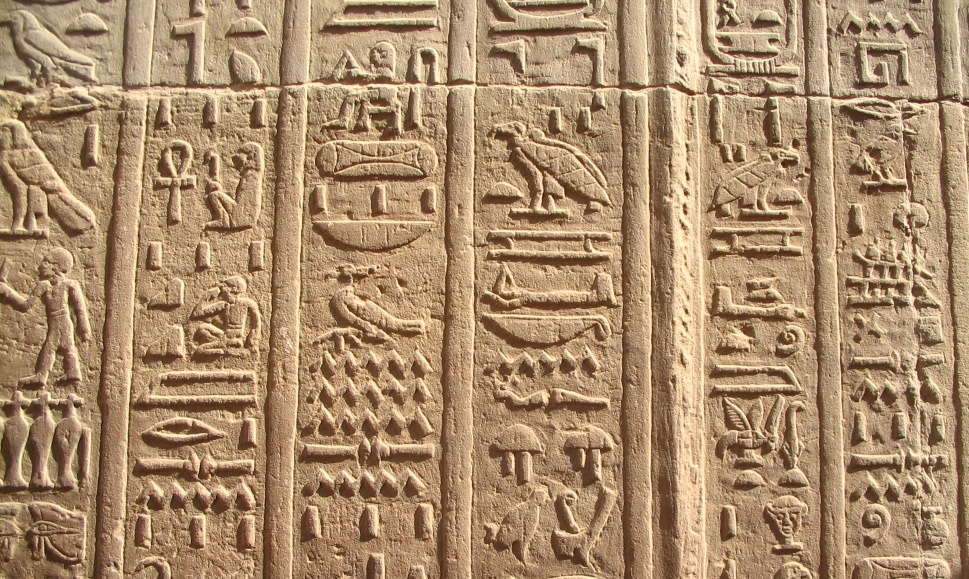
above, the Rosetta Stone which let us decipher hieroglyphics; below, Egyptian hieroglyphics from Abu Simbel

The Rosetta stone was carved in 196 BCE, and it carries three inscriptions, saying the same thing in Greek, in Egyptian demotic script, and in hieroglyphics. The content is fairly boring, a list of taxes repealed by Ptolemy V, but the use of three languages made the stone very exciting when it was found in 1799 by French forces fighting in the Napoleonic Wars in Egypt. When the French lost a major battle, the stone became a prize of war, handed over to the victors, and placed on display in the British Museum in 1802, where it remains.

A few things were needed before writing could catch on. As a rule, nomads would have no interest in making records or carrying records around, especially if they were on clay. So people probably needed something to write on, something to write with, and some useful place where the written records could be kept. Inscribed stones might be set up here and there, but unless there were other uses for writing, the whole recording thing might be a bit of a flash in the pan. As well, there needed to be an agreed alphabet or script that readers and writers could understand.

The Sumerians explained the invention of writing with a tale of a messenger who was so tired when he reached the court of a distant ruler that he could not remember his message from the king of Uruk (between Baghdad and Basrah). Hearing this, the distant ruler took a piece of clay, flattened it, and wrote a message on it for the messenger to take back.

That story has a few sizable holes in it. Just for starters, how would somebody back at Uruk know what the symbols meant? Still, what can we expect in a tale about events that happened so long ago, when it was probably never written down?

The Egyptians said the scribe and historian of the gods, the god Thoth, invented hieroglyphs; the Sumerians either credited the unnamed king, or the god Enlil. The Assyrians and Babylonians said the god Nabu was the inventor. The Maya said they owed their writing system to the supreme deity Itzamna who was a shaman, a sorcerer, and creator of the world. More believably, Chinese tradition says writing was invented by a sage called Ts’ang Chieh, a minister to the legendary Huang Ti (the Yellow Emperor).

Some forms of writing used characters for syllables (Linear B is a good example), other writing systems used a symbol just to mean a letter-sound (as in English), while still others used a symbol to mean a word or idea, as happens in Chinese.

These full-word symbols are called ideograms or logograms (which just means that each symbol writes an idea or a word), and they can mean the same in different languages, rather like the numeral 5 or the signs in airports all over the world. Just to confuse things, some of those airport signs are also called pictograms, because they are pictures of what they represent.

Then again, Egyptian hieroglyphs are a mixture of alphabetic characters and ideograms, with a few extra symbols to clarify the meaning. Few writing systems were designed from scratch: they just grew, a bit like English spelling! The Sumerians lived in what is now southern Iraq.

Ignoring the myth of the Uruk messenger, their writing probably started with marks on clay that Sumerian accountants used around 3300 or 3200 BCE to note down numbers of livestock and stores of grain, the sorts of records societies need, once they start farming. Over about 500 years, the symbols became more abstract, allowing ideas to be written down.

Egyptian hieroglyphs (literally “priestly writing”) are unlike Sumerian cuneiform. They probably developed separately, but maybe the Egyptians got the basic idea of marks to represent language from other people. The Harappan script from the Indus valley in what is now Pakistan and western India, seems to be another independent growth, though nobody has learned to read it yet. The civilization which established the script collapsed in about 1900 BCE, so their writing did not develop further.

The oldest alphabets that we understand seem to have emerged in Egypt around 1800 BCE. They were developed by people speaking a Semitic language, and only had consonants. These alphabets later gave rise to several other systems: a Proto-Canaanite alphabet at around 1400 BCE and a South Arabian alphabet, some 200 years later. There were others, but we will stay with this short list.

The Phoenicians adopted the Proto-Canaanite alphabet which later became both Aramaic and Greek, then through Greek, inspired other alphabets used in Anatolia and Italy, and so gave us the Latin alphabet, which became our modern alphabet. Aramaic may have inspired some Indian scripts, and certainly it became the Hebrew and Arabic scripts. Greek and Latin alphabets later inspired Norse runes and also the Gothic and Cyrillic alphabets.

The way was open for poetry, literature, history, philosophy, mathematics, recipes, racing form guides, technical information, comic books, tax, weather and astronomical records, religious teachings and more to be written down and passed from one generation to another.

All of a sudden, people didn’t need to remember so much, and all of the playing pieces that scientists would need were in place.

Wednesday, 18 October 2023

Writing awards, Peter Macinnis

First draft, with a few wrinkles. Most of the links work...

I apologise for dropping this in here, but after iinet treacherously and without warning, banjaxed my web site, I need a quick fix for submissions to publishers.


Some of my gongs: I'm hurrying here, and there are a few missing...

Summary

Most of these works are already accessible from this link: when the pressure lets up, I will add the rest.

CBCA Notable books:  1998: The Desert; 2008: Kokoda Track: 101 Days; 2010: Australian Backyard Explorer; 2011: The Monster Maintenance Manual  2013: Australian Backyard Naturalist  2014: The Big Book of Australian History 2020: Australian Backyard Earth Scientist

CBCA Short List books: 2008: Kokoda Track: 101 Days 2010: Australian Backyard Explorer

CBCA Eve Pownall Honour Book: 2008: Kokoda Track: 101 Days

CBCA Eve Pownall Winner: 2010: Australian Backyard Explorer

NSW Premier's History Awards, Young People's History Prize Short list: 2007: Kokoda Track: 101 Days

Wilderness Society Short List: 2000: The Rainforest

White Ravens List: 2011: Australian Backyard Explorer

Whitley Awards: 2000: The Rainforest; 2012: Australian Backyard Naturalist 

Australian Awards for Excellence in Educational Publishing: 1997: Slam Dunk Series (Send it to Forensic and Tall Tales or True?); 2019: Australian Backyard Earth Scientist, Student resource: Arts/Science/Humanities/Social Sciences/Technologies/Health and Physical Education/Languages, winner.

WA Premier's Book Awards, Children's Literature: 2013: Australian Backyard Naturalist  (joint winner)

Background

Friends can be polite and say your book is excellent when it isn't, critics often don't know what they are talking about (and I should know: I write reviews sometimes), but most awards are a bit different. All things being equal, some discerning people have looked at your work and decided they can see merit in it, and marked the event by printing off a fancy certificate.

There is one drawback: I have several times had a reviewer express the opinion that one of my children's books was created to meet the requirements of the Eve Pownall Awards. I don't work that way: I do a story that is honest and scientifically correct, and one that has a beginning, a middle and an end. UPDATE: in April 2008, I was surprised to discover that my Kokoda Track: 101 Days had been shortlisted for that very award, sponsored by the Children's Book Council of Australia! Better still, on August 15, I got Honour Book status. Not quite THE prize, even now, but I'm happy, given the competition.

Kokoda Track: 101 Days was also shortlisted for the 2007 NSW Premier's History Prize in the Young people's History Prize category, but missed the Big One. No matter, it got up at the CBCA awards as an Eve Pownall Honour Book.

I'm still not trying to write to any specification but I must be on their wavelength. On March 30, 2010, I was present at a function in Sydney when the shortlist was announced, and my Australian Backyard Explorer was in the 2010 Eve Pownall shortlist. Then in August, it was named as the winner of the Children's Book Council of Australia Eve Pownall award for Information Books. I'm not sure if I approve of people getting awards for having fun, but I didn't say that to anybody until I had my paws on the goodies! It was later added to the prestigious international White Ravens awards for 2011. Have a look, and see the fine company I keep!

Titles I have enjoyed writing in the past include Send it to Forensic and Tall Tales or True?, from Treehouse Press. These were part of the SlamDunks series, which gained a "commended" in the Australian Awards for Excellence in Educational Publishing. Ho hum, always the bridesmaid . . . well, I was, back then. In 2019, as indicated above, I was a winner in the same awards.

In 1998, "The Desert" was cited as notable in the CBCA Book of the Year awards -- and made it onto the Clayton's short list, but not the real thing. "The Rainforest" was shortlisted for the Wilderness Society's Environment Award for children's literature -- we missed the Big One, but, hey, somebody out there likes us -- and in July 2000, we took out a Whitley award for "Best Children's Book -- Story and Illustration". See The Whitley Awards page of the Royal Zoological Society of NSW for more.

In 2011, my children's book The Monster Maintenance Manual was a CBCA notable book and Australian Backyard Naturalist was a notable in 2013. That means, in all, I have had seven notable books. That's not too shabby.

In late 2012, my Australian Backyard Naturalist received a Whitley Award from the Royal Zoological Society of NSW. In July 2013, this book was short-listed for the W.A. Premier's Book Awards, and on September 16, it was joint winner with Steven Herrick's Pookie Allera is Not My Boyfriend.

In April 2014, my The Big Book of Australian History was a notable book in the CBCA Eve Pownalls. I am in the middle of converting this into a three-times-the-size version for adults (suitable for teens and accessible to kids of all ages).

Saturday, 14 October 2023

Australia: a social history

A review of the first edition.
After four sold-out editions of The Big Book of Australian History (2013, 2015, 2017 and 2019), as 2021 came around, I started preparing for the 5th edition.

After much dithering and promising, the publisher (the National Library of Australia) irked me to the point where I took the title back. Then I started filling in all the gaps that older readers want, and all of the things I should have been taught at school and wasn't. These are the things that make history worthwhile.


The fill-ins include things like why daylight swimming was banned in the 1800s (people swam naked), and what the streets were like (filthy) and the plans for the Bunyip Aristocracy (appalling). Plus the first bushwalkers in 1788 and what explorers really did (they followed native roads, as they called them, before adding them to their maps as their discoveries).

I will be pitching it to a few selected publishers, starting this week. This is by way of being the first draft of my pitch. There is depth in this new 260,000-word edition, a richness that you won't find anywhere else, because, as Nino Culotta (John O'Grady) might have said, They[We]'re a Weird Mob. Look: if we weren't, we wouldn't be Australian.

I start with the geology, and how we came from Gondwana and split off, then drifted, about how our rocks and soil are old and poor, and how this has influenced the ways in which our biota have been forced to evolve, and how that influenced the culture of the First Australians before we invaded.

Here are just a few of the more unusual events that shaped the way Australian society evolved after the invasion, and this is the hidden underbelly of our history, a random grab-bag of the stuff that was never mentioned when I was at school:

In early 1788, Peter White, the sail-maker from Sirius, left the ship, carrying just 4 ounces of “biscuit”, and was lost for four days.

In 1790, the Second Fleet arrived. Contracted out to the lowest bidder, there was a 26% death rate among the convicts.

In August 1795, David Collins knew that an Aboriginal woman had come to the Hawkesbury from the other side of the Blue Mountains: that was 18 years before Lawson, Blaxland and Wentworth got over the top (and that order of names is what Macquarie used).

In 1799 near Cape Moreton, now in Queensland, Matthew Flinders met with local warriors to trade artefacts. The thing some of them really wanted was Flinders’ cabbage tree hat.

In 1803, a regulation in Sydney ordered: “That no Pigs be allowed to run without being ringed, as they destroy the road.” (A pig with a ring in its nose cannot use its nose to dig up the ground.)

In late 1803, Lieutenant-Governor David Collins landed at Sullivan Bay on Port Phillip in Victoria. He later gave it up, and moved to Hobart.

In 1813, on 30 January, the word Australia first appeared in print in Australia.

In 1818, the first Chinese man to settle in Australia arrived, just at the time that Indian slaves were being repatriated from Sydney.

In 1822, a tremendous snake was reported at Liverpool, which, to the best of the reporters' belief, was at least forty five feet in length, and three times the circumference of the human body.

In 1825, squatter was an American term.

In 1826, bushfires were first reported on in the papers. In that year, Sarah Webb was the first recorded woman bushranger.

In 1827, seeds of the Scotch thistle, taken from Robbie Burns' grave, arrived in Hobart.

In 1829, Edward Gibbon Wakefield wrote his Letter from Sydney, a plan for a convict-free colony, and this gave rise to Adelaide. He had never been to Australia, and he was in gaol at the time!

In 1830, Lieutenant-Governor George Arthur had over a thousand soldiers and armed settlers sweep across the settled areas in what was known as the Black Line. Two Aboriginal people were captured and three were killed.

In 1831, Sydney saw its first velocipede crash.

In 1832, the horse-powered boat Experiment began operating on the Hunter River.

In 1838, an unknown number of Aboriginal people—possibly as many as 30—were killed near Bingara in the New England region of New South Wales. Seven of the killers were later hanged.

In 1839, the Illawarra Steam Packet Company called tenders for building a surfboat to use for landing passengers and cargo on beaches to the south of Sydney.

In 1841, Eyre undertook an amazing journey, but most drawings show him going the wrong way.

In 1845, Bathurst burr (then just 'the burr') was noticed near Bathurst.

In 1846, men in Sydney could buy cabbage-tree hats, Jim Crow or wide-awake hats.

In 1847, you could buy a telephone in Sydney (but the name meant an ear trumpet!).

In 1849, one Fanny Moyle saw that Joseph Penfold was wounded and said she would fetch a shoemaker to put a stitch in his wound. He went away, fell in a pit and died.

In 1851, Hargraves never found gold: he just conspired with Enoch Rudder to start a gold rush.

In April 1852, pirates boarded the barque Nelson in Melbourne, stealing 8183 ounces (213 kg) of gold.

In June 1852, about 80 white people drowned when a flood arose during the night: two Wiradjuri men, Yarri and 'Jacky Jacky' saved many more.

In the 1850s, Harriette Walters adopted male garb to avoid unwanted attention as she worked on the Melbourne wharves and waited for her husband to arrive in Australia.

In 1853, William Kelly was advised to buy the first class Dublin Diploma of a deceased doctor, as his widow had it for sale. The informing druggist told him the diploma would be excellent for a tolerably smart man, “of good address and general knowledge, with a smattering of Latin”.

In 1855, one 'Scrammy Jack' went one better than those who salted gold claims: he salted a pub.

In 1855, Morris Pell, the University of Sydney’s Professor of Mathematics, recommended higher train fares because ‘otherwise every man, woman, and child would lose all their time and money running up and down the line continually’.

In 1859, Mr Austin of Geelong took delivery of 24 wild rabbits.

In 1862, the first attested case of a redback on a dunny seat was reported.

In 1862, a woman from Ballarat and another from Buninyong ran a foot race, wearing crinolines.

In 1866, the first code of rules for 'Aussie Rules was drawn up.

In 1868, Anthony Trollope could not enter South Australia from Perth without a certificate, issued and signed by a resident magistrate at the cost of one shilling. This asserted that he had never been a convict.

In 1870, the word larrikin first appeared in print. Kookaburra came into wide use that same year.

In 1872, Australia's first photo-bomb happened in central Australia.

In 1877, a cricket game between an All- England team and a group of Victorian and New South Wales players was referred to as ‘Australia v. England’ or ‘The International Cricket Match’.

In 1880, New South Wales and Victoria set a legal minimum requirement for attendance at school between the ages of 6 and 14.

In 1883, some 80 years after Sir Joseph Banks asked George Caley to see if platypuses laid eggs, William Caldwell arrived to slaughter large numbers of monotremes to get an answer.

In 1883, Emily Creaghe, pregnant and riding across the Top End, wrote “Mr. Watson has 40 pairs of blacks’ ears nailed round the walls collected during raiding parties after the loss of many cattle speared by the blacks.”

In 1886, The Mystery of a Hansom Cab by Fergus Hume was out-selling Arthur Conan Doyle's first Sherlock Holmes book.

In late 1891, Australia was in a depression.

In 1892, the people of Port Fairy allowed ‘bathing in company’.

In 1894, the NSW Bathing Bill of 1894 allowed for mixed bathing (males and females together) during daylight hours on some beaches. In that year, Paterson's curse was first noted as a "new noxious weed".

In 1896, women in South Australia voted for the first time.

In 1897, the VFL competition began.

In 1898, in Queensland, a Labor government held office for one week.

In 1898, Thargomindah got electricity from a water wheel. Yes, way out in the desert (and you will have to work out what was going on, or read the book).

In 1898. Louis de Rougemont revealed his 30 years among the cannibal tribes of unexplored Australia, where he rode a turtle and saw flying wombats. He was a fraud, and his real name was Louis Grin.

In 1899, Steele Rudd's On Our Selection was published in The Bulletin.

In 1900, Sir John Forrest gave the vote to women, in a failed attempt to rort the Federation referendum. Also in that year, Frederick Lane won Olympic gold in an obstacle race that involved swimming under boats in the sewage-rich River Seine.

In 1900, Herbert Thomson and E.L. Holmes had an incident-free drive from Bathurst to Melbourne in a Thomson steam car. They spent a total of 56 hours and 36 minutes on the road, at an average speed of about 14 kilometres per hour.

In 1901, bubonic plague struck Sydney. Later in the year, Melbourne matrons stood on chairs and waved their handkerchiefs. Read the book to find out why (no, it was not about the plague).

In 1901, the number of Australians aged over 65 had increased by about 60%, compared with 1891.

In late 1901, a motor car made the trip from Sydney to Broken Hill, taking a month to get there.

The 1902 Commonwealth Franchise Act gave women the vote throughout Australia

In 1903, the water pipeline to Kalgoorlie was opened.

In 1906, Australia had 46 power stations generating 23,000 kilowatts for domestic and industrial use.

In 1909, Francis Birtles rode his bicycle from Perth to Sydney to check if it was possible to drive a car across Australia.

In 1912, Australia and New Zealand competed at the Stockholm Olympics as Australasia.

In 1914, the first shot in World War I was fired in Melbourne, at a ship called Pfalz.

In 1915, the first identified Anzac Day in Adelaide subsided into riot and drunkenness. The original plan to have two trams smash into each other had been dropped...

In 1918, when Major Harry Olden and the Australian Light Horse galloped into the city of Damascus, they infuriated British military adviser Colonel Thomas Edward Lawrence—better known to us as the legendary ‘Lawrence of Arabia’. He had planned to be the first to enter the city, but he arrived two hours after the victorious Australians.

In 1919, scientists first pondered using myxomatosis to control rabbits.

In 1920, a one-legged lifesaver (a shark had taken the other one) entered a surf race in Manly, and came "in the first dozen": he was allowed to start from the water's edge, while the others started at the back of the beach.

In the 1930s, people made sure the rabbitohs had skinned and dressed the rabbit carcasses with the paws still in place, because a cat without a head, skin or paws looks very much like a rabbit. They called the cats roof rabbits.

In May 1931, at the height of the Depression, one Robert Menzies praised traditional British standards of honesty, justice, fair play and resolute endeavour, adding that, rather than give that away by not paying back to British bond holders the loans we had taken out in order to fight their war, ‘it would be better for Australia that every citizen within her boundaries should die of starvation’!

In 1933, Blinky Bill was published, with the intention of saving the koala from hunter's guns.

In 1934, Rev. Father Haydon of St. Christopher’s Catholic Church, Canberra, before a wedding, stopped a girl who was in trousers and ordered her to “Go home and get properly dressed.”

In 1934, there were serious television trials using radio station VK4CM, broadcasting to 18 receivers in Brisbane. In that year, Egon Kisch came to Australia in 1934 to warn about the threat from Hitler’s Germany, and the Australian government tried to deport him.

In 1934, the ABC developed ‘synthetic cricket’. While it was possible to broadcast from England to Australia by ‘short wave’, the signals were often poor, so the ABC used coded telegrams to let commentators in Australia give a ball-by-ball description of the game over the radio. They used sound effects to simulate the sound of bat on ball or the applause of the crowd. Everybody knew they were simulations, but people still listened in all night, each night.

In 1937, the radio serial Dad and Dave began.

In about 1942, the term ‘World War I’ came into common use.

In 1943, the first woman was only elected to the House of Representatives.

In 1944, the last bushranger, Tom Hughes, died. Robert Menzies argued from a powerless position in a broken opposition that Australia needed more universities.

In 1951, it was noted that cane toads were eating Cactoblastis, which had been brought in to control prickly pear,

In 1952, June Gough adopted the name June Bronhill.

In 1965, Gearin O'Riordan's boiling down works still assailed Sydney's airport with an awful stink.

In 1965, students from the University of Sydney went on a Freedom Ride.

In 1966, decimal currency was adopted in Australia.

In 1967, a referendum had 90% of voters supported the necessary changes to the Constitution to limit inequality affecting Indigenous people.

In about 1970, corner shops began to disappear.

In 1975, Prime Minister Gough Whitlam symbolically poured soil into Vincent Lingiari’s hands—as well as giving him the title deeds to land at Daguragu.

In 2017, Aboriginal hopes for a First Nations voice, enshrined in the Constitution were put forward in the Uluru Statement from the Heart.

In 2023, Australia showed the first recorded case of selective community deafness, the ability to hear only hate, greed and fear.

By adding stuff like this random list (and explaining the background, as I have not done here), I have expanded the original to more than three times its original size, making this the Director's Cut, with a great deal more meat on the bones, and rather less politeness to the stuffed shirts.

“…temper, democratic; bias, offensively Australian”
—Joseph Furphy describing The Bulletin in 1897.

Furphy might also have been describing this book! Now here's a rough content outline:

Introduction

1. Ancient Australia
Old rocks made us; The age of giants; Reading the stories in the rocks.

2. The Dreaming
The first people; A surviving culture; Aboriginal artists.

3. Voyages of Discovery 
Drawing maps; Mapping the coast; Naming Australia; The hidden map makers.

4. Settling in
The First Fleet; A surprise meeting; The convict system; The law; Aboriginal resistance; Settling Tasmania; The Rum Rebellion; Macquarie’s legacy; Establishing Brisbane and Perth; Starting Adelaide and Melbourne, Clothes, uniforms, hats and shoes.

5. Travelling to Australia
Passage times; The overland route to Home; Travellers; Making a home in Australia.

6. Mapping the Land
Conquering the Blue Mountains; Searching for the ‘Inland Sea’; Following the rivers; Reaching westward; Wrong way, Mr Eyre?; Criss-crossing the country; Crossing the continent; Exploring science.

7. The Lure of Gold
The gold rushes; Immigration and gold; The Eureka Stockade; Goldfields life; Golden villains.

8. Settling the Land
Going up the country; Raising sheep; The life of a settler; Settler homes; Australian agricultural inventions; Bushrangers and outlaws; Boom and bust; Looking after the workers.

9. Domestic life in the 19th century
Home making; Food and drink; Cleaning; Shopping; Commerce; Inns; Medical perils.

10. The Growth of Cities
City life; Fighting churches; Steam engines; Seeing the light; Moving the masses.

11. Communicating
The hunger for news; The post in the 19th century; Telephones.

12. Federation
Moving towards Federation; Celebrating the new nation; The first Federal Parliament; Who could vote in Australia; Restricting immigration; Providing social welfare; Selecting a capital city site; Travelling south with Mawson 256.

13. Becoming Anzacs
Supporting the British Empire; Wartime leaders; Who was in the Great War?; Australian ‘firsts’ in the war; The Gallipoli campaign; A respected enemy; The home front; Raising an army; Animals at war; The Western Front; Three Australian generals; War in the air; The desert campaign.

14. Modern Times
Turning the radio on; Scientific advances; Government comes to Canberra; Motoring across Australia; Aviation takes off.

15. The Great Depression
The dream fades; The Sydney Harbour Bridge; Doing it tough; The mighty Phar Lap; Bodyline bowling.

16. Defending Australia
War approaches…; Training aircrew; Campaigning in North Africa; Looking to America; War comes to Australian shores; Women at war; Rationing.

17. Building for the Future
Displaced persons; The Snowy Mountains Scheme; Australia’s own car; Expansion of the suburbs; Television comes to Australia.

18. Controversial Issues
The Menzies era; The fear of communism; The Vietnam War; Dismissing a government; Conserving Tasmanian wilderness; Fighting overseas; Reconciliation; Aboriginal land rights; Australia Day; Saying sorry; Vying for the leadership.

19. Dealing with Disasters
Drought; Fighting fire; Cyclones; Floods; Lost in the bush.

20. The Sporting Life
The Melbourne Olympics; Cricket; Tennis; Athletics; Swimming; Surfing; Indigenous athletes; Football; The America’s Cup; Other sporting highlights; Professional women’s sport.

21. Being Multicultural
Dropping the White Australia Policy; Refugees in Australia; Chain migration. Multicultural Australia.

22. On the World Stage
Entertaining abroad; Sharing Australia’s stories; Making music; The Nobel winners; Picturing Australia; Australian dance; Australia on film; A hero in his own lunchtime.

23. Education and the arts
Education; Training the next generation; University education.


Monday, 2 October 2023

You Missed a Bit

This is Australian social history. Conservative politicians whine that standards are dropping, that children are no longer taught the important dates and names (presumably including the names of those conservative politicians). They want unquestioning and regimented learning of the names of lots of dead white males. If you push them harder to define Australian history, their version comes down to Bushrangers and Convicts (both scum); Diggers (the military ones); Explorers (brave openers of untamed wilderness); Farmers (who turned the sterile wilderness into riches at no cost); and Gold (ours by right of conquest). I call this the BCDEFG model.

If you question the politicians about these, they may be able to name five of the more than 2000 bushrangers who once flourished, their understanding of convicts is pitiful, they could not locate a single battlefield on the world map, they would be lucky to name more than four explorers worthy of note (and no, Burke and Wills don't count), they have no understanding of the harm done to country by agriculture, and their "history" of gold is codswallop.

This is the Good Oil, from the author of the National Library of Australia's The Big Book of Australian History. (It's a secret, but the original version of this work was my assemblage of all the Australian history I had written since 2000. That was the marble slab from which I carved BBAH. Don't tell anybody, please!)

This is how people lived, loved, ate, dressed. recreated, travelled and much more: social history writ large (and large means 773 pages, 1.4 kg on thin paper). There is no index in the dead tree version, so get the much cheaper ebook version and use the search function, OK? This is an untapped goldfield, a giant assemblage of original sources.


An ebook in full colour for Kindle; $8.38 and

A print-on-demand paperback.  $60

You'd have to be mad to want the dead-tree version!!


The base page for all of these books is here.

The Speed of Nearly Everything

My commissioning editor said "write me a book about fast stuff that people can read on the john", so I did, but I managed to sneak in some good physics… I set out to look at some of the ways we can work out how fast a salmon leaps out of the water, how fast you fall from the top of a high building, speed records for really slow animals, snail races.

This second edition has been brought up to date, with new material and a good selection of illustrations. It still tells you how to tell how fast a whale or a salmon leaps out of the water, how fast you will be going if you jump off the (missing) nose of the Sphinx, or how fast a botfly really flies. (Note that this information appeared in the first edition, pages 17 to 19, but an incompetent reviewer, William B. Palmer, falsely asserted that it was missing.)

It also deals with the challenges of outrunning bears, bulls, buffaloes, elephants, emus, black mambas, crocodiles, and assorted dinosaurs, snail and slug racing, the speed of cockroaches, chameleons’ tongues and spherical horses, the speeds of assorted couriers and messengers, telegraphs, ships, trains, land vehicles, satellites, time travel and travelling faster than light. In short, nearly everything.

Quoting the publisher’s blurb for the first edition, this is a fascinating almanac of facts, statistics and stories about the speed of virtually everything. Speed records; comparative speeds; relative speeds; optimal speeds; fastest speeds; slowest speeds; human, animal, mechanical and natural speeds are gathered together in an easy-to-follow, original design, and explained in engaging text written by a leading popular science writer. The statistical element is supported by fascinating discussions, historical anecdotes and speed trivia both serious and silly.

This book is written for general readers, and my aim was to take a look at speed, and explore how we find out, and what we know. Here are just a few of the notions I played with:

  • Learn the real story about the bumblebee that couldn't fly but did.
  • How long would a snail take to do a mile?
  • If you jump off the Empire State building, will you splatter or pierce the pavement?
  • How fast do cockroaches run?
  • What really happens when things go faster than the speed of light? (It is possible!)
  • What was special about the earliest land speed records?
  • How fast is a chameleon's tongue and how does it do it?
  • How fast is a volcano?
  • What was the world's fastest book?
  • How high can a high jumper leap on the Moon?
  • Can you play golf on the asteroid Eros?
  • Can you outrun the Pamplona bulls?
  • Who wanted to spin women in labour at high speed, and why?
  • What happens to a dijeridu on a hot day?
  • Is it safer to be hit in the eye with a 0.22 bullet or a squash ball?
  • What was the world's longest skid in a vehicle?
  • Could a human outrun a T. rex?
  • Can you survive falling from an aircraft without a parachute? (Yes, three people did.)

Where to get it

An ebook in fullcolour for Kindle; $6, and

A print-on-demandpaperback. $25


The base page for all of these books is here.

They saw the difference

This is a social history of science.

After a lifetime of talking, broadcasting, writing, explaining and teaching about science to all levels from kindergarten to tertiary and the general public, Peter Macinnis thinks he is getting close to hanging up his mouse and keyboard.

This is a curated selection from the essays, articles, stories, talks and chapters he has delivered across half a century of science activism, with some bridging passages thrown in.

Here, you will find background on most aspects of science, from stable isotopes to black holes; from what Darwin got wrong to magic numbers; climate change to difference engines; the Antipodes to liquid crystals; scientific fraud to the other six types of science; plate tectonics to slime moulds; unconformities of a geological kind to steam turbines; statistics to killing cancers with germs; perfect numbers and imperfect, fraudulent scientists; who Wimshurst was and why he mattered, why James Watt never watched a kettle and why it's too late to worry about 'Frankenstein genes'.

This is a lively potpourri of science, a gentle flood of understanding of the whys and wherefores of science.


The base page for all of these books is here.