![]() |
| How Newton’s experiment is often wrongly shown. |
The writing diary of a well-mellowed science writer who cares about the public understanding of science and knows the ropes. This blog bounces between my curiosity, the daily realities of professional writing, the joy of pursuing nature, and my recycling of ideas that won't be in some book or other as far as I can see, but still needed sharing. I welcome comments and suggestions! Spam will be blocked and reported. For my books, see http://members.ozemail.com.au/~macinnis/writing/index.htm
Search This Blog
Thursday, 22 April 2021
Different light: Newton and the spectrum
Monday, 19 April 2021
A Different Brain
This is the first part of They Saw The Difference, announced here.
![]() |
| Dart’s original illustration of the Taung child, 1925. |
I have always told my students that the best actors go into law, the next best become teachers, and the leftovers go to stage and screen. The reader may justly conclude from this that when I teach (or write) I’m putting on a show.
About 1992, I prepared for work each day by slipping the
fossilised toe-bone of a giant kangaroo into my shirt pocket, a child’s brain
into one trouser pocket and its skull into the other.
<SFX> Brakes screech, voices off, shouting “Wha-a-at?”
To clarify, the skull and brain were fossils, 2 to 3 million
years old, plus or minus a bit, and if the kangaroo toe-bone was real, museums
around the world make casts of their best and rarest examples to sell to other
museums, so what you see in a glass case or a lecturer’s hand is usually a
copy, cast in resin from a mould of the original, and painted to resemble the
original, which is somewhere safe. No matter, just having casts of the skull
and part of its brain in my pockets allowed me to tell their story, as well as
if I held the genuine relics.
Raymond Dart was
an Australian teaching in South Africa in the 1920s. In 1924, he received two
boxes of rocks on a morning when he was supposed to be getting ready to act as
best man to his friend, Christo Beyers. Peeking into one of the boxes, he saw the cast of a brain lying loose, and in that, he saw something important.
Soon after the
brain’s owner died, mud partly filled a skull, and this mud later hardened to rock.
Technically, it was an endocast, a copy of part of the inside of the skull
which closely reflected the brain, but it wasn’t any old brain—it was special,
because of its small size and the position of its brain stem.
Interpreting
fossils is an art and a science. Experts must know anatomy, how the parts work
together, what small differences mean, and they work with those small
differences. The position of the large hole in the skull where the spinal cord
leaves the brain, the foramen magnum,
was immediately obvious in the shape of the brain. Any animal with a brain stem
like that had to have walked upright.
We cannot be certain how the Taung child died, but clearly the skull had ended up on its side in a lime-rich deposit, where the brain case was slightly more than half-filled with the mud which became the cast.
Dart saw that it fitted into a
block of stone in the case, so a major part of the brain owner’s skull was probably
there as well. He was a medical man, but fascinated by fossils, and he knew
that this was important. So was his friend's wedding, but afterwards, he itched to get back to his find.
The covering rock
had to be carefully removed before the face could be examined, but a quick look
at the cast was all Dart needed. The brain said this animal had a skull which
attached to a vertical spine, lying directly below the skull, rather than
behind it, as in chimpanzees and gorillas. The owner walked upright, like
modern humans. Here is how Dart worked it out:
I was also convinced from the earliest period of my
investigations that these creatures had placed great reliance on their feet for
walking and running and that, consequently, their hands must have been freed
for other tasks. This was implicit in the globular form of the skull which was
obviously balanced on a more vertically placed type of backbone than that of a
gorilla or chimpanzee. The improvement in the poise of the head implied a
better posture of the whole body framework, since there must have been a
relative forward displacement of the foramen magnum (the hole in the
base of the skull which links the brain with the spinal cord).
—Raymond Dart, Adventures with the Missing Link, 1959, 11.
The people who interpret fossils work like Sherlock Holmes
at his best. To those who can read, a glimpse of a document can be enough, but
those who can read fossils can gain just as much from a single glimpse of just
the right hint. At this point, Dart made a political mistake.
Even in the 1920s, a careful observer would have seen that the British Empire was already in decay, and there were few careful observers around, but there was a cast-iron rule: London is always right. When Dart reported his find in Nature in 1925, London came down on him like a ton of bricks.
His find (known as the “Taung child”, from
where it was found and its obvious youthfulness) was small-brained and most
British scientists were certain that any small-brained thing was no ancestor of
theirs. Piltdown Man was the human beginning, they said: he had a big brain,
and best of all, he was found in Britain! (There’s more on Piltdown in the
Afterword, but you'll have to get the book to read that.)
Today, we might
think Dart’s name for his find, Australopithecus
(“southern ape”), was not the best name for an upright-walking individual, even
one with a small brain, but Dart was trying not to draw too much fire upon
himself. It didn’t work, but in the long run, the brain stem evidence held up
and Piltdown was eventually shown to be a fake.
The true status of
the Taung child lay hidden inside its jaw until 1987. In both humans and the
other apes, the “adult” teeth emerge in a specific sequence. There is one order
of appearance in humans, and a different order of tooth eruption in the other
apes. Concealed inside the Taung child’s skull, teeth were erupting, and their
pattern of development would tell us what the Taung child was, either human or ape. As
there is only one Taung child, you cannot slice it up, just to see what is
inside. You could take X-rays, but there is too much other material in the way,
and the things we are looking for are much too faint.
For many years, it
seemed as though we would never know what was inside the jaw. Then in 1987,
Glenn Conroy and Michael Vannier had a bright idea. Instead of cutting the
skull into thin slices, they made a series of virtual slices with X-rays, and
fed the results into a computer, and used back projection to build up a
three-dimensional picture of what was inside. Seeing how the Taung baby’s teeth
were erupting would give the answer.
The researchers
took their X-ray shots, just 2 mm apart, in three different dimensions:
vertically, from front to back, vertically, from side to side, and
horizontally. (They called it the sagittal, coronal and transaxial planes, if
you prefer the technicalities.) The method is less important, but the answer
was delightful:
…the Taung ‘child’ is not a little human, but just as
important, it is not a little ape…
— Glenn C. Conroy & Michael W. Vannier, Nature 329, 625–627, 21 October 1987.
The whole answer was told in the differences: the Taung baby
is a betwixt-and-between, a half-and-half, a missing link if you wish, and we
would never have known if the two researchers had not decided to give it a CAT
scan! Sadly, we had to wait another sixty years to find out what it was.
The story I told,
over several years at the Australian Museum, was about how Dart saw a
difference, and recognised a new scientific truth. This was just a few years
after Conroy and Vannier had confirmed the role the Taung child’s people played
in our origins, but there was more: I had human and gorilla skulls, that toe
bone of the giant kangaroo and the matching bone from a horse. Always, it was
about differences.
At other times, I
talked to my audience about Edward Tyson (1651 – 1708), one of the unsung heroes of science,
who persuaded Robert Hooke to pay seven shillings and sixpence for a 43 kg
porpoise from a London fishmonger, so Tyson could dissect it. Back then, even experts like John Ray called the porpoise a fish,
but Tyson’s Anatomy of a Porpess,
published in 1680 showed the danger of judging a book by its cover. He said:
“If we view a Porpess on the outside, there is nothing more than a Fish, but if
we look within, there is nothing less.”
Tyson later
dissected an infant chimpanzee which had died after being brought to London
from Angola. While he referred to it as both a ‘pygmie’ and an ‘Orang-Outang’,
the drawings show a chimpanzee, but Tyson’s book, filled with illustrations, showed
for the first time just how close humans were to the other animals, and how
they differed.
If Copernicus had
removed the earth from the centre of the universe (something I describe in chapter 10), Tyson and his
assistant, William Cowper, helped to remove Homo
sapiens from a central position in creation. This change tied together
humans and the whole of ‘lower’ creation. Tyson had taken one of the crucial
steps towards recognising that evolution happened.
Next, back to
Newton again…
Sunday, 18 April 2021
They saw the difference
I am, first and foremost, an historian of science, and I'm going to talk for the next month or so about my new e-book, soon to be a print-on-demand book, called They Saw the Difference. The thing is, I've been busy getting our block of townhouses repainted and rejigging a couple of older titles. so for now, here's the introduction to They Saw the Difference.
I keep six honest serving-men
(They taught me all I knew);
Their names are What and Why and When,
And How and Where and Who.
—Rudyard Kipling, introduction to ‘The Elephant’s Child’ in the Just So
Stories.
Differences, seeking, cultivating and studying them, make our civilisation work. The art of noting and celebrating differences bloomed in Renaissance Europe, and detecting differences shaped modern science and technology, but the habit was there long ago.
The early hominin who saw that this rock was better than that rock for forming tools, or observed that wood burned and rocks did not, the one who noticed that water ran downhill and not up, these were the ancestors of modern scientists and technologists.
![]() |
| My granddaughters seeing the difference an echidna makes. |
As the subtitle says, this is a social history of science, concentrating on the why and the how, with a good dollop of what, and something of the who, where and when, along with regular bursts of something completely different. This book compulsively pursues puzzles to their ends.
For example engineers and physicists, hunting for scraps of literary
icing to decorate their published work often quote these words of Paul Ambroise
Valéry (1871 – 1945): “One had to be a
Newton to notice that the moon is falling, when everyone sees that it doesn’t
fall.”
If the quoters offer a source (most of them don't), it has a
date of 1970, which is well after the poet’s death. By enlisting the burrowing skills of
Project Wombat, I know that their 1970 source is volume 14 of Valéry’s
posthumous collected works, but the quote was first published as “Il fallait être Newton pour apercevoir que
la lune tombe, quand tout le monde voit bien qu’elle ne tombe pas,” in Mélange, Grandeurs, 384, Oeuvres, t. 1, La Pléiade, in 1939. I
sweat the details to get the backstory.
“Is there any point to which you
would wish to draw my attention?”
“To the curious incident of the dog in the night-time.”
“The dog did nothing in the night-time.”
“That was the curious incident,” remarked Sherlock Holmes.
—Arthur Conan Doyle, ‘Silver Blaze’, in The Memoirs of Sherlock Holmes.
Valéry knew what was going down when Newton’s apple fell. He
didn’t imagine crazy young Isaac, sitting under a tree, thinking “apple,
falling: that’s odd!”. Newton was differently equipped, mentally speaking, but
he knew his apples. To him, the odd thing wasn’t the falling apple, it was the
curious way the moon failed ever to reach Earth. That was his dog that didn’t
bark in the night.
He saw that the moon’s orbit involved a fall that went on forever (in
our time frame), the descent always cancelled out by the satellite’s forward motion.
That was the difference he saw, a whole branch of science sprang from it, and
Paul Valéry could see that. We will return to Isaac Newton again soon, because
he could see differences, and he also made a difference.
I chose to follow, not the broad highways of science, thronged by the
famous and important, but rather to stray down the alleys and dusty tracks,
where the interesting people and the curious science lie in wait for us. I have
enjoyed making this work, written for the child I once was and still am: I hope you find
some of the same joy.
Two roads diverged in a wood, and
I—
I took the one less traveled by,
And that has made all the difference.
— Robert Frost, The Road Not Taken.
Monday, 5 April 2021
Back in the saddle
Well, the past three months have been a bit of a rush. I finished editing and compiling Old Grandpa's Book of Practical Poems, mainly for my grandchildren, and that was going to be it, but there was an old ms, lingering on my hard disc, a novel with the working title Sheep May Safely Craze. That is now (as of this morning) locked up and being submitted.
No sooner had I got into the sheep than I attended a kid's lit function, and before I go on, I need to comment. An over-rated novelist once said in a radio interview that he might write for children, “but only if I had brain damage”. This got right up the noses of children’s writers everywhere, because those of us who write for the young know that our craft is far more challenging than writing for adults.
True, the occasional B-grade royal or C-grade celebrity may “write a book for children” (usually meaning they had it ghost-written), but the sales of “their” fulsome drivel will usually relate only to the alleged author’s notoriety.
Such works are
stereotyped, devoid of intellectual commitment or literary value. No matter, we
serious and devoted scriveners keep on engaging young minds, turning on the
lights, although I sometimes take a break and write a book for adult readers,
if there’s a story there that will feed older minds. The book I describe below is just such a
case.
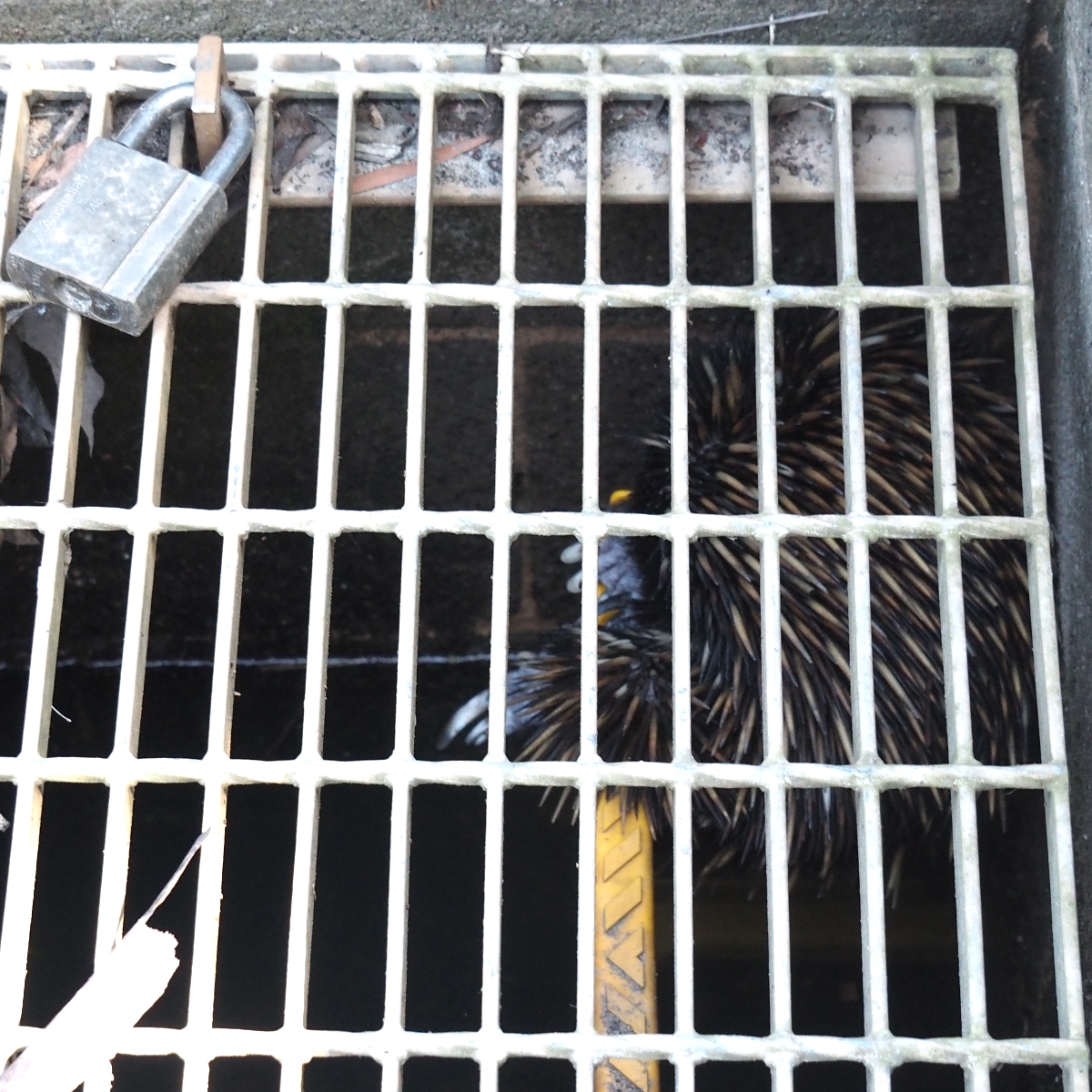
![]() |
| The trapped echidna |
![]() |
| The freed echidna |
Over coffee afterwards, three friends asked me, separately, and within
the space of a couple of minutes, if I was doing a book on echidnas. My answers
were, respectively, “Naaah”, “Maybe” and “You betcha!”
My third interlocutor started out by assuming I would
say yes, and before I could answer, she had reminded me that most children’s
books about echidnas are cloying, saccharine tales of how an anthropomorphic Eddie the echidna couldn’t play with
balloons. Those books aren’t about echidnas, they’re about overcoming
disabilities, and while that’s socially useful, those books don’t advance
understanding or inspire curiosity.
I had already decided that editing a poetry anthology for youngsters and completing a social history of science for oldsters would see me ready to hang up my pen and retire to gardening, leavened by watching noisy action movies and reading Proust, Joyce, P. D. James, Andrea Camilleri and other quality murder mysteries. Instead, I succumbed to peer pressure and launched into this
(Literary social climbers will be pleased to know that Proust and
Joyce return in cameo roles in chapter 10, though this may be seen as a cunning
ploy to convert certain library costs into tax deductions.)
Going home on the ferry, I started making notes, and I soon
realised I would have to read a lot of technical stuff, but there was a story
there, waiting to be told, and young readers would like it. Echidnas, spiny
anteaters, porcupine anteaters (or Tachyglossus
aculeatus if you have my sort of training), have odd quirks. My notes, my
initial thoughts, included the following headings, all later went into my
planning spreadsheet, and here they are:
* spiky, not at all cuddly;
* not really warm, lay eggs, suckle young:
* many scientific names;
* mainly solitary;
* good diggers (claws!);
* fossils, platypus relatives, Zaglossus;
* Sydney 2000 Olympic mascots: echidna, platypus and kookaburra;
* five-cent coin, postage stamp:
* echidna trains;
* do they drink water?
Over the next fortnight, my plan began to change, because in
one week, Christine and I saw four different echidnas, and in the five days
around Christmas 2020, we saw three more, and different, echidnas. Then when I
started looking at the scientific literature, I realised the really good story
was too complex for young readers.
My initial plan for an intellectually honest, stereotype-free, factual book for
youngsters had to go on hold. Having
declared to friends and family that echidnas (working title) is to be my Last Book, I may still
come back to do a simpler version for youngsters, because we still don’t have
all the answers, and that’s a good thing for young people (of all ages) to
know.
In this book, you will find heaps of technical stuff
about physiology, chromosomes, parasites, embryos, membranes, teeth and more. I
promise one thing, though: as a children’s writer, I take all the facts, one at
a time, and make each give a sound account of itself, but there will only be
facts. There will be no flights of fantasy like one I found in Blazing Passion, the book a friend from
Project Wombat passed on, complete with this blurb:
…a
breathtaking romance that races from the turbulence of nineteenth-century
England to the sweltering penal colonies in the Australian jungle…
The book in
question was published by Playboy Books, and ‘Stephanie Blake’ is in reality two men who clearly know very
little about Australia (“sweltering penal colonies in the Australian jungle”?),
but, one assumes, given their publisher, know lots about erotic fantasy. Should
you want a copy, Blazing Passion
came out in 1978. To save your time, here’s a sample of what passes for
dialogue there:
“I’ll fix you up a proper feast. Platypus eggs. Bacon.
Sausage and pancakes. And real coffee …”
Actually, I do offer one flight of fantasy later on in the book, but it
is clearly fanciful. Finding it is something I leave to the reader, but it’s
not the bit about socks full of sea urchins. Those are totally real, and also rate a mention in Sheep.
But that's another story.
Actually, what is a whole 'nother story is that I am resuming control of my out-of-print works and republishing under the Amazon Print-on-demand system.
More on that, later...
Saturday, 13 February 2021
I aten't dead yet
If you haven't heard of Granny Weatherwax, that will make no sense.
This is just to say that I'm still here, I've been working flat out, and the new book is now complete, and the second, adverted to below, is marinating, so normal service will be resumed shortly, once I have got the pitching worked out.
Some bits and pieces will show up here, and I will now offer some hints about the subject matter of the second book.
Thursday, 26 November 2020
They saw the difference.
I'm fairly happy with the text, and it's being shared with friends this weekend. In a week or so, I will start pitching it to a couple of print publishers, getting in before Christmas. A social history involves looking mainly at why people did things, but adding something of how they did it.
Why is this necessary? Because the fun bits are the background gossip, like my story of how Darwin was inspired by a false belief and the way Becquerel found radioactivity because the weather was bad. Again, most of us have no idea what Heinrich Hertz was up to when he discovered radio waves, or what Balmer was doing when he explained the lines that show up in the spectrum.
I mentioned Balmer six years back, when I wrote about the fraudulent work of Dulong and Petit, but I never dealt with it here, so here's a taster for you.
Balmer’s lines
Do you remember the spectroscope/spectrograph in chapter 1?
By the mid-1880s, spectroscopy had come a long way. The lines in the absorption
spectrum had been pinned down, one by one, so the exact wavelengths of the
hydrogen lines could be identified. That left a major puzzle: why did the lines
appear where they did in the spectrum?
Johann Balmer set
out to make sense of a jumble of numbers. In this, he was like Bode, or Dulong
and Petit with their mathematical rule tying specific heats and atomic weights
together, or even Maria Goeppert Mayer (next), who found certain ‘magic numbers’
of neutrons and protons that were associated with very stable nuclei.
In the real world,
laws do not leap out at you. They usually start when somebody goes
data-snooping. That means making lists of measurements, and poring over them to
see if there is any pattern to offer a hint about a rule lying beneath the
measurements.
Balmer found a
relationship linking four of the hydrogen lines in the visible spectrum. He
decided there should be another hydrogen line, right on the edge of the
ultraviolet, a line of which he had no knowledge. He checked, and the line was
there, as predicted, so Balmer’s rather odd little equation was confirmed.
Score one point to data-snooping.
Balmer had some
trouble reconciling the values reported by different observers. With hindsight,
probably the observers were looking at stars with differing degrees of red
shift? As we will see later, the red shift was important, once people detected
it and chased it down. To find his formula, Balmer found a common factor,
deduced from Anders Ångström’s measurements on the first four hydrogen lines,
which gave him a value, b = 3645.6x10-7mm. Here, in translation, is
his explanation of how b fits in:
The wavelengths of the first four hydrogen lines are obtained by multiplying the fundamental number b = 3645.6 in succession by the coefficients 9/5; 4/3; 25/21 and 9/8. At first sight, these coefficients do not form a regular series; but if we multiply the numerical values in the second and the fourth numbers by 4, we see a consistent regularity appearing [the series becomes 9/5, 16/12, 25/21, 36/32] and the coefficients have for numerators the numbers 32, 42, 52 and 62 and for denominators a number that is less by 4 [than the numerator].
For several reasons it seems to me probable that the four coefficients which have just been given belong to two series, so that the second series includes again the terms of the first series; and so I am able to present the formula for the coefficients in the more general form m2/(m2-n2), in which m and n are whole numbers.
That is to say, the wavelengths of the hydrogen lines are
given by l=b(m2/(m2-n2)).
Now back to Balmer:
For n=1 we obtain the series 4/3, 9/8, 16/15, 25/24 etc., for n=2 the series 9/5, 16/12, 25/21, 36/32, 49/45, 64/60, 81/77, 100/96 etc. In this second series the second term is already in the first series but in a reduced form.
Balmer compared the first four hydrogen lines as measured by
Ångström with calculated values. In Ångström units (10–10 metres),
the values for the lines are:
Alpha line: Balmer: 6562.08, Ångström: 6562.10, difference: +0.02
Beta line: Balmer: 4860.8, Ångström: 4860.74, difference: -0.06
Gamma line: Balmer: 4340, Ångström: 4340.1, difference: +0.1
Delta line: Balmer: 4101.3, Ångström: 4101.2, difference: -0.1
Clearly, the model is a very close fit to reality, but
Balmer went looking for his fifth hydrogen line: this was the acid test. He
calculated that it would be at 49/45x3645.6 = 3969.65 Ångström units.
I knew nothing of such a fifth line, which must lie within the visible part of the spectrum...and I was compelled to assume that the temperature relations were not favourable to the development of this line or that the formula was not generally applicable.
On reference to Professor Hagenbach he informed me that many more hydrogen lines are known which have been measured by Vogel and by Huggins...[and] he was kind enough to make a comparison of the wave lengths thus determined...
There was something going on here. This sort of close fit
has to have a reason behind it, but for the time being, all people could do was
look out for a cause.
In time, they
would find it, and so did Maria Goeppert-Mayer, but while that's what comes next in the book.
The girl who hated poetry
Eliza D came to see me in despair. "It's Henry," she said. "We're engaged to be married. but whenever I want to talk of love, he starts spouting poems..."
"Which poets?" I asked.
"I don't know," she said, "but he called me his 'bright star' the other day..."
"That's Keats," I said. "I think he loves you."
"Another time, he said 'My love is selfish. I cannot breathe without you' but he never touched me."
"Keats again," I told her. "I think you're going to be fine. Marry him!"
"I don't know," she said. "The other day, I decided to test him out by taking off my clothes, but when he should have been getting interested, he sat back and started babbling about unclasping my warmed jewels..."
"That's also Keats," I said. "The Eve of St Agnes, very romantic..."
"You might think it's romantic, but I think he's made of stone, and it's sending me round the twist!"
I stopped her there. "Eliza, old thing, if you can't stand the Keats, get out of the hitching."
Being an Australian writer
The perceptive reader may have noticed a hiatus. the reason will be explained shortly. I now do a monthly column for a CBCA newsletter called iRead, but as it may not be accessible to all, I plan to follow up with a release here, a couple of months later. This is the first.
There’s a game I play overseas, and you can play it as well, once we can get away. Sit in a coffee shop in Riga, a wine bar near Rome’s Spanish Steps, a Greek café in Banff, a chippie in Glasgow or a restaurant in Reykjavik, and say “G’day!” with a carrying voice, with vowels as flat as a goanna B-double roadkill. Then watch the Australian heads swivel, seeking an unseen compatriot who may have news from home. That single “G’day!” reminds them of where home is, but they never find me.
I knew from a tender age that I would be a writer, and an
Australian writer at that, because Australia has always been my home. I may
speak the rounded vowels of Received Pronunciation, but when I write and play
games, a streak of larrikinism oozes out.
My early role models were Norman Lindsay with his Magic Pudding, Dorothy Wall, who wrote Blinky Bill to kill off the
koala-shooting trade and Leslie Rees, whose ‘Digit Dick’ books and some of his
Oz wildlife stories resonated. It was Henry Lawson who set me going with a
short story His Country—After All,
where an Australian in New Zealand smells the smoke of a fire made of gum
leaves and gum twigs, and gets all nostalgic for home.
The catch: you can’t write smells, though Lawson gave it a
good go. If you want to give a book an Australian flavour, you need the right
words, from the right period. For the past decade, I have been nailing down
Australian words, where they came from, and when, using the National Library’s
Trove collection of digitised newspapers.
I started on this, thinking I might one day write some
historical fiction, even though my day job has been writing straight-out
history. I think it began with an idle thought about when the billy came into
use. A search on (and note the wording!) fulltext:"quart
pot" AND "tea" will show that the humble billy was a quart
pot first of all. The billy was a Tasmanian coinage, I think.
With some distress, I traced the earliest use of “two bob”
back to Charles Dickens, and what could be more Australian than “true blue”?
Alas, The Sydney Gazette and New South
Wales Advertiser mentioned in a filler in 1827 that the term was in use as
early as 1737, in England. Struth, Bruce!
So what about that quintessentially Oz term, ‘larrikin’,
which I define as calling “g’day” in foreign places? Well, ‘larrikin’ emerged
without warning in Melbourne’s The Argus
in 1870. We had paddocks and sheoaks before 1810, and sly grog by 1825, though
it seems people didn’t shout drinks until the 1850s.
Squatters were around from 1825, but back then, they were
shady characters, while until 1805, bushrangers weren’t even thieves, they were
just bushmen. Being an Australian writer has its pitfalls!
My researches are online at http://members.ozemail.com.au/~macinnis/writing/early-language.htm
Thursday, 22 October 2020
Food and drink in 1859
This is the last of a series of entries are drawn from chapter 7 of my book, Mr Darwin's Incredible Shrinking World, and they all deal with life in that era. For background on the book, see the first entry in the series, Life in 1859, but if you just want to see the others, use the tag 1859, which appears at the end of each entry.
Friday, 16 October 2020
Young Dark Emu and Bruce Pascoe's Eve Pownall Award
Today, the Children’s Book Council
of Australia announced that Bruce Pascoe’s Young
Dark Emu was the winner of the Eve Pownall Award for information books.
Earlier this year, bigots associated with a magazine called Quad Rant (or some
such) started a withering fire, directed at the CBCA for daring to shortlist
the book for the prize. It was wrong, they said, without evidence, so it wasn’t
an information book. Keep this unsupported allegation of a dearth of evidence in mind, as it’s common
practice among bigots to make claims like this. It seems that if they disagree with something, it isn't evidence.
The CBCA must withdraw the
shortlisting, they demanded. Now it has won the top prize, I imagine they will
be foaming at the mouth. At the back of their complaint was the fact that
author Bruce Pascoe says, from the viewpoint of an Indigenous man and scholar,
that the life of the first Australians was a lot more complex than we had been
led to believe by the spotty Europeans who had invaded this land. But Pascoe
wasn’t expressing opinions about what was right and what was wrong: he looked
at what the whitefellas had reported, and dealt with facts, whitefella facts, recorded by whitefellas.
That's hard to get around, and in the Culture Wars, bigots don’t
like that. They call people like me “Black-Armband-Wearers”, but that’s OK: we
say they’re all wearing white blindfolds, so the honours are even. The other, and nastier side is what
they don’t dare say up-front: Pascoe looks like a whitefella, so he can’t be a
blackfella.
I’m clearly a whitefella, albeit one
of mixed race, and I’m a trained biologist so I know quite a bit about race and
culture. I also write Australian history, so I know a lot of things that
get left out of Australian history in our schools, like the items Pascoe
has dug out, so I’m well-placed to examine his evidence, and see if it stacks
up.
School history is commonly a matter
of learning lists of names, dates and bullet points. School history as it relates
to explorers rarely mentions the Indigenous men, women and boys who accompanied
the explorers, except when they can be cast as “faithful servants”. School
history never mentions that most of the
explorers followed what they called “native roads”, and how many people know
that this began in February 1788?
Those who have read my works of
history will know about this sort of thing. My books have been published at
various times by Allen and Unwin, Murdoch Books (Pier 9), Five Mile Press and in the last decade, the
National Library of Australia.
I began my working life, fully intending
to be a pre- and post-Islamic Mediaeval Javanese historian, but when the 1965
coup in Indonesia banjaxed my hopes, I became a botanist instead (as one does),
but I retained the synoptic viewpoint of the historian and carried it into my
scientific work.
As a writer (I don’t call myself “an
author”, it’s too pretentious), my writings have mainly dealt with either
science and technology, or with Australian history. If people are going to
criticise the Eve Pownall judges’ decision in Young Dark Emu, because somebody claims the judges lack historical
training, I must be considered well-equipped to assess both the work, and the
judges’ decision. Quick answer: I endorse both, totally.
I have a policy of not arguing with
creationists, climate deniers, anti-vaxxers or bigots, because life’s too short
to waste trying to rescue sub-humans who cannot connect their other neuron or
express themselves clearly. This is a statement of fact, and what follows is a
set of facts, not opinions.
The Eve Pownall awards are for
information books, and they come from the Children’s Book Council of Australia.
I know a fair amount about these awards, because I won one in 2010, I was
runner-up in 2007, and I have been “long-listed” a number of times since then,
including this year, when I missed the short list. I didn’t mind missing out,
because the book I saw as the pick of the crop, Young Dark Emu, was there.
I’m a harsh critic of bilge, and my
other main professional skill is in spotting fraud and dishonesty. Because I
have written in great detail about Australian history, I was more ready than
most to assess Young Dark Emu, and I
did so early this year, knowing that assorted Quadrant gibbons were hurling lumps of
whatever gibbons hurl.
I attacked his sources and the
premises as a conscientious Devil’s Advocate, even though I agreed with Pascoe’s general
position. He and his book passed my audit with flying colours, and I have a
spreadsheet that demonstrates this. I will share my spreadsheet with supporters
and critics of Pascoe, but I will require proof of professional standing from
the critics.
I say this because the lead stirrer
in this matter seems to be a Queensland housewife (a dismissive pejorative that
I stand by) who claims to be a retired teacher, although looking at some of her
letters to the Canberra Times in the
1980s, when she appears to have sold dinghies, I am inclined to doubt this. She
does not engage in reasoned debate—consider this 2018 letter she fired off to The Australian (a newspaper for which I
worked, 30 years earlier):
‘Dave
Sharma says “like most Australians, I accept the evidence for man-made climate
change” (“The swing with a sting in its tail: why Wentworth was such a painful lesson”,
27/10). The assumption that most Australians agree with him is unsupported.’
Some two thirds of a century ago
(yeah, I’m approaching advanced middle age), I was a debater, and enjoyed
nothing more than massacring the sort of idiot who relied on assertions that
red was blue. They follow this up with a truculent “So there!”, and try to change the
subject: this may work in schoolyard bullying, but rebuttal-by-thuggish-denial fails dismally in
intellectual circles.
Hackett calls herself “an author” on
the strength of a single book, a travel memoir, published in 2002 by New
Holland, a reputable publishing house. Apparently she has also self-published
six booklets of local history.
Riffing on Martin Amis’ infamous comment
about writing for children firmly, I suppose if I were brain-damaged, I might
write a local history, though even then, I would draw the line at letters to
the editor, or writing for Quadrant.
I want the 50-odd books I have had published to be my memorial, not some vile
drivel in a hate mag funded by shady sources.
Hackett does not engage in
scholarship of any sort: rather, she takes in the washing of others. She cites
somebody called Russell Marks who (according to her) criticised an account of an event
involving Charles Sturt: the objection is about ascertaining the latitude and
longitude of an event. Pascoe had credited two friends with identifying the
location, but the Quadrant gnomes
didn’t like it, because it struck them as unnecessary.
‘His
[Sturt’s] journal also records that the incident took place on the 3-4
November, as anyone who had actually read the journals would know. These
details can be verified on pages 70 and 71 of Sturt’s Narrative of an
Expedition into Central Australia. Put another way, there is no way that
Pascoe’s researchers could not have stumbled upon the fact that Sturt had done
their work for them.’
The event
is described on Sturt’s page 76, the location was identified on page 70 (not “pages
70 and 71” as stated), and more to the point, if you are going to play the
nit-picking pedant game, you need to win your spurs first. Sturt's Narrative was in two volumes, the text referred to here is to be found in volume 2! (Now do you see why I don’t waste time on these
people?)
While we are at it, the Marks
objection, as cited by Hackett, is said to be to a footnote to a statement on page 98, but
it isn’t a footnote at all: what they cite is plain text on pages 100 – 101.
Any Year 8 of mine who made a hash of citations like that would soon be set
straight, but why did Pascoe’s friends determine a date and place for Sturt to
be fed on roast duck and bread in the first place?
Marks is
clearly unfamiliar with Sturt’s eminently readable but slightly sprawling
style. Items which are six pages apart in
the journal, like (a) the estimated position and (b) Sturt’s feast might have
been near each other or not. That was the way Sturt wrote, and I know, because
over several years, earlier in this century, I read all of the published
explorers’ journals, and even some of the unpublished ones. I created a massive
database, and that allowed me to assess the content of ‘Dark Emu’.
The simple fact is that most of the
early writers didn’t ‘get it’. ‘Blacks’, they thought, were savages who did
nothing and knew nothing. The “dispersals” (killings) went on, as Emily Creaghe
noted in 1883:
‘Mr. Watson has 40 pairs of blacks’
ears nailed round the walls collected during raiding parties after the loss of
many cattle speared by the blacks.’
As a
scientist, I am aware of the shortcomings of the Australian biota as
agricultural material: without imported plants and seeds, farming as we
invaders know it wasn’t possible, but land management was, and Pascoe reminds
us of just how far this went. It was far more than firestick farming: there was
careful cropping, and even planting in places.
Of
course, what we are ignoring is the elephant in the room: Pascoe doesn’t ‘look
black’, they say, so he must be a fraud! I am 25% Scots, but I have a Scots
name, and my heart lifts to the skirl of the pipes, because I was brought up
that way. Culture is learned at the parental knee, not inherited in the DNA.
My father
knew an Indigenous piper whose party trick was to play ‘A Man’s a Man for a’
That’. My party trick was to sit at my Scots/Welsh father’s feet at Hogmanay,
as he warmed up the pipes. I’m a bleepin’ Scot and I’ve got a sgian dubh for
your black heart if you say otherwise!
Now just
to play the Hackett bluff-them-with-denial game, she says: “No qualified
scholars or reputable academics agree with Pascoe’s claims. The accepted
scientific and academic view is that the Australian Aborigines were
hunter-gatherers.”
This
qualified scholar says “bollocks”. So there.
Please feel free to share this.