Somebody asked me in an unbelieving tone the other day about Crooked Mick's dog, the one that could round up a swarm of plague locusts, and drive them through a small camp fire. Now don't get me wrong: I didn't say that Mick's was the only dog that did this, but it was more efficient at it than most dogs.
You see, a plague swarm is usually a few miles (let's say 5 kilometres in your terms) wide, and many of the swarm are well out of the reach of even the best jumping dog, as they fly up to a mile above the earth — call it about 1.5 km. Narrowing the swarm's front is easy, but getting the high fliers down low enough is always a problem. The important point is that Mick's dog got around this difficulty in a new and rather creative way. He was dead lazy, as everybody knows, but Mick's dog was quite good at solving unusual problems.
Plague locusts will always settle on anything green, and Mick's dog had somehow worked out or noticed that male blowflies on the Speewah are green. So what he used to do was to round up all the blowflies (something any Speewah pup could do) and then cut out the males into a compact mass. Driving this mass of male blowflies under the swarm of locusts, the dog would then have to lead the locusts back to where the campfire was lit.
Then came the really hard part. To keep the locust swarm moving down, the dog needed a compact swarm of male blowies, and that meant keeping the blowies in one group while driving the locusts through the flames, so their wings were singed, and they dropped to the ground to die.
That wasn't hard: even my dog could do that on a good day, but the hard part was that the smell of dead and dying locusts brought all the female blowies around, and keeping them out of the way, and controlling the male blowies, AND driving the locusts through the flames, but not so close that they put the fire out, and gathering enough wood to keep the fire going at the same time, that was pretty hard.
So as I said before, Crooked Mick had a pretty good dog there. In fact, if we had a few more like him today, we could use a lot less chemical spray than we do. Which reminds me: Mick's dog also had a good way of dealing with the Speewah mosquitoes. Now this really was amazing, because the dog was born in the middle of a small drought, and so he was eight years old before he saw his first mosquito.
Yeah, that's a small drought as they come and go on the Speewah. When it rained after a real Speewah drought, one of Mick's mates fainted at the shock of water on his face, and they had to throw three buckets of dust over him to bring him round.
Anyhow, the mosquitoes came when the drought broke, and like everything else on the Speewah, they're big. They don't whine, they go FLAP! FLAP! FLAP! It's just as well they aren't around in the times of drought, or they'd blow all the dust away to New Zealand.
Well, Mick's dog didn't hesitate. As the first mosquito flew over, the dog sized the situation up, and jumped, taking a lump out of the mosquito's proboscis, the giant stinger thing on the front end of the mosquito. Hardly letting go, he slipped to a new spot on the stinger, and bit again, as the mosquito flew on.
Finally, the dog had chewed all the way around, and the proboscis fell to the paddock below, where it speared into the ground. The mosquito was now unbalanced, and it spiralled down to the ground, close to its stinger, and wandered off, looking dazed. As the mosquito landed, the dog let go, stepped safely onto terra firma, then turned around and looked for the next victim.
It took him a week, and by the end of that week, the female mosquitoes were all unspiked, and the whole of the Speewah home paddock was full of proboscises, all stuck in the ground. Later, when the floods came, the proboscises all filled with water, which made them really useful in the drought that came after that. All you had to do was chop a wedge into the side, and hold a billy underneath to catch the water flowing out.
But don't get me wrong: other dogs could probably have done the same thing, but I doubt they would have worked it out quite so quickly.
* * * * *
Somebody told me the other day that Crooked Mick's dog couldn't have seen that the male blowflies on the Speewah are green, because dogs are all colour-blind, but that is a false assumption. You see, the dogs on the Speewah are all kelpies, brought out to Australia from Scotland, and the kelpies have a dash of seal in their pedigree, and seals can see colours quite well.
In any case, as I mentioned before, the dog was born in the middle of a drought, so until he was eight years old, he never saw anything green. So not being used to green things, he immediately saw the colour when it appeared.
So you have to face it: there's no sense in underestimating the brainpower of a Speewah dog. Although Mick's dog did have one failing: it could set up a camp fire, fill the billy at the nearest water hole, and put it on the fire, but unless you gave it matches, there was just no way it could light the fire. And not just any old matches: it had to be given safety matches, and quite often it used three or four of them.
Nobody could ever work out why: the dog was completely normal in every other way, but it just couldn't handle that one simple task. Probably it got upset by somebody asserting within its hearing that it was colour-blind. Or maybe it was just that the dog was lazy. That was its real failing, laziness.
* * * * *
Note: there is a whole book of these stories, which I have been pitching to publishers, but they will probably appear in an
e-book.
There will be quite a number of these on the blog, all with the tags Speewah and Crooked Mick.
Tuesday, 20 September 2016


Sunday, 18 September 2016
Does thermodynamics matter?
To put it another way, do ordinary folk need thermodynamics,
or an understanding of it? C. P. Snow, later Lord Snow, certainly thought they did, because, as he saw it, thermodynamics is an area that matters intensely.
As a scientist who also wrote literary novels (as did his wife, Pamela Hansford Johnson), Snow was very aware of how ‘the other side’ saw science, and vice versa. Here, Snow is characterising the attitude of scientists to the ‘arts culture’, in his first entry into this arena, his lecture called The Two Cultures:
As a scientist who also wrote literary novels (as did his wife, Pamela Hansford Johnson), Snow was very aware of how ‘the other side’ saw science, and vice versa. Here, Snow is characterising the attitude of scientists to the ‘arts culture’, in his first entry into this arena, his lecture called The Two Cultures:
…the whole literature of the traditional culture doesn’t seem relevant…They are of course, dead wrong. As a result, their imaginative understanding is less than it could be. They are self-impoverished.
But what about the other side? They are impoverished too—perhaps more seriously, because they are vainer about it. They still like to pretend that the traditional culture is the whole of ‘culture’, as though the natural order didn’t exist. As though the exploration of the natural order was of no interest either in its own value or its consequences…
As with the tone-deaf, they don’t know what they miss. they give a pitying chuckle at the news of scientists who have never read a major work of English literature. They dismiss them as ignorant specialists. Yet their own ignorance is just as startling. A good many times I have been present at gatherings of people who, by the standards of the traditional culture, are thought to be highly educated and who have with considerable gusto been expressing their incredulity at the illiteracy of scientists.
Once or twice I have been provoked and asked the company how many of them could describe the Second Law of Thermodynamics. The response was cold: it was also negative. Yet I was asking them something which is about the scientific equivalent of: Have you read a work of Shakespeare’s?
I now believe that if I had asked an even simpler question—such as, What do you mean by mass, or acceleration, which is the scientific equivalent of saying Can you read?—not more than one in ten of the highly educated would have felt that I was speaking the same language.
Sir Arthur Eddington thought thermodynamics mattered very much to
scientists:
Eddington was always at his best when he was having fun with science: “Electrical force is defined as something which causes motion of an electric charge; an electrical charge is something which exerts an electrical force.”That, however, was bettered by this comment, also from his book, The Nature of the Physical World:
The law that entropy always increases—the second law of thermodynamics—holds, I think, the supreme position among the laws of Nature. If [your pet theory of the universe] is found to be contradicted by observation—well, these experimentalists do bungle things sometimes. But if your theory is found to be against the second law of thermodynamics I can give you no hope; there is nothing for it but to collapse in deepest humiliation.So, yes, thermodynamics matter. It would be worth asking a climate change denier who babbles (as they all do) some drivel about the uncertainty of science, one of Snow's questions.
Oh, and if you aren't sure what the second law says, try this: In any spontaneous process, there is always an increase in the entropy of the universe.
Another way of saying this is to assert that there can never be a 100% efficient (or perfect) heat engine. Another form of the law states that heat flows spontaneously from a hot object to a cold object. Heat will not flow spontaneously from a cold object to a hot object.
If you understand thermodynamics, you can answer this:
You have a perfectly insulated room, and inside it, there is a refrigerator. It has been switch on, and the door had been wedged open. Now:
- Does the room get cooler? or
- Does the room get hotter? or
- Does the temperature stay the same?
This one tricks a lot of people, and the odds are that it will fool climate change deniers as well. Nobody who is unable to answer this should speak about climate matters.
Wednesday, 14 September 2016
Convict escapes
This is one of a series of pieces that may or may not ever see the light of day in a book: it is more likely than not that I will be self-publishing my Colonial Concerns, from which this is taken, as an e-book: it turned into a huge opus (a quarter of a million words of Australian history) that frightens print publishers. If and when the e-book happens, I will edit this to indicate where it can be obtained. In the interim, this is available to students of all ages, complete with sources.The First Fleet arrived with enough food to last the population two years. They also brought live animals, plants and seeds, but these were not for eating. One important source of fresh food for the early settlers was fish. There was a catch with relying on fish as a food source: there had to be boats around, and for some convicts, that was a temptation, but let’s look at the history of escaping back to the sailing of the First Fleet.
Many convicts hoped desperately to
escape. Most of their attempts were acts of desperation with no chance at all.
The masters of the convict transports were fairly desperate to stop escapes as
well. Arthur Bowes Smyth noted in his journal, that the masters had to safely land, the
convicts and deliver them “into the Care of the Governor … under the penalty of
40£ for every Convict that was missing” [1]
Given that penalty, it is surprising
that when the fleet was at Teneriffe, a convict was allowed to work on deck
while there was a boat alongside his ship, the Alexander, with oars in it. This was all too much for John Powers,
who rowed away that night in what Smyth calls the jolly boat. Unwisely, Powers
went ashore and fell asleep. Marines found the boat the next morning, then they
found him, and they took him back to the ship.
Powers was then “heavily ironed”[2], but later in the voyage,
he tried to start a mutiny, and in Sydney, he stole some boards and received
200 lashes in November, 1788. After that, he seems to have disappeared. Perhaps
he just died and nobody bothered to take note of it.
Then again, he may have
stolen some more boards, made a boat and went to sea, but if he did, he
probably drowned. At the end of 1793, David Collins wrote a list of the losses
in that year:
There died between the 1st of January and
31st of December, both inclusive, two settlers, seven soldiers, seventy-eight
male convicts, twenty-six female convicts, and twenty-nine children. One male
convict was executed; six male convicts were lost in the woods; one male
convict was found dead in the woods; one male convict was killed by the fall of
a tree, and two male convicts were killed by lightning; making a decrease by
death and accidents of one hundred and fifty-three persons. To this decrease
may be added, four male convicts, who found means to escape from the colony on
board of some of the ships which had been here. [3]
The forger-artist, Thomas Watling was one of those who failed to escape on the way to
Australia, but quite a few disappeared, rather desperately, once they came
ashore in Australia. Four seamen from the First Fleet escaped at Cape Town, and
only two were recaptured[4]. The
chances for escapees were poor, though.
On the other hand, one Portuguese
soldier at Rio asked to be taken on board the fleet so he could go with them to
Botany Bay. Captain Phillip refused. [5]
*****
Once in Sydney, convicts had three possible
ways to escape alive:
* They
could run away into the bush;
* They
could stow away on a ship; or
* They
could get or steal a boat and sail away.
Running away into the bush was always
possible, but surviving in the bush was quite another matter, because the
convicts had no idea of how to feed themselves, or how to stay alive, dry, and
warm. Almost as soon as the convicts landed, two of them, Ann Smith and a
Frenchman called Peter Paris (or Parris) went missing.
John White thought a Frenchman might
have found more favour with La Pérouse, but he added that “… the French
commodore had given his honour that he would not admit any of them on board …
he might have been concealed, through pity, by his countrymen, and carried off
without the knowledge of the commanding officer”. [6]
If Smith and Parris had sailed away with
the French, the two would have died with them when the French ships were
wrecked, not long afterwards, but a large ship would always be safer than a
small boat.
Hiding on a ship was hard to do. When
the transport Neptune was unloaded in
August 1790, she was bound for China to pick up a cargo, but before she left,
the town-adjutant, marine lieutenant Long, searched the ship. He found a man
and a woman hidden in the ship’s supply of firewood. [7] This was no chance search:
among the convicts, there was little honour, and informers were everywhere.
Those who went off into the bush never
lasted long. They had no idea of how to get food in the bush, no idea of how to
stay warm and dry, and little chance of being helped by the Aborigines. [8] That only left stealing a
small boat.
On the night of September 26, 1790, five
male convicts took a small punt from Rose Hill and headed for Sydney. The punt
would have been a death trap, once they left the shelter of Port Jackson, so
the party, John Tarwood, Joseph Sutton, who had already been caught and
punished after hiding on the Neptune,
George Lee; George Connoway, and John Watson, took a small boat, and made a
break for the open sea. [9]
Collins called this boat small and weak,
but it had a mast and a sail, and enquiries revealed that the escapees had
taken food for one week; their clothes and bedding; three iron pots, and some
other utensils. Rather optimistically, they were planning to reach Otaheite, or
as we would say now, Tahiti, which was a distance of more than 6000 km.
They were searched for in the harbour,
and when no trace was found, the authorities concluded that they had sailed
over the ocean which, as Collins put it, “… from the wretched state of the boat
wherein they trusted themselves, must have proved their grave.”
In fact, they sailed up the coast as far
as Port Stephens and put in there, Sutton later died, but the other four men
were taken in by the local Aborigines, and when Captain Broughton of the Providence put in there during a storm
in August 1795, he found four miserable, naked, dirty, and smoke-dried men who
begged to be taken to Sydney.
By that time, each had a native wife and
one or two had children, and according to them, the natives worshipped them as
the spirits of their countrymen, which, after death, had gone away and then
returned in pale human form. They had had enough.
Until that time, everybody assumed that
Tarwood and his party had all died, and the same assumption applied to William
Bryant and his family and friends, but Bryant was a Cornish sailor. He knew the
sea, and he planned ahead.
The first thing people needed was
secrecy over the time it took to get everything ready. You needed food, water,
clothes, some sort of tent or shade cloth, tools, money, some sort of map and
instruments for navigation. Most of all, you needed a boat big enough to sail
in the open ocean, and you needed to know how to handle it.
Bryant had been tried for resisting
revenue officers (as a smuggler) in Launceston in March 1784, and sentenced to
death, but this was commuted to seven years’ transportation. Mary Braund (or
Broad) was part of a family well-known as sheep-stealers, but she was charged
with highway robbery. Found guilty, she was sentenced to death, commuted to
transportation.
They married, and by 1791 they had two
small children, and wanted to go home. They gathered another seven convicts:
William Allen, Samuel Bird, Samuel Broom, James Cox, Nathaniel Lilly, James
Martin and William Morton. Five of the adults including Mary Bryant had arrived
in the First Fleet, the other four had come in the Second Fleet. William
Bryant’s sentence had expired, three had been transported for life, the others
had at least a year or two to go.
When they left Sydney at the end of
March, 1791, his sentence had run out, but no records had reached Australia, so
he couldn’t prove that he deserved to be free. Mary Bryant had two more years
to serve, they had everything they needed, and only required a moonless
night—and no ships in the harbour that might chase after them.
The snow Waaksamheyd had been chartered to bring food to the colony from
Batavia (Jakarta) and when the frigate Sirius
had been lost off Norfolk Island, Captain Hunter and his crew (they all
survived) were placed on board to return to England.
The escapees had bought a chart of sorts
from Detmer Smith, the master of the Waaksamheyd,
along with a compass and a quadrant. William Morton and James Cox also knew
something of navigation. Detmer Smith also sold Bryant muskets and food, the
money coming from the fish that Bryant had held back and sold on the black market.
Waaksamheyd’s master had been a good friend, but the authorities might take
over his ship to chase after them, so that ship had to leave port before they fled, but
the officers knew Bryant had something planned, and they were watching him
closely. There was a new moon on March 24, so on March 28, the moon would have
gone by about 10 pm. Later in the week, there would be moonlight longer. They
had to go.
He gathered his friends, they got the
hidden stores together, and crept off into the darkness. Along the way, they
dropped a handsaw, and they spilt a couple of kilograms of rice that were seen
the next day [10],
but nobody admitted to seeing them go off in the governor’s six-oared cutter.
Their plan was a simple one. They rowed
into the harbour at Kupang (it was spelt ‘Coepang’, back then) on the island of
Timor, and said they had been shipwrecked, a claim made more believable because
they had a woman and children with them.
Somehow, the Dutch authorities
discovered that these were really escaped convicts, so they locked them up.
Then came a piece of really bad luck. HMS Pandora
had struck a reef near Cape York, after searching for the Bounty mutineers, with 14 prisoners on board.
Taking to the ship’s boats, he and his
whole ship’s company arrived in Kupang. Now Captain Edwards quizzed them, they
confessed, and the game was up.
It might have been better if Edwards had
still had his ship, because he would have set out for Britain, but now he
needed to get all of these people home, and that meant going to Batavia to find a ship to carry them all. Back then,
Batavia was a disease-ridden death-trap, and it was diseases caught there which
reduced the Bryant party to five survivors.
They travelled to the Cape of Good Hope,
where they found H.M.S. Gorgon,
returning from Sydney with some of the marines, including Watkin Tench, who
managed to get many more details of their travels from Mary Bryant. Among other
things, Tench says that one of the men let slip the truth when he was drunk. At
the end, he wrote:
Ralph Clark (a notoriously poor speller) wrote in his journal as they sailed up the Atlantic on Sunday, May 1792:I confess that I never looked at these people without pity and astonishment. They had miscarried in a heroic struggle for liberty after having combated every hardship and conquered every difficulty.The woman, and one of the men, had gone out to Port Jackson in the ship which had transported me thither. They had both of them been always distinguished for good behaviour. And I could not but reflect with admiration at the strange combination of circumstances which had again brought us together, to baffle human foresight and confound human speculation. [11]
Squaly weather with a great dele of Rain all this day last night the child beloning to Mary Broad the convict woman who went a way in the fishing Boat from P. Jackson last Year died about four oClock committed the Body to the deep Latd. 5–25 No. [12]
Of the party, William Bryant and his son
Emanuel died in Batavia, Bird and Morton died on the way to the Cape of Good
Hope, Cox either jumped or fell overboard on that same voyage, and Mary’s
daughter Charlotte died in the Atlantic.
Mary Bryant, along with Allen, Broom,
Lilly and Martin were charged with escaping transportation, for which the usual
penalty was death, but they were merely sentenced to complete their original
sentences in Newgate Prison. In May 1793, the writer James Boswell gained for
her a free pardon, and later gave he a pension of £10 a year, on condition that
she was of good behaviour.
The men were released in November 1793,
and three of them disappeared from the record, as did Mary Bryant. One of them,
Samuel Broom, alias John Butcher, may
have enlisted in the New South Wales Corps. By 1795, a man of that name was
back in Sydney, and he later obtained a grant of land. The dates make this
unlikely, as the Butcher in question enlisted in May, 1792.
[1]
This is from the transcript of page A1085095 of the State Library of NSW copy
of Smyth’s journal. It is missing from the version in the National Library of
Australia. (This often happens when one of the versions was the original, and
another is a “fair copy”. Scholars say that the State Library version is
probably a fair copy, and the National Library version is probably the
original.)
[2]
See David Collins, An Account of the
English Colony in New South Wales, volume I, Introduction, page lxiv (with
electronic searches, look for “heavily ironed”).
[3]
See David Collins, An Account of the
English Colony in New South Wales, volume I, chapter XXIII, page 278 (with
electronic searches, look for “there died between”—this also finds the figures
for 1792).
[4]
See David Collins, An Account of the
English Colony in New South Wales, volume I, Introduction, page lxxxii
(with electronic searches, look for “fiscal’s people”).
[5]
See David Collins, An Account of the
English Colony in New South Wales, volume I, Introduction, page lxxv (with
electronic searches, look for “soldier of the island”).
[6]
John White, Journal of a Voyage to New
South Wales, 1790, entry for February 8, 1788, available as http://setis.library.usyd.edu.au/ozlit/pdf/p00092.pdf,
on page 72.
[7]
See David Collins, An Account of the
English Colony in New South Wales, volume I, page 107 (with electronic
searches, look for “among the fire-wood”—include the hyphen!).
[8]
See Arthur Phillip, The Voyage Of
Governor Phillip To Botany Bay, page 118: in electronic versions such as http://setis.library.usyd.edu.au/ozlit/pdf/phivoya.pdf,
search for “starved”.
[9]
See David Collins, An Account of the
English Colony in New South Wales, volume I, pages 112–3 (with electronic
searches, look for “Connoway”.
[10]
See David Collins, An Account of the
English Colony in New South Wales, volume I, p. 128-9, or online at http://setis.library.usyd.edu.au/ozlit/pdf/colacc1.pdf
(in which it is pages 153–4).
[11]
This appears in a footnote to page 108 of Tench’s printed Complete Account. See Watkin Tench, A Complete Account of the Settlement at Port Jackson, http://adc.library.usyd.edu.au/data-2/p00044.pdf,
p. 147, or online e-text at http://www.gutenberg.org/ebooks/3534.txt.utf-8.
[12]
Ralph Clark was clearly the worst speller in the First Fleet!
Friday, 9 September 2016
First Fleet backgrounder
The British public first learned about the government’s plans to settle Australia in their newspapers in 1786. It seems that The Times was a little confused about the location of Botany Bay:This is one of a series of pieces that may or may not ever see the light of day in a book: it is more likely than not that I will be self-publishing my Colonial Concerns, from which this is taken, as an e-book: it turned into a huge opus (a quarter of a million words of Australian history) that frightens print publishers. If and when the e-book happens, I will edit this to indicate where it can be obtained. In the interim, this is available to students of all ages, complete with sources.
It took The Times three weeks to think about this.Government is now about settling a colony in New Holland, in the Indian seas; and the Commissioners of the Navy are now advertising for 1500 tons of transports. This settlement is to be formed at Botany Bay, on the west side of the island, where Captain Cook refreshed and staid some time on his voyage in 1770. As he first sailed around that side of the island, he called it New South Wales, and the two Capes at the mouth of the river were called by the names Banks and Solander. There are 680 men felons and 70 women felons to go, and they are to be guarded by 12 marines and a corporal in every transport, containing 150 felons. There are several men of war and some frigates to go, but they all come back, but one or two of each, which are to remain there some time to assist in establishing a garrison of 300 men intended to be left there. The whole equipment, army, navy, and felons, are to be landed with two years provisions, and all sorts of implements for the culture of the earth, and hunting and fishing, and some slight buildings are to be run up immediately till a proper fort and town-house are erected. This place is in nearly the same latitude with the Cape of Good Hope, and about eight months voyage from England. [1]
After that, the plans to go to Botany Bay were almost daily news. People talked about it, people sang about Botany Bay, but even if you can see and hear it said on television or read about it in story books, prisoners were not sentenced to be “transported to Botany Bay” until June 1791. [3]…the measure of sending convicts to Botany Bay … must meet with the approbation of all moderate men. No measure has been yet devised, which so effectually combines the punishment and the security of the felons. [2]
In October, the fleet was said to be
leaving in December 1786, a few days later, it was reported that 300 felons
were already gathered together in Newgate. In April 1787, the fleet had still
not sailed, though “Hughes’ troop” were performing the “favourite Opera of
Botany Bay” [4].
Everybody important knew about Botany Bay, but the fleet was still at anchor.
On May 5, another 38 convicts were
loaded onto a transport in Portsmouth Harbour [5], but on May 13, the fleet
sailed escorted by the frigate H. M. S. Hyaena.
Late in May, The Times reported that
the Botany Bay fleet was “… all well the 20th instant in lat. 47:50 N. long 11:
30 West.” [6] That means the frigate Hyaena had left the fleet in that
position on May 20, and now reached England. (The word “instant”, sometimes
abbreviated to “inst.”, was commonly used then to mean “this month”.)
In summary, the ships left on May 13,
1787, and sailed all of 1787, and part of 1788, before reaching Botany Bay.
They called at three ports along the way to take on supplies, and there would
be a few incidents. In those eight months, some would die, babies would be
born. Some who arrived alive would die in Australia, while others would return
to Britain. Others would find a new and better life in what would become
Australia.
The path followed.
The eleven ships of the First Fleet were a mixture. There were two navy ships, Sirius and Supply, there were store-ships Fishbourn, Golden Grove and Borrowdale, and the convict transports Alexander, Scarborough, Charlotte, Prince of Wales, Lady Penrhyn and Friendship. |
| The main points on the route of the First Fleet (Peter Macinnis) |
The frigate, Hyaena went with them for a few days, returning to England on May
29 with reports and letters. The fleet sailed on to Teneriffe, arriving on June
3.
They bought musket balls and paper for cartridges (somebody had forgotten
these!), and a convict named John Powers tried to escape (see my next post). They left Teneriffe
on June 9.
The
fleet crossed the Equator on July 14, and those who had not “crossed the line”
before were subjected to a set of rough ceremonies.
On August 2, the fleet sighted the coast
of South America, and on August 4, they dropped anchor off Rio de Janeiro in
Brazil. At noon, a ship passed by, headed for Portugal, and took letters and
reports from the fleet that would later reach the government in England.
Captain
Phillip had served at one time in the Portuguese navy and spoke Portuguese, so
he was made very welcome. During their stay, all of the people on the fleet
were given good food, with fresh vegetables and fruit. It took a lot longer for
scientists to show that scurvy was caused by a lack of vitamin C in the diet,
but by 1787, sensible sailors understood the disease, and knew that fruit and
vegetables prevented it, somehow.
At Rio, they also bought seeds or plants
(or both) of coffee, cocoa, cotton, banana, oranges, lemons, prickly pear with
cochineal beetles (to be used to make a red dye), guava, tamarind and some
medical plants.
They left Rio on September 4, heading
for Cape Town in what is now South Africa, arriving there on October 13.
 | |
| Arthur Phillip, frontispiece to his The Voyage to Botany Bay |
Before they left Cape Town on November
12, Phillip and some of the officers and men bought cattle, horses, sheep,
goats, pigs and other stock to carry to the new colony.
They also bought fresh
food for everybody, and took on supplies of water for drinking and cooking.
Captain Phillip also sent back reports with an English army officer who was
returning to England from India.
At Cape Town, they bought seeds or
plants (or both) of figs, bamboo, “Spanish reed”, sugar cane, vines of
different sorts, quinces, apples, pears, strawberries, oak and myrtle trees,
rice, wheat, barley and corn. They had brought the last four from England, but
those seeds might have been damaged, so the extras seemed like a good idea.
On November 25, Captain Phillip
transferred to H.M.S. Supply, and
with the three transports which had most of the men convicts (Alexander, Scarborough and Friendship),
he went ahead to start making preparations at Botany Bay.
Captain Hunter took charge of the rest
of the fleet. David Collins sailed with him and he wrote the best account of
the trip, so we will now follow them.
On Christmas Day, Hunter’s seven ships
were at 42° 10’ south, and on December 30, calculations based on the moon
(called “lunar observations” or just “lunars”), they decided they were at 118°
19’ east, and by noon on January 3, they were at 44° south and 135° 32’ east.
They had gone fast, and now they were ready to turn north.
On January 7, they sighted land, and
just as night was falling on January 19, they saw Botany Bay. The next morning
Hunter’s seven ships sailed in.
The rest is history, as they say.
[1]
News report, The Times (London,
England), Thursday, Sep 14, 1786; pg. 3; Issue 529. The stories from The Times are located in a Gale database
which is hard to access. I use it through the State Library of NSW: ask your
librarian for help.
[2]
News report, The Times (London,
England), Friday, Oct 06, 1786; pg. 2; Issue 548.
[3]
Search for “Botany Bay” (with the quote marks) at http://www.oldbaileyonline.org/
[4]
News report, The Times (London,
England), Tuesday, Apr 24, 1787; pg. 3; Issue 733. This probably refers to an
opera of that name.
[5]
News report, The Times (London,
England), Saturday, May 05, 1787; pg. 3; Issue 742.
[6]
News report, The Times (London,
England), Saturday, May 26, 1787; pg. 1; Issue 757.
Monday, 5 September 2016
Back to critics
 |
| Sibelius memorial Helsinki |
 |
| The addition that came later. |
I was reminded of this in Helsinki, when we visited the memorial to the composer (left): it is quite abstract, but the Finns, perhaps recalling that, wanted to see his face there, and so the face seen on the right was added, out to one side.
I remembered his alleged comment about statues, and we moved on.
As we got back on the bus, I recalled another review, published in the Times Literary Supplement in 1908. The author was E. V. Lucas, a not-bad writer, though largely forgotten today
When I find such things, I save them in my meticulously curated image collection, so here it is.

However, as it is a bit hard to read, I fed it through my OCR reader and hand-corrected it, then added a bit of leading, to make it more accessible. The result appears below:
"The Wind in the Willows"
The author of “The Golden Age” and of “Dream Days,” the historian of the immortal Harold, has disappointed us.
There is no getting away from that melancholy fact. He has written in The Wind in the Willows (Methuen, 6s.) a book with hardly a smile in it, through which we wander in a haze of perplexity, uninterested by the story itself and at a loss to understand its deeper purpose.
The chief character is a mole, whom the reader plumps upon on the first page whitewashing his house. Here is an initial nut to crack; a mole whitewashing. No doubt moles like their abodes to be clean; but whitewashing? Are we very stupid, or in the joke really inferior? However, let it pass.
Then enters a water rat, on his way to a river picnic, in a skiff, with a hamper of provisions, including cold tongue, cold ham, French rolls, and soda water. Nut number two; for obviously a water rat is of all animals the one that would never use a boat with which to navigate a stream Again, are we very stupid, or is this nonsense of poor quality?
Later we meet a wealthy toad, who, after a tour of England in a caravan, drawn by a horse, becomes a rabid motorist. He is also an inveterate public speaker. We meet also a variety of animals whose foibles doubtless are borrowed from mankind, and so the book goes on until the end. Beneath the allegory ordinary life is depicted more or less closely, but certainly not very amusingly or searchingly; while as a contribution to natural history the work is negligible.
There are neat and fanciful passages; but they do not convince. The puzzle is, for whom is the book intended? Grown up readers will find it monotonous and elusive; children will hope in vain for more fun.
The materials for an English “Uncle Remus” are here, but without the animating spirit. For ourselves, we lay “The Wind in the Willows “ reverently aside, and again, for the hundredth time, take up “The Golden Age.” Perhaps that is the real inner purpose of the new work—to send readers to its deathless forerunners—to “The Golden Age” and “Dream Days.”
So be it.What can one say?
********
Footnote: My good friend Pam McLaughlin has alerted me to an instance of a statue of a critic. As immediate past president of the International Cabal of Sibelians, if you want to see it in the flesh, as it were, hurry: Sibelius is always right!
Sunday, 4 September 2016
Le Havre in April, a fishy tale
Talking of red light districts (OK, I wasn't, but let that go), Nicolas Baudin left Le Havre
in France in 1800 with two ships, intent on mapping the Australian coast, but
it was largely a scientific expedition.
Mind you, it wasn't all fun carrying scientists, and he wrote to his
friend, the NSW governor, also a naval man:
“I must say here, in passing, that those captains who have
scientists, or who may some day have them aboard their ships, must, upon
departure, take a good supply of patience. I admit that though I have no lack
of it, the scientists have frequently driven me to the end of my tether.”
One of those on board one of the ships, Charles-Alexandre
Lesueur, was an artist when he left Le Havre, but he worked with the
scientists, and as disease knocked out most of the scientists, he shifted
across and took on-the-job training as a biologist.
While many specimens were collected in 19th century
Australia, the scientific work and later storage all happened in Europe. Older
Australian type specimens are generally to be found in European countries.
We know now that for the sake of accurate science, and for
the sake of records, collections made in Australia are better studied and
stored in peaceful Australia, but that notion would not take hold for almost
another century. It was still the age of the pillaging visitor-expert who came
to fetch, rather than to study. One Scot went back to Cambridge in the 1880s
with 1300 pickled echidnas, and having married an Australian heiress, did no
further research on them.
Over time, that attitude to specimens would change, but it
would be a perilously slow change, and back then, I was interested in when the
changes happened. The Good Guys were the Germans, the Bad Guys were the British
and the French. The Germans wanted their specimens kept in Australia, the
French and the Brits took everything away with them.
After his voyage, Lesueur wrote up his work and then moved
to New Harmony in Indiana in 1815 (with his specimens). While he was there, he pursued his trade of
naturalist-artist, but in 1837, he returned to France and settled in his native
Le Havre, taking his collections of specimens with him. And so Australian
specimens came to be in the Natural History Museum in the French port city of
Le Havre in 1944.
Europe is currently experiencing its longest-ever period
free from war in recorded history, but it hasn’t always been so. Florence, the
resting place of French botanist Julienne Houtou de La Billardière’s Australian
type specimens, was damaged in World War II and London’s Natural History Museum
was badly damaged in the Blitz in 1941.
Ports are natural targets in modern warfare, and in that
year, the Musée d’Histoire Naturelle du Havre was badly damaged by bombing and
fire. Anyhow, for good and valid
reasons, I needed to get to Le Havre, and in 2004, Chris and I walked around Cyprus,
then had a fortnight based in Paris, and we allowed one day to visit Le Havre.
We always set out early when we are headed for towns with
unusual museums. This helps us avoid crowds, but the plan can have its
drawbacks. We expected to wander the station,
take in the sights, have a coffee and a sweet item or two, and then take a slow
train, just in time for the museum opening at 2 pm.
The snag was that the efficiently helpful SNCF (railway)
staff at Gare Saint-Lazare railway station in Paris took us in hand and bundled
us onto a speedy train earlier than the slow service we had planned to catch.
The combined result of an early start and a fast train was that we arrived in
Le Havre, three hours before our target museum opened.
It was a chilly, windy and rainy day in late April, more
winter than summer. We wandered,
buffeted this way and that, through a town where unseen (we did not dare look
up!) workers above us scrubbed a winter’s supply of seagull excrement from
buildings and awnings. To dodge the
wind-blown spray of lime-rich, fish-stinking splatters, we took refuge in a
tavern.
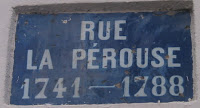

We were drawn to one tavern because it was on the intersection of Rue Lesueur and Rue Laperouse, and we decided to wait there for the museum to open so we could see Lesueur’s Australian collections, relatively unspattered. Rue Lesueur was clearly appropriate, but unless you are Australian, I need to explain that Laperouse was an early French voyager to Australia.


We were drawn to one tavern because it was on the intersection of Rue Lesueur and Rue Laperouse, and we decided to wait there for the museum to open so we could see Lesueur’s Australian collections, relatively unspattered. Rue Lesueur was clearly appropriate, but unless you are Australian, I need to explain that Laperouse was an early French voyager to Australia.
It was, we decided a Sign (or Signs?) from on high, so we went in and met an odd sight. The occupants of this
small tavern resembled the chorus of pimps and madames from Irma La Douce,
but we just took them to be quaint rural folk, and they made Chris and I welcome. We must
have seemed equally exotic to them, but we chatted in franglais, and got along
for an hour or so, before we went out, through the drizzle of dilute
bird-droppings that was still splashing down, to examine some stuffed
Australian animals.
Later, I learned that our refuge was at the epicentre of the
town’s red light district. The other customers were almost certainly
professionally qualified for roles in the film, but they had welcomed us as fellow
humans on a cold day.
I will always recall rainy windswept, chilly Le Havre, on a
spring day where winter struck back, as the shop awnings dripped stickily after
their annual scrubbing to redistribute the guano deposits contributed by the
hardy seagulls. I probably learned more at the Musée de la Marine in Paris, but
Le Havre, the port so many French explorers departed from, has fonder memories
for me.
And being able to say, honestly, “when we were in the red
light district or Le Havre…” is a good way of getting attention at a dinner,
almost as good as “when I used to light a bushfire each afternoon…”
But that’s another story…
Sunday, 21 August 2016
All about germs
Originally, a germ was a seed, and this sense is still
preserved in expressions like 'wheat germ' and 'germinate', which is what a
seed does when it sprouts, or in the 'germ of an idea', but for the most part,
germs are now the latter-day equivalent of evil spirits, for they are
invisible, all around us, and they cause us to be ill. The only difference,
perhaps, is that certain mages can sell you cloths and sprays that will banish
these spirits from your hearth and home. Then again, maybe things today aren't
all that different after all.
Those of us with a thoroughly modern outlook are inclined to
commend ourselves smugly for understanding these things, when those before us
did not. But then again, maybe they did have a few clues about what was going
on. Here is Daniel Defoe, in his Journal
of the Plague Year, (published in 1722!) discussing what really caused the disease, writing
about how one could tell who had caught the plague:
I have heard it was the opinion of others that it might be distinguished by the party's breathing upon a piece of glass, where, the breath condensing, there might living creatures be seen by a microscope, of strange, monstrous, and frightful shapes, such as dragons, snakes, serpents and devils, horrible to behold. But this I question very much the truth of, and we had no microscopes at that time, as I remember, to make the experiment with.
In fact there were microscopes in London just before the
plague arrived, but these were primitive devices that would not have revealed
the germs of the disease, the Yersinia
pestis bacteria. It seems fairly clear, however, that Defoe had some idea
that there were microorganisms of the sort that Anton van Leeuwenhoek had
described, and that these might have caused the disease.
Well and good, by the time Defoe published, the
scientific age was well advanced. Back at the time of the Black Death, our
ancestors were really stupid, and knew nothing, right? Well, maybe not...
For a start, they were not completely lacking in any understanding. Here is Chaucer speaking through the host of the Tabard, in the Prologue to the 'Cook's Tale', most of which is sadly lost to us.
For a start, they were not completely lacking in any understanding. Here is Chaucer speaking through the host of the Tabard, in the Prologue to the 'Cook's Tale', most of which is sadly lost to us.
And many a Jakke of Dover hastow soold
That hath been twies hoot and twies coold.
Of many a pilgrym hastow Cristes curs,
For of thy percely yet they fare the wors,
That they han eten with thy stubbel goos;
For in thy shoppe is many a
flye loos.
The Jack of Dover was probably a pie, and the cook stands
accused here of twice heating and twice allowing the food to cool before
selling it, a sure recipe for food poisoning, even if it is one ignored by many
modern fast-food sellers. Pilgrims who have eaten the cook's old goose, fed on
stubble, will have cursed him because his shop has many flies. In other words,
Chaucer was fully aware, some time before he died in 1400, of what caused
people to get ill from food they ate.
But refrigeration, surely that is a modern invention, and
something that only modern people like us understand? Perhaps not, if you
consider how Francis Bacon died in 1626, according to John Aubrey:
Mr Hobbs told me that the cause of his Lordship's death was trying an Experiment . . . it came into my Lord's thoughts, why flesh might not be preserved in snow, as in Salt. They . . . bought a Hen, and made the woman exenterate it, and then stuffed the body with Snow, and my Lord did help doe it himselfe. The snow so chilled him that he fell immediately ill . . .they put him into a good bed, warmed with a Panne, but it was a damp bed that had not been layn-in in about a yeare before, which gave him such a colde that in 2 or 3 dayes . . . he dyed of Suffocation.
In other words, they decided to see if poultry meat could be
preserved by chilling it, had the woman who supplied it remove the entrails
('exenterate' it), and then used snow to do the freezing task. So even the
principles of refrigeration, it seems, were understood in the dim, dirty,
unhygienic past. About the only thing we can give ourselves credit for is for
inventing a phobia about germs.
And even there, we aren't very original. Louis Pasteur hated
three things: the Germans, the left-wing French who swarmed everywhere and
threatened to destroy the body politic, and the germs that he felt were trying
to do the same thing to human bodies, like tiny, malignant revolutionaries. At
least one good thing came of it: Pasteur studied the brewing of beer so French
beer would be better than the German beer that all those horrid workers insisted
on drinking.
Subscribe to:
Posts (Atom)