Search This Blog

Thursday, 31 January 2013

Let's play nicely


There is always a risk, when we consider statements that are more than a few hundred years old, that some of the key words may have altered drastically in the interim, changing the meaning entirely.
St Paul's Cathedral, London

When King James II commented that the new St Paul's Cathedral in London was "amusing, awful and artificial", should Sir Christopher Wren have slipped out the back and slit his throat?

Not a bit of it: the monarch was merely observing that he considered the building to be pleasing, awe-inspiring and skilfully achieved, and no insult or criticism was intended. Or so they say.

In Richard II, Shakespeare has John of Gaunt say:
Gaunt am I for the grave, gaunt as a grave,
Whose hollow womb inherits nought but bones.
This prompts King Richard to ask "Can sick men play so nicely with their names?" but this is no praise, as we shall see. In the Reeve's Tale in the Canterbury Tales, Chaucer writes "This miller smyled of hir nycetee", which we might be tempted to take to mean he smiled at their nicety, but a more accurate rendering is that he smiled at the simplicity of the two scholars he planned to swindle.

That aside, most of the time when Chaucer uses 'nice', he means foolish, for that was the original meaning of the term. We get this word from the Latin nescius, meaning ignorant or unknowing, with the prefix ne- meaning not, and the -scius reminding us of words like scientia, knowledge, or even science. So originally a nice person was somebody who knew nothing, a fool, in other words.

Then began the slow progression of this word to its present meaning of somebody who is inoffensively pleasant. After the simple meaning of 'foolish' that Chaucer has as the primary meaning, the word came to indicate people who are foolishly concerned about particular things, and then it became fastidious and precise, and after that, we might have spoken of somebody being nice in their dress, with no hint of praise intended.

At the time when King Richard spoke to John of Gaunt, though, only one meaning would have existed, but Shakespeare's audience would have understood 'nicely' here to mean something like delicately, or with precision, a sense we preserve today when we speak of somebody making a nice point, or performing something to a nice degree.

In the same way, we may speak of somebody having a nice sense of discrimination or honour. Discrimination is bad (unless it's positive discrimination, whatever that may be!), but having a discriminating palate is a good thing among foodies and wine buffs.

Piero della Francesca's Resurrection, with a blow-up
of Piero as an inset, top right corner.
Finally, it came to our modern sense of 'pleasantly agreeable', and it is a term that is commonly applied to people of a religious persuasion, church-going Christians who might look at Piero della Francesca's Resurrection and admire it greatly.

These are people who would admire Piero for depicting himself as one of the sleeping guards outside Christ's tomb, and who would glory in the nice precision with which Piero had identified himself by showing his goitre, an outgrowth of the thyroid gland, caused by a lack of iodine in the diet.

While people closer to the sea got enough seafood to provide the iodine they needed, in some areas, people never saw the sea, and food from the sea could not reach them before it went rotten — unless it was preserved in some way, like anchovies. Seafood was expensive, and so many people went without, and developed goitres as a result.

In extreme cases, iodine deficiency and the goitrous condition can bring about a degree of simplicity and gentleness that was seen by their luckier neighbours as like that of the Christians, or chrétiens as the French-speakers in alpine areas called them.

That is one version of the origin of the term — the other is that the goitrous were recognised as still being humans with Christian souls, as opposed to the brutes of creation, unbaptised, but incapable of sin.

Either way, the more goitrous among them became known as chrétiens, or crestins, and so we got our word 'cretins', now generally misapplied as no more than a term of abuse. Once, though, cretins were a group who were at once nice in both the original and in the more modern sense.

If the cretins had been uniformly naughty right across the alpine areas, would that have been a case of a regional sin?

Tuesday, 29 January 2013

The mystery of the seahorse teeth


This story goes back some years to when I was writing a book called Mr. Darwin's Incredible Shrinking World.  Basically, this was about the events of 1859, the year that Charles Darwin published The Origin of Species.  It is common to hype the publication and say that the world would never be the same again, once Darwin's work was in print. The implication hangs there that if Darwin had published sooner, the world would have changed sooner.

My response was to agree that yes, the world did change, massively, in 1859, but that it was doing so in any case, and most of the changes happened before Darwin's book came out, and change depended on those points.  Many enabling things happened, like the development of the spectroscope, which allowed some new elements to be identified, enough so that a few years later, Mendeleyev could draw up the periodic table of the elements.  We hit a critical mass of identified elements in 1859.

There were other patterns as well: germ theory was fluttering around, though not yet accepted, muscular Christianity had emerged a year or two earlier, the notion that we needed mens sana in corpore sano, or "a healthy mind in a healthy body".  Lawns (the subject of another book a few years later) were in vogue, so were public parks, and many team sports—and lawn tennis, began in 1859.

Why was Darwin's world shrinking?  Communications were getting faster, the world was rapidly being linked by a web of telegraph cables, railways were reaching out as fast as they could lay tracks, steam presses got news out faster, and books and newspapers were rushed across a nation or the world by steam trains and steam ships.  They started digging the Suez Canal in 1859, to bring the world closer together.

There were changes in materials as well, and I started looking at cargoes that steamers brought to the world's major ports.  I was interested by gutta percha, a rubber-like material that was used to waterproof cables under the sea.  It also made waterproof boots and clothes and envelopes in which naturalists could send specimens of seaweeds to one another.

It was fascinating, though not entirely productive, but my interest was in unearthing the unexpected.  Like the discovery that The Times reported in January 1859, the screw steamer Behar had docked at Southampton from Alexandria, bringing passengers and pearls valued at 12,200 rupees, 728 bales of silk, 490 bales of flax, 59 boxes of oranges, 26 cases of seahorse teeth, 23 packages of elephants' teeth and 47 packages of sundries.

In late October, the same paper advised readers that the mail packet Norman had reached England from Table Bay with one package of specie, 253 casks of wine, 2000 horns, six cases of ostrich feathers, 100 cases of arrowroot, 13 bales of wool, 180 bales of skins, 1000 wet hides, 44 tons of copper ore and "ten packages of sundries". (What, pray, was the rest of the cargo, if not completely sundry?)

It sounded a bit like that Masefield poem, but I was particularly taken with the seahorse teeth carried by Behar.  We have seahorses near my home, and they are relatives of the pipe fish, curious little things looking like the knight of a chess board.  I had visions of exploited workers somewhere, sitting with tweezers, picking the teeth out of the mouths of small dead fish, and dropping them in a glass bowl.  How many teeth, I wondered, would it take to fill one bowl?  Would the ting! ting! of falling teeth deafen them as they fell into the bowl?

I wondered what the teeth were used for, and suspected a medical application.  In the end, I discovered that "seahorse" had at least three simultaneous and contradictory meanings in the 19th century—and the Oxford English Dictionary asserted that my little fish, genus Hippocampus, was first called "seahorse" in 1859 (that was wrong, but we'll come to that later.)

In point of fact, the seahorse teeth came from the other two types of "seahorse", and the teeth were a form of ivory.  To find out which sort of animal's ivory was involved, you needed to look to see where the ship came from, because if the ship came from the east, the seahorse in question was a hippopotamus (that name comes from the Greek for "river horse"!).  If the ship came from the north, the seahorse in question was a walrus.

I dealt with the matter fairly promptly, and went back to more pressing matters like Abe Lincoln preparing to make his run for the White House and the last battle to see several royal persons commanding armies: the resulting carnage from a battle with modern arms and untrained leaders provided the impetus that gave us the Geneva Conventions and the Red Cross a few years later.  See what I mean about a time of change?  The seeds of more recent strife in Chechnya and Indochina were sown in 1859 as well…seahorse teeth just didn't rate a lot of attention.

Anyhow, if you Google the phrase "seahorse teeth", you will find my name associated with a few of the top hits, but now I have some time to spare, I thought I would dig around more carefully, because I was still fairly ignorant on the matter.

First up, it turns out that my original thought of a medical benefit from the teeth had some merit. Francis Bacon, Lord Verulam, died in 1626, but not long before he died, he wrote in his Natural History in Ten Centuries that wearing a ring of seahorse tooth could prevent cramp.  Reading between the lines, "cramp" here probably meant rheumatism, but did he believe it himself? You decide:
Nor is the philosopher less free from the absurdities of sympathetic magic, such as wearing a lion's claw to make one brave. Thus the wearing of diamonds, emeralds, and yellow topaz comforts and exhilarates, rings of seahorses' teeth worn on the fingers prevent cramp, the root of the peony tied to the neck cures the falling sickness and the nightmare, little bladders of quicksilver or tablets of arsenic are to be worn as preservatives against plague, being poisons themselves, they draw venom to them from the spirits.
This seahorse tooth may well have been walrus tooth, because in 1633, there is a passing reference to a Captain Bruton, who was apparently somewhere near modern Canada.  The Captain had dealt with the locals to buy a "unicorn's horn" (probably a narwhal's tooth), but then he went with them to buy seahorse teeth, and they killed him.  Bruton is a bit shadowy, so just as I left the seahorse teeth on the back-burner for later, now I leave Bruton.

Onward and upward: Thomas Sheridan's A Complete Dictionary of the English Language, 1780 and 1789 is available though Google Books, and by now, the walrus was at the front in any discussion:
The seahorse is a fish of very singular form, it is about four five inches in length, and nearly half an inch in diameter in the broadest part; the morse*; by the Seahorse Dryden means the hippopotamus.
In 1800, Thomas Pennant offered a list of imports from the East Indies, and seahorse teeth were on the list. (Pennant, Thomas, The view of India extra Gangem, China, and Japan, v. 3., 282.  London, J. White, 1800: try Google Books and you will find it if you persevere.)  Those would have been hippo teeth, but then, just four years later, this appeared in The Sydney Gazette and New South Wales Advertiser, 16 December 1804, on page 3:
Captain Rhodes has brought up several of the very curious tribe vulgarly denominated the sea-horse, nearly resembling that found at the Philippines in shape, but in other respects differing… the whole length of the animal not exceeding twelve or fourteen inches. 
That is no walrus or hippo!  So in 1804, 55 years before the OED has it, vulgar people are calling the fish a seahorse.  How forward of them, how vulgar!

In February 1827, readers of the same newspaper could learn of traders who had settled at Natal in southern Africa, where Mr, Henry Nourse had bought " a quantity of the tusks of the hippopotami, which had formerly been regarded by the Portuguese and natives as of very trifling value. The sale of Mr. Nourse's cargo, however, discovered that sea-horse ivory was worth half as much again as the tusks of the elephant, and since that time it has been in great demand, and better estimated by the Portuguese." 

That's a hippopotamus, that is. Yet in 1835, when a Colonel Fairman was called before the Bar of the House of Commons, he was described as having "…a long pair of sandy coloured mustachios hanging down on each side of the mouth, giving his countenance, very much the appearance of that of a walrus, or sea-horse, in the books of birds and beasts."  Now the seahorse is a walrus again.

Much of the seahorse ivory was used to make false teeth, even in 1860, but American dentists had investigated porcelain as far back as 1818, though in 1822, an anonymous Boston writer classed "the teeth and tusks of the hippopotamus or sea-horse" as the best of all.  By 1830, though, porcelain was making significant progress.

Still, there were other ways the ivory could be used. The story of Henry Harrison, who appeared in a Sydney court in 1838 is best left in the words of the reporter, who called himself Sam Weller:
Henry Harrison was placed at the bar, with a stick resembling a boa constrictor taking a snooze, with a sea-horse tooth top; this appendage was placed along side of him, and they were well matched. The charge was for flourishing said stick about his head in the streets, thereby placing in eminent peril the knowledge boxes of several of her Majesty's subjects; he was therefore secured. As there appeared to be a considerable question whether Henry had, or had not, been indulging in spirituous or vinous potations, and there being no fuddleometer at hand, he received the benefit of the doubt, and together with the dray-load of a walking stick, was allowed to depart; Henry, grasping his companion in his arms, dropped a tear upon the ivory nob, which had become somewhat sullied by a night's lodging in the watch-house, bowed and departed.
There's what the world needs: more fuddleometers!  This is especially so as the assorted vessels called Seahorse which get in the scholar's way of sorting the seahorses were now joined by a steamer of that name which, in 1840, started out on the Gravesend–Australia run. This one is worth looking up, because there were a few adventures on her first voyage.

A table of Chinese customs duties was published in the Southern Australian on February 9, 1844.   It reveals some rather strange merchandise. This is a selection rather than a quote, mainly featuring those we might not see or know today and a few old friends:
Assafoetida, Bees' wax, Betel Nut, Cochineal, Cow Bezoar, Cutch, Elephants' teeth (whole and broken), Fish maws, Flints, Horns (buffalo and bullock), Horns (Unicorn or Rhinoceros), Mother of Pearl, Putchuck, Rattans, Skins (cow, ox, sea otter, fox, tiger, leopard, marten, land otter, racoon, shark, beaver, hare, rabin [sic— other versions of that time show "rabbit" here], ermine), and Seahorse teeth.
Blast!  Now I have a few more items for the to-do list!!

Meanwhile, the seahorses had made it to central Australia by 1845, where Captain Charles Sturt had gone out, seeking a theoretical inland sea.  Sturt got on well with Aborigines, and when one man visited his camp, he tried to get information by showing his guest pictures from "Cuvier's Plates", some of which the visitor seemed to know:
He guessed the use of the boat the moment he saw it, and pointed to the north-west as the quarter in which we should go…He examined the sheep-netting, and putting his head to the meshes, intimated to us by signs that the fish we should find were too large to get through them. He recognised the turtle, the hippocampus, and several sea-fish, figured in, naming them respectively; but he put his fingers on all the others, and gave them a general name…
From this, Sturt deduced that the man had been to a sea that contained seahorses, and not too far away, at that.  Hope springs eternal and all that: sadly, there was no Inland Sea to be found.

The following year, the Navigator, from Boston reached Hobart, and the cargo included a cask sea-horse teeth.   Then following year, Mr. De La Hunt, Wholesale and Retail Chemist & Druggist of Hobart Town was offering for sale both seahorse teeth and dentists' gold, indicating what use the teeth might be put to.

In 1849, the brig, William, 121 tons, from the Fiji Islands, reached Sydney on February 4, and on February 6, Mr. Mort was offering for auction, 10 tuns of cocoanut oil, 11 pigskins, 2 cases of tortoiseshell and one bag of seahorse teeth which appear all to have arrived in the William.

Ivory sales continued to boom in London, and a sale in late 1882 saw good sales:
There were offered 129 tons ivory, including 35 tons from Bombay, Zanzibar, and Mozambique, 46 tons from Egypt and Malta, 10 tons from the Cape, and 28½ tons from the West Coast of Africa, Lisbon, etc. There were also 3½ tons of sea-horse teeth, 2¾ tons of mammoth, and 3¼ tons of cuttings and waste.
Then followed some sums, showing that people were beginning to get a bit of biological understanding, something that might not have happened if Darwin hadn't printed his troublesome book:
It is estimated that the 5,286 tons of ivory imported into Great Britain during the nine years from 1873 to 1881 inclusive represent 296,016 pairs of tusks, and consequently the same number of elephants that have died or been slaughtered to meet the demands of luxury for the last nine years. At this rate of destruction it is clear that the noble elephant must rapidly disappear, and ivory become a thing of the past, unless the traveller of the future should reveal fresh sources of supply on a vast scale.
The walrus type of seahorse offered another product that hardly rates a mention until it was gone, when it popped up in The New England Magazine, August 1894, 655 (my italics):
Pitch and turpentine torches, seahorse oil and candles have dickered and faded away. Tents, thatched roofs, hewn clapboards, fiddles and bass viol, the foot stoves and the sexton who supplied the live coals, along with the procession of silent, mournful faced worshippers, will never be called back, except in memory and even then after a little time, one by one they drop out of mind and print.
In 1927, ivory came from elephant tusks, rhinoceros horns, narwhal horns, seahorses' teeth, walrus teeth, and boars' tusks, but the writing was on the wall, and the plastic was on the billiard table. Ivory was still used for the backs of hair brushes, bead necklaces and billiard balls for the wealthy. But the world was still changing.

In 1936, Lord Ritchie, Chairman of the Port of London Authority could report that he had found in the schedule of rates, duties to be paid on both "dragon's blood" and "seahorse teeth", neither of which he had heard of. (The Times, April 22, 1936, and the newspaper felt that it needed to explain these two products to its readers.)

(To save adding it to the crowded back-burner, Dragon's Blood, Sanguis draconis or Sang. Drac. on the pharmacist's shelves, was a gum from certain trees, used to be used for dyeing horn to imitate tortoiseshell, in staining marble, and for various kinds of tooth-powder (which we used before tooth-paste).

Anyhow, that was the end of the seahorse tooth as an item of commerce. Right at the end, though, I was trying to find out how big the teeth are in the seahorse we know today, and I discovered something I ought to have known as a biologist.

I needed that training, because to cut through all the other bits and pieces of informatic detritus, the dark matter of the web, I had to use biological language and search on <Hippocampus dentition> to discover that the fish we call a seahorse has no teeth.

In short, seahorse teeth are as rare as rocking horse manure and hen's teeth. Or space on my back-burner!

———————————————————————————
* Footnote added February 8.  Lesley Knieriem commented on something else in an email: "The text began with the words "морж"  and "плотник"  ... [and he]  recognized them as "Walrus" and "Carpenter"...  So there is Thomas Sheridan's mysterious "morse" explained!  All things come to those who wait.

NOTE: this link appears in the comments below, but it isn't clickable. http://www.bbc.com/news/magazine-33085031 Now it is!

Addendum, 31 July 2017: Somebody went to the trouble of tracing the disappearance of teeth in the Hippocampus crowd. https://www.sciencedaily.com/releases/2016/12/161214151616.htm

* * * * * * *
This blog covers quite a few different things, so I tag each post. I also blog about history, and I am currently writing a series of books called Not your usual... and the first two have been accepted by Five Mile Press, The offcuts appear here with the tag Not Your Usual... . For a taste of Australian tall tales, try the tags Speewah or Crooked Mick.   For a miscellany of oddities, try the tag temporary obsessions. And language us covered under the tags Descants and Curiosities, while stuff about small life is under Wee beasties.


———————————————————————————
Commercial information: may be skipped.


Mr. Darwin's Incredible Shrinking World was published by Pier 9/Murdoch Books in paperback, ISBN 174196279X or 9781741962796.

Try your local library!  Libraries are marvellous!

Get it as a Kindle e-book from Amazon UK

Get the Kindle version from Amazon US (the price looks better at the time of writing)


A patented egg parachute


I am getting on a bit and some bits of me are no longer working as well as they might, but I have some good yarns still to tell.  Some of them are even written.  The thing is, I lack the patience to cajole nervous publishers into taking them on as projects, so I plan to use some of my tales as blog entries here, while others will probably emerge as e-books.  We'll see how it turns out.

Mostly, these items, whether in e-book form or blog entries, will relate to my curious mind and assorted temporary obsessions: some of them entail revisiting things I write about years ago, like seahorse teeth, which I will come back to later.  Today, let me talk about crazy inventions.

From US Patent 5813165
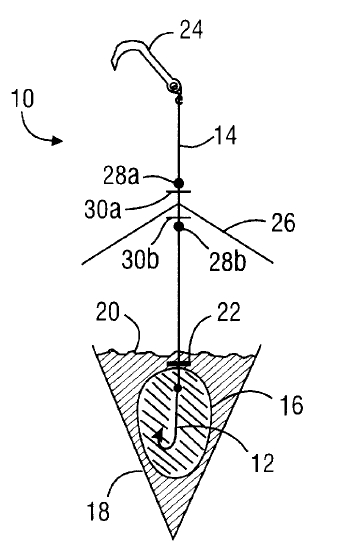
In the superficially crazy stakes, there are probably few inventions which could hold a candle to U.S. Patent 5813165, granted in 1998 to Franklin Wayne Dougherty Sr. for a biodegradable snake trap, designed to be dropped by parachute, and incorporating an egg and a fish hook. Surely, I thought when I read this patent, the specification was part of a complicated shaggy dog story?

Then I recalled an experience, one hot tropical dawn, five years before the patent was granted.  That experience gave me a context in which to examine the idea and recognise just how amazingly clever it was. So I have to wonder: how many of those crazy ideas that we see as "ludicrous" ideas only appear ludicrous because we lack a key detail?

I was working on the island of Pohnpei in the Federated States of Micronesia, between Guam and Hawaii. I was there for a science curriculum development in a new nation, and I began each day by going for a dawn walk, usually along the Deketik causeway that ran over to the Pohnpei International Airport, about 1 km away.

Traffic on the causeway was usually light, and there were wetlands to admire, making it a pleasant walk. One day, I noticed a lot of activity around the airport and realised that many people were moving around, and they all seemed to be in army uniform. Micronesia is pleasant and civilised, so a coup was unlikely, but I decided to retreat.

Later that day, the locals had a good laugh at my expense when I told them I had run away. From time to time, aircraft coming in from Guam arrived with one or more brown tree snakes, and when a snake was spotted, the army was called out to hunt the snakes down.

Guam's snake infestation of Boiga irregularis originated, around the end of World War II, probably in a ship that came from Papua-New Guinea. The population levels are now high, most song birds on Guam have been wiped out, and the rain forests are declining because song birds pollinate many rain forest species.

The snakes also invade electrical systems, shorting them out. They seem to be quite capable of getting into cargo containers that can end up on other islands. Nobody really wants that.

The snake trap can be dropped into inaccessible areas from an aircraft, and it will hang in trees where only the snakes can get at it. They will swallow the egg whole and then crush it, at which point they will be hooked, and in the end, they will die.

Pohnpei has rain forests, and there are rain forests on Saipan and many other Pacific islands. Until snake numbers are reduced in infested places like Guam, we can expect to see the army called out in any places that are snake-free. That apparently crazy biodegradable trap may just help a few soldiers get the chance to sleep past sunrise.

In short, that turned out to be a clever solution to a serious problem caused by brown tree snakes in Micronesia. So how many of the other "ludicrous" ideas that we have seen are only ludicrous because we lack a key detail?

The devil is always in the details, as we can see here.

There was a tale doing the round in the 1840s about a sailor who had broken his leg, and was advised to share the details of his case with the Royal Society. It seems he had fallen from the top of the mast, and fractured his leg, he had dressed it with nothing but tar and oakum, and yet in three days was able to walk as well as before the accident.

The collected Fellows of the Royal Society confessed that they were amazed, but sorely puzzled. Despite what Bishop Berkeley may have believed about tar water, he was not a medical man, and so tar was not a recognised medication. Neither was oakum. Quite a few of them doubted whether the leg had really been broken, and they demanded more details and more proof.

Certificates were delivered, attesting that yes, the leg had indeed been broken, and that truly, absolutely no other dressing had been applied. Letters went back and forth, and surgeons began to worry that they might have been losing a valuable portion of their practices. Imagine how relieved they must have felt when the honest sailor, in a postscript to his last letter, added these words. "I forgot to tell your honours that the leg was a wooden one."

So when you scrutinise something that is new, different or unexpected, it all depends on where you are standing, but stand not in judgement, not even on a broken wooden leg, until you have all the details!

The tar water?  That's another story for another day.

Thursday, 24 January 2013

Pelican log

Pelicans being fed, The Entrance, NSW,
about 1990, a tourist attraction using scraps
from the local eateries.
OK, normal service is about to be resumed. My nasty back problem has eased, I have managed to finish the book that has been eating all my time, and my life will be a bit more my own to go and smell the flowers and admire the birds.

When I say "finish", that is the manuscript only: there will be feedback, edits, revisions, cuts needed by design and much more, so the work isn't over, but the really hard part is done.

The book I have been doing is a history of Australia for young people, and while I know most of the content fairly well, there were some bits where I was rusty or less interested, but I was working to a set of specifications, so I just had to get up to speed on the weak areas. Most writing jobs, the writer (or this writer, anyhow) only chases stuff which is of interest. Here, the target age group needed a good outline of what happened, how and why. I couldn't just goof off.
Clontarf Reserve, king high tide.
Clontarf Reserve, low tide.

Anyhow, because my back was being annoying, I have been doing more swimming, and I decided to take my tablet to the beach, and record the extremes of the tide at my usual favourite, "Clonny" to the locals, Clontarf Reserve on the maps. It is on Middle Harbour, a part of Port Jackson (alias Sydney Harbour).

Here, you can see two extremes: a king tide and an almost matching low tide. Look carefully, and you will see that these shots are taken from the same place.

Lake Eyre, Central Australia, birds in flight, inset, birds feeding.
This shot was taken from a light aircraft at about 500 feet.
Then I noticed a pelican out in the bay.  I like pelicans, always have and probably always will. The Australian Pelican, Pelecanus conspicillatus, is the world's largest.

Big and clumsy on land, pelicans soar gracefully, and from my study window at home, I can see them working their way from updraft to updraft.  At each, they circle, gaining altitude, and then glide off to the next on a wing span of up to 1.8 metres. In the outback, they use thermals in the same sort of way.  Smart birds!

Pelicans have a sense that tells them when there is water in Lake Eyre. The lake is usually a flat dry plain of white salt, but sometimes, a cyclone moves in over the northern or eastern coast and rain buckets down, far inland. If the low pressure zone that is the ex-cyclone pushes far enough south, the rain fills a maze of channels that carry the water south, and maybe, into Lake Eyre.

The water moves across the plains at walking pace. At Lake Eyre, the salt dissolves, the mud softens, and the eggs of tiny crustaceans and fish hatch out. Algae that have been lying dormant below the salt come back to life. The crustaceans eat the algae, the fish eat the crustaceans, and then the pelicans arrive to eat the fish.

Dead fish, Lake Eyre South. Note the coin for scale.
Nobody know how they do it, but pelicans know there is water in the dry centre of Australia. Over many, many thousands of years, instincts have evolved to send them into a place full of fish, with no predators. There, they build unprotected nests, feast on fish and raise as many new pelicans as they can.

Then, as the water dries up and the fish disappear, the adults fly off, abandoning the last chicks if they cannot fly. Next time a low pressure zone slops in over the coast and delivers water to the lake, the chicks that got out safely will be back again to breed.

The careful reader may be wondering if I am just a tad obsessive about pelicans.  Not really, but these sagacious and gainly/ungainly birds do, from time to time, become a temporary obsession.

I like pelicans.  Live with it.


 Anyhow, I was taking shots with the tablet, and I began to wonder if maybe it would be better if I used a real camera.


Well, that was easy enough.  When I go to the beach in the early morning, there aren't that many people, and they are mostly regulars, so expensive kit can be safely left on the beach, and I took the camera each day.

And that was how I made an interesting discovery.


I took the next shot (it should be on the right, I hope) to post to Facebook, calling it 'Fisherfolk all'.  In the background, there's a human in the water, while nearest the camera, one Australian Pelican, six Little Black Cormorants, and on the left of the shot, one seagull.


These are sharky waters, and I commented that maybe the birds were out, waiting for the 08:45 shark to pass by.


The next day, I realised that the seagulls fly at the cormorants and the pelicans when they surface to swallow fish, and I noticed a certain amount of ill feeling.


The cormorants are less able to fight back, but there is no doubt that the pelican does.

By the way, these are all large-ish shots, so you can see more detail if you click on the pictures.


Then I found something magical. The cormorants and the pelican hung together: I thought the cormorants were just hanging around the pelican for protection, but there's more to it,

Pelican and underwater cormorants, cooperatively fishing.

They work as a team to catch fish!  I only have one shot to show this so far: the pelican is on the outside of the pool, and three cormorants were working on the inside, swimming together and all of them were catching fish.

I know this, because I could see them popping up to swallow and then diving again.

Sadly, the study period may have come to an end, because after preening himself on Thursday morning, the pelican flew away. A few minutes later, I saw him (or her?) gliding fast from the north. Close to the pool's end, a couple my age were watching something up in the sky and got the fright of the life when the pelican passed over, about a metre up. When I spoke to them, they said their attention had been on another pelican, circling up high, gaining altitude.

They swam back to the beach then, and a couple of minutes later, I saw a new pelican climbing into the sky.  I think it was my pelican, which had flown around the corner to pick up an updraft.

If it was my pelican, perhaps it knows there's a flood coming, somewhere inland, and it's off to breed.

We'll see, but I am looking in my box of temporary obsessions to see which one to take up now.

Friday footnote: no pelican this morning :-(


* * * * * * *
This blog covers quite a few different things, so I tag each post. I also blog about history, and I am currently writing a series of books called Not your usual... and the first two have been accepted by Five Mile Press, The offcuts appear here with the tag Not Your Usual... . For a taste of Australian tall tales, try the tags Speewah or Crooked Mick.   For a miscellany of oddities, try the tag temporary obsessions. And language us covered under the tags Descants and Curiosities, while stuff about small life is under Wee beasties.


Thursday, 3 January 2013

The buttered cat, revisited

It is a little-known fact that I used to be a research physicist.  What I have never before admitted was that I gave it up after watching action-thriller movies which proved beyond doubt that the laws of physics often fail to hold.

Now I am sort-of retired, I have decided to clean up and clear away some of the intellectual detritus that lies in my bottom drawer, like my proof that the world only looks round because of the shape of the lenses used to photograph it.  I will get to that one later: I have noticed a recent upsurge in the matter of the buttered cat, and thought it time to share my data.

Background: The question goes like this:

1. When you drop a buttered piece of bread, it drops butter side down; and

2. A cat always lands on its feet.

So what would happen if you took a piece of buttered bread, strapped it on the back of a cat (butter side up) and dropped it off the a high tower?


Theory, as often found on the Internet:

Even if you are too lazy to do the experiment yourself you should be able to deduce the obvious result. The laws of butterology demand that the butter must hit the ground, and the equally strict laws of feline aerodynamics demand that the cat cannot smash its furry back.

If the combined construct were to land, nature would have no way to resolve this paradox. Therefore it simply does not fall. That's right you clever mortal (well, as clever as you mortals can get), you have discovered the secret of antigravity!

In short, a buttered cat will, when released, quickly move to a height where the forces of cat-twisting and butter repulsion are in equilibrium. This equilibrium point can be modified by scraping off some of the butter, providing lift, or removing some of the cat's limbs, allowing descent.

Most of the civilised species of the Universe already use this principle to drive their ships while within a planetary system. The loud humming heard by most sighters of UFOs is, in fact, the purring of several hundred tabbies.

The one obvious danger is, of course, if the cats manage to eat the bread off their backs they will instantly plummet. Of course the cats will land on their feet, but this usually doesn't do them much good, since right after they make their graceful landing several tons of red-hot starship and angry aliens crash on top of them.

As a committed scientist, I investigated it, and reported back. I have never published all of my data, so here is the truth about this conundrum, for the very first time.

TOP SECRET, now declassified

We immediately flew into action, planning to levitate cats, but stopped, realising that we had to do the experiments first, or our flights would be invalid. We paused to ponder the available variables. The only proper way to investigate this is to experiment with the variables: cat, butter and dropping. Bread, we realised, was only an intermediary, a substrate of negligible importance.

A cat is a furry mammal with claws. We can use non-furry mammals like chihuahuas, non-furry non-mammals with claws like eagles, and furry clawless mammals. This led us to select a really unlucky rabbit (it had just lost all four of its feet in a poker game). It was allergic to butter, swelled up enormously, and floated away on the breeze.


Butter is organic and oily, so one of my colleagues proposed holding the cat constant and replacing the butter with other carbon-based fluids. Unfortunately, we used ethanol which produced a very high cat, which looked promising, but the cat just sat there, smiled, and then dissolved, explaining the Cheshire Cat effect.

High-octane Avgas looked promising, but an over-excited researcher rubbed the cat with amber, producing a spark. This produced the first recorded occasion on which a cat went "woof". The cat was no longer constant in a number of apparently vital aspects.

Fish oil caused the next cat to chase itself so fast that it overheated, due to air friction, causing a convection effect which took it up into the atmosphere in a highly uncontrolled manner, destroying a small UFO from Sirius. At least, we think it was, as the Air Force people we talked to kept saying something about "Gotta be Sirius".

About this point, we considered dogs, since Sirius is the Dog Star, and the Dogon people of North Africa knew about Sirius being a double star. While we realised that people might be cynical about this, we were all too aware of the connection between the cynics and dogs (the word "cynic" actually means "dog-like"!!). Remember that Socrates was always in the doghouse with Xanthippe, the first landings in America were at Labrador, and one of the greatest saints in the Christian calendar is St Bernard. Taken with the fact that intellectual Scots are called canny (a clear parallel with canine), the way was clear.

Unfortunately, the research was in fact unnecessary, as we discovered with a quick literature search, always an important part of the scientific armoury. Older readers may remember Laika, the dog in the Sputnik: recent research in the freed archives of the Kremlin reveals that all of the early satellites were in fact powered by buttered dogs, and it was only an unfortunate breach in security that revealed one instance, that of Laika, levitating around the earth in a butter barrel.

On instructions, we closed down this aspect of the investigation, and turned back to the cats again. Sadly, I have to report no practical advances in this area, as we were unable to find any suitable semantic alternative to dropping, and so we devoted our efforts to producing a calibrated cat-dropper.

As this proved physically dangerous, we switched our efforts to producing a taxonomy of cat-dropper variables, so that future workers should immediately be able to identify any cat-dropper to type.

In view of the overwhelming importance of this advance in human knowledge, we would welcome donations of funds in any hard PacRim currency, to assist in this project. We hope then to turn to developing a classification of butter types by salinity, oiliness, particle size and colour, and to a full-scale taxonomy of cats.

Meanwhile, if anybody sees any worried-looking lightly buttered cats flying in city streets, please tell them that the reference to "rightly battered cats frying" was, in fact, an unfortunate typo by a Japanese temp, and that they would be completely safe to come back. Oh yes, and say that we've removed those graffiti in the lab, the ones that read:
"The habitat of our tabby-cat
Is a fireside warm and bright:
If pussy dear should get too near,
We'll put her out tonight."
Even though there really WAS no felico-incendiary allusion intended. . . One final brief etymological and entomological note. Buttered flying cats must surely make us think of the order Lepidoptera, otherwise the world's moths and butterflies. Why are they so called? Well, the answer is simple: they metamorphose from caterpillars, and I need hardly point out the significance of THAT.

Saturday, 29 December 2012

Effective Science Writing


Look me up on the web, and you may find that I have said that I sometimes do pro bono work—if the task is interesting and/or the cause is a worthy one, but preferably both.

So when Pramila Majumdar asked me to help out by writing a chapter in a book called Effective Science Writing, I jumped at it. Yesterday, I got an email to say that it has been launched in India, and I will get a copy in due course.


The launch party, somewhere in Assam, December 28, 2012.
As it is now out there for young Indian science writers, I thought I would share the chapter that I was asked to write, as I submitted it.  Note that this is unedited, but it is there for general consumption. [Note also that I have added a few updates, which appear, like this, in square brackets and red text.]

* * * * * * * * * * * * * * * * * * * * * * * * * * * * * * * * * * * *

3. Things to keep in mind before you begin writing
Peter Macinnis is an Australian science writer. Trained as a biologist, he has been a secondary science teacher, a systems bureaucrat, a fraud investigator, a museum educator, a teacher of computing and the in-house science writer for an online encyclopaedia. He has been writing and publishing books related to science for 40 years, and working as a freelance broadcaster for Australia's ABC since 1985. He writes popular history (with a science bias) for adults, and has had children's books named as "notable" in three of the past four years by the Children's Book Council of Australia. These generally have a science theme.
His Australian Backyard Explorer (published by the National Library of Australia) was the CBCA's Book of the Year in the information books category [in 2010]: it looked at the people who mapped Australia, and the science and technology they had to use. [It was listed later in the 2011 White Ravens awards. His 2012 sequel, Australian Backyard Naturalist, recently won a Whitley Award from the Royal Zoological Society of New South Wales.]

* * * * * * * * * * * * * * * * * * * * * * * * * * * * * * * * * * * *

I have a brief of sorts to write this chapter. In it, I was asked to discuss these topics:
• Understanding your readers;
• Searching for stories and;
• Where to publish;

I was also asked to add other important ideas. I will deal with these:
• Fitting science into unlikely places;
• Setting down a plan and applying it;
• Keeping a full record of ideas, information and sources;
• Being open to revision;
• When to write the ending;
• How to know what information is reliable;
• Why you should always listen to your editor;
• The importance of networking.

I am writing this introduction some days before I will start writing the main text, and I am copying the points above from my notebook, ten minutes after I scribbled them down. The final product will probably be very different, but I plan to leave this introduction unedited. That may be the most important thing I do here, because it shows how I think.

Note that I used a paper notebook and an old-fashioned pen for my first sketch of this chapter. I always scribble some rough notes, and I will come back to that later, but it is important for the reader to realise that I am almost totally reliant on computers for my productivity.

My first step, at this point, was to take those 11 points and paste them in below this introduction, using the same order as above. I formatted them (in MS Word) as headings. I added full stops at the end, then opened up some space between them so I could start inserting text in blue italics. The blue text works like the scaffolding on a building site, and all the blue bits will be demolished at the end.

This is the end of the introduction that will not be revised. After this paragraph, everything may be revised and changed as I work my way into my thinking. From past experience, I know it will be!

Why communicate science?
I do it because I love and admire science. I hope I can help reduce the amount of stupidity in the world by helping readers to understand the role of science and technology in their lives. I want to show people how to assess the claims of flat-earthers, perpetual motion eccentrics, medical frauds, climate change deniers, opponents of evolution and other charlatans. Some of the frauds are confused, others want to make money by confusing people, but they can all be rejected by people who understand science. I don't try to beat the frauds, I try to make people more able to see what the crooks are doing.

I want to make my readers immune to unfounded fear, while being able to assess the very real risks that can emerge from some kinds of science and technology. I want them to see the opportunities of new science and technology, I want them to be able and willing to grab those chances and use science and technology to help other humans. I want them to know how to learn from previous mistakes.

There was a famous World War I French general, called Marshal Foch, who began every planning meeting by reminding his staff that the key objective was to defeat the enemy. Only then, knowing that, would they start their meeting. Before I start to write, I sit down and ask myself whether I plan to help people understand, or if I want to win hearts and minds, or to fascinate them—or maybe I just want to amuse my readers. Most of the time, all of those will be in the mix, but I need to know what I hope to do.

Point number 1: aside from earning a living, what are you going to do with the story you are sitting down to write? What changes will it make? (I hope that this chapter will help people focus more closely as they write about science.)

Searching for stories.
There are excellent sources around for science writers, because most researchers out there want to be famous. Finding material is never the problem, but keeping your head above the flood and finding the right material can be a real challenge. Behind all those researchers hoping for fame, there are public relations people, pushing easy angles that lazy journalists can use. By all means read them, but never trust a press release as a major source!

Many press releases seem to promise a better way to do something, but the most common line is a cure for <the common cold; multiple sclerosis; cancer or some other disease>. Lots of new drugs might one day lead to an approach that may generate a molecule that might attack an obscure cancer, way off in the future. Most of the time, the discovery will go nowhere, but a PR person will dress this up as an amazing, absolutely certain cancer cure.

Remember that most discoveries are interesting and offer a story to tell, but only a few discoveries are breakthroughs. Remember also that there are things a science publicist might do or say that no professional science communicator would do or say. The publicist and the communicator both want people to go "wow!" but only one of them wants that to be a reaction to the science.

Press releases can be useful, if you know who to trust. Between 1998 and 2005, I churned out 30,000 words of science news each month. It was a treadmill, but an easy one, because I had all sorts of people alerting me about interesting stuff. I began with Eurekalert and Newswise, where I signed up for lists of the press releases that were placed on those two databases each day.

The best part of that is that both Newswise and Eurekalert are free. The first is some sort of consortium, the second is run by AAAS, the American Association for the Advancement of Science. You can find them at http://www.newswise.com/search/index and http://www.eurekalert.org/search.php. The second best part is that this search can look back at all of the stories containing a key word, so you can see how else a topic has been in the news.

The third best part is that you can work out who are the good feeds with information that you can use. I had a good personal relationship for some years with the American Geophysical Union, and could get copies of the actual published papers, so I could read at least the abstract and conclusion, while skimming over the discussion. When I found a good source, I would ask them to put me on their mailing list, and set of one my email filters to sort those emails into a special priority box.

Mind you, that was before Twitter. These days, you just need to select who you will follow with some care, and then the world's news will come to your door. I don't use Twitter that much, because I mainly do books these days, but I still follow Newswise, Carl Zimmer, ConversationEDU, Guardian Science and tedtalks.

Sometimes, a story will find you—and those ones are often the best. Many years ago, I was looking at a law that was proposed by two Frenchmen, Dulong and Petit, a rule of thumb that ties atomic weight to the specific heat of an element. I though that was rather clever, went back to their original work, and started converting the data into modern units. Then I pulled down a chemical data book, and found some odd discrepancies, and realised that I had uncovered a fraud that had been unnoticed for 165 years.

Later, I found that a couple of other people had noticed the fraud at about the same time, but by then, I had done a little radio program on it and got myself known. I have never looked back.

Point number 2: there is never any shortage of material to work with, and there is a story in almost everything, if you look at it the right way. (I have drawn almost entirely on experience to write this piece, but I also chatted with am couple of friends who are in the same game.)

Fitting science into unlikely places.
Many years ago, I was one of a group of bushwalking science teachers. We often took some of our students along with us on day walks, and we always managed to find a few interesting bits of geology or biology to show them. Then one of my friends bought a brilliant book called Science As You Go, and we realised that we could bring in chemistry, physics and even astronomy, even in the wilderness. That was how I learned to look for the science in almost anything.

I like bringing out the science behind curious things like the way seagulls follow behind the ferry that I ride to and from Sydney; or the science behind sand that squeaks when you walk on it, or the reason why poisons work as they do; or even how an orb-weaver spider makes its web, and why it always makes it across the garden path I need to walk along each morning. One of these days, I am going to write an essay on this quote from one of J.B.S. Haldane's essays, 'On Being the Right Size', from Possible Worlds.

You can drop a mouse down a thousand-foot mine shaft; and, on arriving at the bottom, it gets a slight shock and walks away, provided that the ground is fairly soft.  A rat is killed, a man is broken, a horse splashes.
Maybe I won't, though I would love to. What I do know is that a comment like that makes a science piece truly memorable. If people smile about it for a few days, they are thinking about it, and that principle is lodged in their minds forever.

Science communicators should avoid trying to be comedians, but the occasional memorable line makes the reader recall, relish, and roll over the facts that lie beneath it. The best place for that wry or clever comment is usually at the end of the piece.

One of my zoology lecturers once told us "a female whale evaginates her teat and the calf clings on while she pumps out six to eight gallons of milk in as many seconds." That was interesting, but what made it stick in my mind, 45 years later, was his extra comment that "if the calf doesn't hang on, it gets a face full of milk".

Point number 3: there is always a place for humour in a piece, but it should be humour that serves some purpose other than making people think you are a nice person. (I am prepared to bet that half of my readers will tell somebody either the Haldane quote or the amazing whale fact.)

Creating a beginning.
I never consciously sit down and wonder how I am going to begin a piece. I suppose there must be a point where I think of my start, but usually, the beginning emerges from the real facts that made me think of writing a piece.

The start is important, and fiction writers know this. They work endlessly over the first page, trying to create the perfect hook that will keep the reader hanging on while they do the necessary foundation work. Pick up any best-seller, read the first page, and look for the hook. It will be there, and you need a hook as well.

I think I mainly use one of these tricks:
• The plain news piece. This is fairly ordinary, and also fairly common. You simply write up a discussion of what a scientist somewhere has reported and then explain why it is important. Fort a bit of polishing up. You can set the scene first, and then cut to the new discovery.

• The direct question. This is a fairly straightforward situation where you ask the reader if he or she has ever considered why something is important.

• The indirect question (I was showing a trigger plant to a friend who asked . . .)

• The completely irrelevant anecdote that suddenly becomes relevant later on in the piece, or even at the very end. This one works well when you are a bit older, and have the experience to think of an anecdote you can use.

• The atmospheric, a trick piece where you set the scene and then work your way in from there. This is a subset of the irrelevant anecdote, but it can work very well.

No, I'm not going to do it all for you. As a science communicator, you are an essayist, and the only way to learn your craft is to study with the masters. Here, I have to confess myself ignorant of good role models from the sub-continent, so I will suggest a method to use if you are writing in English. I leave it to you to undertake the translation of this into a more local method, but I am sure that it can be done.

I can recommend Charles Lamb, William Hazlitt and Leigh Hunt for writers of the past. In more recent times, there are Walter Murdoch (and Australian, and the uncle of Rupert Murdoch, but don't hold that against him!), J. B. Priestley, George Orwell. Or you may prefer to look at the science essayists like Isaac Asimov, Arthur C. Clarke, Martin Gardner, Stephen Jay Gould, Sir Peter Medawar, Oliver Sacks, Lewis Thomas, Lewis Wolpert—and J. B. S. Haldane, who alone among those on this list, had an Indian connection.

You can also search more widely, looking online at the intelligent pieces written for the New Yorker or The Guardian. Or you might try an Australian radio program called Ockham's Razor (one to which I sometimes contribute). This draws mainly Australian contributors, but it also gathers speakers from all around the world. They must all speak for 15 minutes, less a top and tail, about 2000 words, and the quality is patchy but often reaches sublime levels.

I suggest that you gather a collection of perhaps 60 pieces that you really like, and 15 or 20 pieces that leave you uninterested. Then analyse these, as if you were a forger of bank notes. Make lists of the methods used, the tricks of the trade, the flourishes, and rate them. :Look at the low-rating ones, and if you think they are useless, remove them from the list.

Once you have your methods, you can make a deliberate choice of the tricks you will use in a piece. In this way, you will make these tricks part of your tool-kit, and before long, you will use them naturally.

Point number 4: know before you start how you plan to begin. (Once you have done that, you will probably know how you are going to end.)

When to write the ending.
I like to start with a good idea of how I will end a piece. If I don't quite know what that will be when I begin, I try to have an ending in place by the time my first draft is 40% complete. By that time, I will have most of the key points set down, but I will probably be starting to ramble.

Recently, I have been writing a set of children's books, each of about 1500 words, each one to have 17 "openings", with a picture on one page, and text on the other. I write the first six opening to get the story line set, then I write the ending, which is often two or three openings in length, then I fill in the middle section.

About a third of the time, I will later change my first ending to a better one, but at least I didn't waver and wobble.

Point number 5: know as quickly as you can how you plan to end—and before you start writing is best. (Only then will you know where you are going.)

Keeping a full record of ideas, information and sources.
From time to time, even the most focused writer is going to falter, wondering just what brilliant idea was supposed to be going there, or just where that idea came from. That is the reason why I started storing everything in a spreadsheet, about ten years ago.

Mow I know what spreadsheets are supposed to be for, but I heard a story of an old Sydney sporting journalist who used to write news stories in Visicalc. And I realised that he was doing one paragraph to a cell, and then using numbers in another column to sort the cells. It's something that journalists used to do in the days of typewriters and hot metal typesetting, when we used copy paper and double-spaced our paragraphs on that.

I realised that I could do a lot more, because you can sort on three different columns, so I started adding three columns on the left: chapter, part and number, as well as whatever datum I had found and its exact source.


But I hadn't finished yet: I could sort at other times by date, or place or topic, and compare items from different places and then sort again and move everything back into sorted chapters.

The example here is from an incomplete research database for a study of gold rushes and gold lust, around the world. The text in column F already totals more than 120,000 words, twice the length of the book I plan to write.

From time to time, I spot something interesting but not for the book in hand: labelling it chapter 99 pushes it to the very bottom, and because I always use the same layout, I can quickly scoop up those odd bits and move them into a more relevant spreadsheet at some later time.

The thing about my spreadsheet system is that it works like a large number of filing cards that I can shuffle in a variety of ways. I can sort all the entries by year or date, or by the place where they happened. This helps me to see patterns that I might otherwise miss.

Point number 6: plan and record from the very start, because there will always be one vital point that your editor will query or doubt. (Good record-keeping saves time and avoids headaches.)

Setting down a plan and applying it.
Some 3000 words into writing this chapter, I took a break and slept. I awoke in the early morning with a fairly well-formed outline for a general-market book with a strong science bias. Even before my first cup of tea, I noted down six chapter headings, and a few things to chase up. Now I can get on with this, knowing that I won't lose those ideas.

The plan is your helper, not a tyrant. As I work through this in Microsoft Word, I have the Document Map open, and every so often, I type a paragraph that I realise is more relevant to one of the other sections. When that happens, I move it. I have already shifted many of the headings, added a new one and merged two others, but I am still following the plan.

Point number 6: always have a plan. (Starting to write without a plan is like trying to explore Norway without a map or compass. It may be interesting—until you fall into a fiord!)

Understanding your readers.
You need to know what your readers expect, which means knowing what they are likely to understand.

Most readers know little of other countries' idioms, so you need to "fit in" and make your writing appear to come from one of them. It have learned that Americans have only heard of one civil war, so where we might write "the US Civil War", they just say and write "the Civil War". Every audience has its own peculiarities.

Think about the age of the audience, the strength of interest and type of interest that they will bring to their reading. Are the readers going to understand what it means to think like a scientist? Will they know that science is often puzzling, going against intuition?

For example, if we just examined the world in our lifetimes, we might say that species don't vary, because we can't see it happening. To explain evolution, we have to make people understand that our intuitive ideas are often wrong.

Point number 7: know you public. (If you don't, they probably won't want to know about you!)

How to know what information is reliable.
You need to choose your source and reference material carefully. There are many traps out there for somebody working on the fringes of journalism, because they are usually decent, honest, reliable people who don't tell lies. There are also frauds who try to sell fake stuff, there are PR people and bloggers whose job is to make pollution look good, politicians who prefer to muzzle the truth out of ignorance or greed.

With experience, you will learn where the charlatans are. For some years, I would not read anything coming out of the US Office of Naval Research, because the stories they released were not only boring and misleading, but every six months or so, the flacks there would release a few old stories again, hoping nobody would notice. I assumed they had a monthly target for press releases, and met that target by recycling. I met their dishonesty by ignoring them.

There were other US colleges with no real research to report, who kept on churning out bland rubbish. This is why, whenever possible, you should find and read the abstract of the paper online, and if you are going to write about it, you should email the lead author or the nominated contact person, and ask for a PDF of the paper. That gives you a chance to form your own opinion.

When I am scoping and planning a book, I will use Wikipedia as a starting point, but I know the traps: I use Wikipedia as a place to find things I should look into. There will always be rubbish there, but the quality stuff is building fast, as more and more people add original material and the sources. To see the sort of thing I mean, I contributed original material to the entries on the Silex Piano and the 1812 New Madrid Earthquake. In each case, I chanced upon original material that no search would have uncovered, and added it.

All I would say is: approach Wikipedia (and everything on the web) with caution. Use those sources wisely!!

Point number 8: trust nobody. (At least until you have double-checked what they say.)

Being open to revision.
Know as you begin that most of your first draft will be changed, either by you or by your editor. All writers are egotists, and the better you are as a writer, the more people will notice that (to be polite) you have a high regard for yourself. That usually shows up as a high regard for what you write. Anybody who can't see how good your writing is can be safely ignored, right?

Wrong. You are being your own worst enemy, because you are up too close to the issues, you care too much about things, but you simply can't make a judgement. The copy editor who questions your work is a friend, not an enemy.

There is another aspect: when we re-read what we have written, we see what we expect to see. All sorts of typos, spelling mistakes and bad grammar can slip past us. One method that I favour is to use software that converts my prose into an mp3 file that I can listen to while I am reading the text. The software I use is quite cheap, as it was designed for use by people with poor vision. You can find and buy it on the Internet: it is called TextAloud.

Against my better judgement, I was persuaded a few years ago to write a history of a World War II military campaign. I was asked to write it so teenagers could understand the complexities of a three-month series of battles on the Kokoda Track. As it happened, the general commanding the Australian army was a coward, a bully, a fool and a crook. My book rapidly turned into a brief of the evidence to prosecute that general. It didn't fit the brief I had been given.

I had a chat with the publisher, we agreed that the manuscript was rubbish, I ditched that draft, went back to my notes and wrote a second draft that told a human story and became a prize-winner. The first draft would never have won anything.

Point number 9: trust your editor. (Editors have a different view, and can often see what you can't.)

Where to publish.
This is the one area where I won't be of much assistance. As I have indicated, I have my networks, my contacts, and a solid reputation for always delivering as specified, on or before the deadline. That helps, but there's another issue that is even more important.

Remember what I said about listening to your copy editor? Here is a secret: editors talk to each other about writers, and they sometimes recommend an author to a published, based on knowing their track record. I rather suspect that some of my most valuable deals would have been missed if they knew me as a difficult character who refused to make changes in the text.

That is why you never refuse an offer, because you never know which one will give you the contacts you desperately need. The same applies to the poorly-paid writing jobs that are offered by magazines published for schools. Most of these have a regular turnover of staff, in part because those magazines go out of business, but also because the editorial staff are always looking for better work. And when they move on, they take the email addresses of productive and helpful writers with them.

The short answer as I see it: it isn't what you know, it's who you know, so you need to work hard to make yourself known.

I have rarely succeeded with a "cold call" where I come in as an unknown and pitch an idea, but it sometimes works. Most magazines offer a list of staff names, and sometimes emails. If they don't provide emails, you can sometimes work them out. Suppose you want to publish in The Magazine, and you know that the email addresses will all be in the form <something@themagazine.co.in>, there will be a few email addresses floating around out there on the web.

You need to be tricky and Google <"@themagazine.co.in"> (with the quotes but not the angle brackets) or <email AND "@themagazine.co.in">. With luck, this will harvest you enough email addresses to show you how the IT staff at The Magazine generate email addresses for the employees.

(This also works when an airline refuses to pay a promised refund because the call centre says wrongly that the refund has been paid, there is no other phone number and no published email address for the CEO.) 

(Note: the paragraph above is an example of the sort of indulgence that tempts clever writers. Under normal circumstances, I would have deleted it, but I left it in as a warning. While both true and correct, it is smug and doesn't tell the reader anything important. Be ruthless!)

So, once you have a name and an email, send a short email to the editor's assistant: one paragraph on your qualifications and achievements, a second paragraph listing one to three proposed topics, and asking if they would like to see a full outline or a draft. If you get no answer, try emailing the editor instead, but don't mention the earlier email.

I began my writing life expecting to write books and magazine articles. I was lucky enough to find a second strength: the writing of crisp 2250-word essays (this chapter is in effect, two such essays back to back). Then I found myself hired to write science news by a publisher whom I approached about an entirely different project. Luck was definitely a part of it, but persistence also played a part.

The printed book is probably dying, slowly, and magazines and newspapers are disappearing, but there is still a place for crisp prose that carries a message, interests the reader and ends cleanly.

Point number 10: it does no harm to approach an editor with a proposal. (Try to keep it down to one page of 12-point type with your name and contact details at the top, one paragraph about you, one paragraph about the content of the article you wish to write, and a few sentences about why you are well-equipped to write the article.)

Point number 11: good luck, and welcome to a noble profession. (I wrote that, just after writing the introduction—but I hope you guessed that!)


* * * * * * * * * * * * * * * * * * * * * * * * * * * * * * * * * * * *
[Addenda:

For more technical tricks, see How I get to write a book, and Planning a book with a spreadsheet. Also, look down the left-hand side of my writing home page and test out the links.]


Wednesday, 12 December 2012

An Australian Christmas


I was asked by a friend overseas to explain for her students what an Australian Christmas is like. Here is how I explained it in 1992. It was only later that I expanded it and turned it into a talk as well. The radio version was written in 1993, and I think it went to air at the end of that year. I was reminded of it the other day (I am now talking 2012), when an English friend asked what it was like having Christmas in summer.

Then I found myself minded, a few days later, to annotate and resurrect it while making an appointment to have a basal cell carcinoma burned off tomorrow.  Read it through, and you will see why that was a trigger.

You can find the original 1993 radio script here and at the bottom, there are links to my other radio talks.

* * * * * * * * * * * * * * * * * * * * * *

Our Christmas is different, under the Australian summer sun. My favourite Australian Christmas carol says it all, I think:
The north wind is tossing the leaves,
The red dust is over the town;
The sparrows are under the eaves,
And the grass in the paddock is brown . . .
Now that's Christmas in Australia. My family have lived here for close to 200 years, and while there're still traces of our Celtic inheritance and culture, we're part of this land now. When the Koori people claim any sort of relationship with their land, most whites scoff, but you can become a part of the land. It even happens to whites, with time.

Much of our sense of belonging came very fast, once the time was right. My parents' generation still look to Europe, my generation, and even more, my children's generation, see Australia as "home". This isn't the cheap imitation of patriotism favoured by struggling politicians, it's a deep sense of being in the right place.

When I visited Britain earlier this year [that was, 1993], I went to Kew Gardens. I explored the more exotic plant displays for a while, then I went to the "Australian house" for the muted greens of our vegetation. I sat and looked, and knew then it was time to go back home where I belonged, back where the greens are less lush, the dust is red, and the Christmas wind is hot.

A winter Christmas would be totally alien to me. Some forty years ago [60, now!], I learned that carol about our red dust and brown grass at school. It seemed right then, it seems perfect now. My parents never knew the song as children: its time hadn't come, then. Their carols were about winter snow and cold, but my favourite Yule-tide song describes what I experienced as a small boy, the warm summery Christmas times and events that I still love today.

As an only child, I always took off after lunch on Christmas Day for the local beach, with one of my new books from the uncles to read. (Those books always seemed to have a Scots or Jacobite theme when they came from the uncles.) When I left for the beach, my parents had a sleep to recover from the 4.30 am start we kids in the street always demanded, plus the rounds of drinks in each others' houses, from 8 through to 12, and a heavy, if cold, late Christmas lunch. Every year, my father would slip and cut himself, opening the tinned ham. It was one of the givens in life.

They played that carol on the radio, and a number of others from the same South Australian composer, just as I sat down to the keyboard to write this out. Now I've heard my Christmas song, I know that Christmas is here.

Usually there's a warm westerly breeze, our local equivalent of South Australia's north wind, coming from the continent's dry interior. All our hot winds come from the dry centre of the continent, and a hot wind is part of Christmas, too.

As a child, down at the beach in the late afternoon of Christmas Day, with my new book and my towel, there'd be sun, hot wind and hot sand, seagulls scavenging for scraps, a few worn-out adults improving their sun-tans, back before we learned all about skin cancers, and that's how I still think of Christmas. All salt and sand and seagulls and slightly smelly seaweed. A sibilant time.

It's late on a Sunday morning as I write this. I've just spent the last two hours at the beach, where my son is a "nipper", a trainee life-saver. Several hundred boys and girls have spent the morning in beach sprints, flag races, swimming races out past the breakers and back, and surf-board races. Now four small ones are in the back yard, piping as though they're competing with the birds, while my wife plasters them with cool factor 15 sunscreen, before they can go into the pool.

All of a sudden, the day spent on the beach or round the pool, soaking in the sun to get a healthy tan, is a thing of the past. Christmas presents this year will feature broad-brimmed hats, UV-proof shirts, sunscreen in designer bottles.

There's been a ghost of Christmas past in our house this week. My wife found a red patch on my back last Sunday. She was putting sun-screen on me before I went out as one of the safety patrol for the children during the swimming race. It was only small, but it was there.

I said that probably the mark was no more than an insect bite. She agreed, and we both worried silently to ourselves. The next day, I went to have a medical check. We may feel we belong here now, but our Celtic inheritance hangs over us, and Australia has the highest incidence of skin cancer in the world: we take no chances any more. It didn't make us gloomy, but we played safe.

In the end, it was nothing serious: only a small red patch that the doctor burnt off with dry ice and alcohol, just to be on the safe side. Not to worry, he told me: skin cancers are easy to deal with, so long as you get them early.

Then, because I like to get value for the consultation fee, I casually mentioned a small dark patch like a mole on the sole of my foot. The good doctor almost wrenched my foot off in his eagerness to get a clear look at it, for melanomas, he said, often appear first as dark patches on the sole. Melanomas aren't skin cancers: they're much worse. Melanomas are colonists, who leap-frog about, all over the body, riddling it with out-of-control growths. Melanomas are killers, but my spot was no melanoma, to our joint relief.

The politicians of the northern hemisphere muddle around about banning CFCs, and say the ozone hole is only in the south. In Edinburgh last April, I was told the only problem with the ozone hole was a few skin cancers in people of Scots descent in New Zealand. Nothing for anybody else to worry about, said the speaker.

Well, they'll soon learn that they're not immune either. Soon they, too, will understand the difference between skin cancers and melanomas. It's taken our wider public just two or three years to recognise what some of us first heard about twenty years ago. Soon the Northerners will have to change too, when the ozone holes start to appear over the Arctic. But hopefully it will not affect their Christmas habits, just their summer habits.

It's been raining here, once again. Australia's had a lot of rain in the last few years. Not long ago, there were floods in some of the best wine-growing areas. Still, "We always have unseasonable weather in summer", say the traditional cynics, tongue in cheek. Our local rain has brought frogs around from the nearby creeks, and so I check the pool at night and in the morning, to save them from drowning. That's almost become a Christmas habit, like having an early morning swim before the sun gets up too high.

We change our Christmas habits slowly, but few of us will sit down to a hot Christmas dinner in Australia this year. Some will take picnics to the beach and sit under umbrellas, eating sun-screen flavoured chicken or ham sandwiches, and they'll lick at fast-melting ice cream cones. Others will be out on boats on the harbour, while others will wait till Boxing Day when a fleet of up to 200 yachts will set sail to race to Hobart, 600 nautical miles away. A few people will go to the cricket or the tennis, many will just sit in their shady gardens, brushing away the flies.

The well-off may decide to go to a restaurant (if they booked in months ago), where they will eat too much, and drink too much good Australian wine. I, too, will drink some Cabernet Sauvignon, a red wine from an area where the dust is generally red, and the grass is brown, or will be, when the recent floods dry out. Red wine isn't good for me, I know, but I'll indulge in a small way. And I'll try not to cut myself, opening the ham.

My family will sit for their lunch in the enclosed and screened conservatory that I refurbished last year, a sort of extension of the family/lounge/dining room. My older son and I have just replaced the panel of shade-cloth on the clear fibre-glass roof today. It's tough black fibre-glass cloth, which will block out the sun's heat, and much of its ultra-violet.

We'll drink cold drinks in its welcome shade, and maybe even sleep there at night when it's hot. With luck, I'll finish the shelf where the flower pots and fish and frog tanks will go, before Christmas Day. I only have one frog at the moment, recuperating after being netted, three quarters drowned, from the swimming pool, but I'll release it tonight.

Right now it is noisy with children in the pool. My study windows are open, and four eleven-year-olds are in there, playing water cricket or something similar. The gum tree that hangs over the pool is in flower, and we've scooped maybe 2 kg of stamens from the pool surface. Christmas for us is a time of flowers, but they can be a mixed blessing.

We have Santa Claus here: just as we were leaving nippers, my son said "Oh, that's right. There was a Santa person coming at eleven to hand out lolly bags." "Do you want to go back," I asked. "No, they'll probably get salt all over them when the Santa comes in, in the surf boat."

The Santa in question is not the real one at all, but the fattest adult member of the surf club, in swimmers and Santa suit, smuggled out in a surf boat. He gets robed out beyond the breakers, and then comes ho-hoing in, standing in the bows and waving as the boat rides the waves to shore.

These surf boats are long, slim and light, rowed by four rowers and controlled by the "sweep" who steers the boat, and keeps the stern to the boiling breaking waves. The sweep is mostly an older man, who has already had many skin cancers burnt off. In a few years, I suppose all the boat crews will wear full suits to row in the morning sun.

Well, that's Christmas in urban, coastal Australia. Inland, we've had some good rain, but soon it'll be dry again, the red dust will swirl, and the grass will be brown once more. To outsiders, it may seem desolate, bare and forbidding. To us, it'll be more like home.

With luck, the sparrows won't get in under my eaves too much, for they go there to eat the spiders. I counted fifteen species of spider there, the other day, and what with the wasps eating some, and the sparrows plundering more, the spiders are having a hard time. I resent these feral foreign birds, which displace our native birds, as well as munching on my spiders.

Out on the plains the brolgas are dancing, says another of the carols in the set. Brolgas are magnificent birds, though I've only once seen them dancing. We leave for the bush, two days after Christmas, and we'll spend three or four days in the wilderness, where the Devonian metamorphics thrust up into the base of the Permian sedimentary rocks, where a single hand can span a gap of 100 million years in geological history.

We'll all take our new books (maybe with less of a Scots and Jacobite flavour to them than in my youth), and a couple of spare fly sheets to shelter from the sun under during the day. With any luck, the bush flies will be less of a problem than they were last year.

We'll see no brolgas, but we should see many other birds, kangaroos will crop the grass around the tents when it gets dark, and wombats will waddle and crump noisily through the camp site in the middle of the night. There'll be too many invertebrates to count, alas!

We'll explore the area, and maybe find a good cave in the higher rocks: the prospects look good. These "caves" are generally just rock overhangs, but they're good for camping in, during really wet weather. Some years ago, my three children and I were rained into a cave for 36 hours: when the mist lifted, we could wave at the people in the cave over the valley, and we could make our way around the cliff line to visit the university students in the next cave, or the adults in the other direction, or they'd come and visit us. For a wilderness area, it can get quite convivial in the Budawangs at Christmas!

We'll probably bump into any number of other like-minded families and groups on the single-file foot tracks. We'll all stop, each file to the left side of the track, share a few words, discuss wood and water supplies, and what's living where, who's heard the latest weather forecast, and then move on.

That's an Australian Christmas, in my view. Who needs snow, or reindeer, or jingle bells, when you can drift along a mist-covered river at piccaninny daylight, hoping against hope for a brief sighting of a shy platypus?

     The north wind is tossing the leaves,
     The red dust is over the town;
     The sparrows are under the eaves,
     And the grass in the paddock is brown ,
     As we lift up our voices and sing
     To the Christ child, the heavenly King.

A merry, joyous and peaceful Christmas to you all. May your land grow on you and yours, as this new land has grown on me and mine. We all deserve to belong to our own land, whether it has been our land for sixty years or sixty thousand years. We hope Australia will have a prosperous New Year, but somehow I think we will only do so when we can come to grips with the problems that come with belonging to a land.

Some years on, my children are somewhat grown, and every so often, I get little bits burnt off. So far so good . . .


________________________________________

I must confess that, twenty years on, Christmas will be more sedate and less adventurous.  And according to this article, my favourite carols are being forgotten. A few pages on, you can find an article by me about bunyips, should the fit take you.

________________________________________

The original version is one of a set of talks which were originally heard on ABC Radio National in Australia. All of the talks are copyright © Peter Macinnis, 1985-2012, but permission will be readily granted on request for all educational and most non-profit purposes (and for socially useful for-profit purposes)—I'm not particularly territorial, and on this one in particular, I'm generally delighted to share.